
A faculty member during a presentation

Institute for Law and Philosophy

Events

Select...
Select...
Sep22

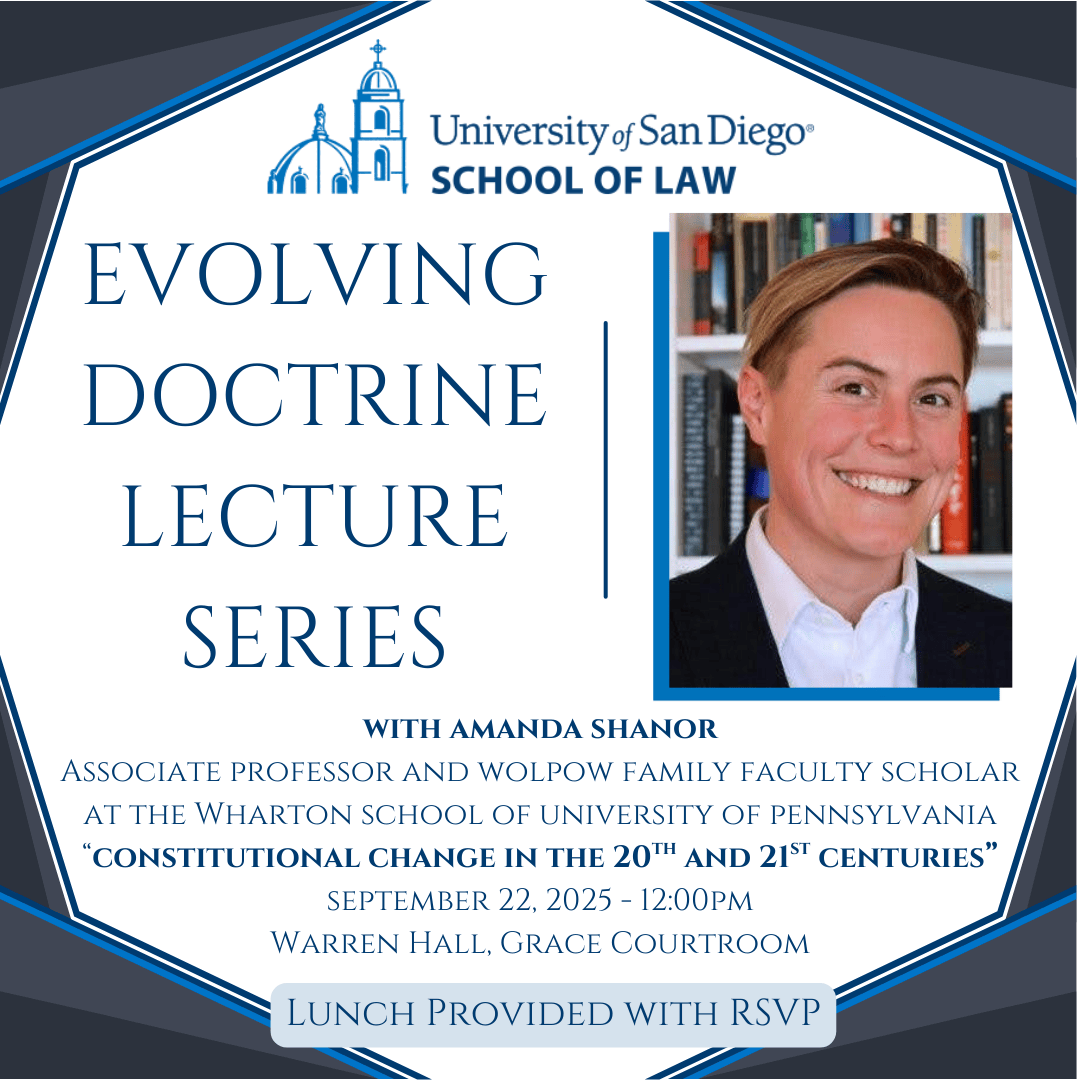
Evolving Doctrine Lecture Series with Professor Amanda Shanor

Monday, September 22, 2025 - 12 p.m.

Constitutional Change in the 20th & 21st Centuries Featuring Professor Amanda Shanor About the Speaker Amanda Shanor is an Associate Professor and Wolpow Family Faculty Scholar at the Wharton School of the University of Pennsylvania who teaches and writes about constitutional law, particularly the freedom of speech. Shanor’s research explores the changing meaning of the First Amendment and the forces that affect it; democratic theory, illiberalism, and equality, and the intersection of constitutional law and economic life. Prior to joining the academy, Shanor was a practicing lawyer in the National Legal Department of the American Civil Liberties Union who worked on the organization’s Supreme Court litigation and national strategy, including Masterpiece Cakeshop . Shanor previously litigated constitutional and national security cases, including Humanitarian Law Project v. Holder .  Shanor’s scholarship has been published or is forthcoming in the Columbia Law Review , the New York University Law Review , the Northwestern University Law Review , the UCLA Law Review , the Emory Law Review , the Wisconsin Law Review , the Harvard Law Review Forum , and the Yale Law Journal Forum , among others. Shanor is a regular contributor to legal blogs, including SCOTUSBlog. Shanor teaches first-year constitutional law at Penn Law. While an academic, Shanor has continued to litigate, file amicus briefs, and advise and moot advocates on speech, equality, separation of powers, and other constitutional issues.  Shanor is a graduate of Yale Law School and Yale College and holds a PhD in law from Yale University. Shanor served as a law clerk to Judges Cornelia T.L. Pillard and Judith W. Rogers on the D.C. Circuit, and Judge Robert W. Sweet in the Southern District of New York. About the Talk The United States has one of the shortest and oldest written constitutions in the world. It is also one of the most difficult to amend.  In the 20 th and early 21 st Centuries, however, even as the relevant words of the U.S. Constitution remained the same, its meaning changed dramatically—including with regard to women’s rights, racial justice, economic regulation, and the freedom of speech.  This lecture discusses the ways that social and intellectual movements have shaped constitutional meaning since the turn of the 20th century, and it considers the forces now pressing for the radical transformation of separation of powers and First Amendment doctrine. Event Details This event is open to School of Law Students, Faculty and Staff.  Lunch Provided with RSVP. The Evolving Doctrine Lecture Series Established in 2023 to give modern perspectives on doctrinal lectures. This series aims to provide social and historical context to 1L doctrinal courses and give students a better understanding of past and present impacts of doctrinal law on society, with a focus on marginalized groups. We hope this series will supplement our doctrinal courses by connecting 1L studies to current affairs and socio-legal challenges. The Evolving Doctrine Lecture Series is generously supported by the Jane Ellen Bergman and Nathaniel L. Nathanson endowments.  The Bergman endowment  presents opportunities for USD students, faculty, and staff to hear distinguished lecturers speak about issues concerning women, children, and human rights.  The Nathanson endowment  brings distinguished speakers in the field of constitutional or administrative law or civil liberties and human rights to the University of San Diego to discuss issues of national significance.

Amanda
Feb18

Institute for Law and Philosophy Speaker Series: Jeff Sebo (NYU)

Tuesday, February 18, 2025 - 12 p.m.

Jeff Sebo - New York University Associate Professor of Environmental Studies, Affiliated Professor of Bioethics, Medical Ethics, Philosophy, and Law, Director of the Center for Environmental and Animal Protection, Director of the Center for Mind, Ethics, and Policy, and Co-Director of the Wild Animal Welfare Program The Moral Circle Who Matters, What Matters, and Why A philosopher calls for a revolution in ethics, suggesting we expand our “moral circle” to include insects, AI systems, and even microbes. Today, human exceptionalism is the norm. Despite occasional nods to animal welfare, we prioritize humanity, often neglecting the welfare of a vast number of beings. As a result, we use hundreds of billions of vertebrates and trillions of invertebrates every year for a variety of purposes, often unnecessarily. We also plan to use animals, AI systems, and other nonhumans at even higher levels in the future. Yet as the dominant species, humanity has a responsibility to ask: Which nonhumans matter, how much do they matter, and what do we owe them in a world reshaped by human activity and technology? In  The Moral Circle , philosopher Jeff Sebo challenges us to include all potentially significant beings in our moral community, with transformative implications for our lives and societies Jeff Sebo works primarily on moral philosophy, legal philosophy, and philosophy of mind; animal minds, ethics, and policy; AI minds, ethics, and policy; global health and climate ethics and policy; and global priorities research. He is author of The Moral Circle (2025) and Saving Animals, Saving Ourselves (2022) and co-author of Chimpanzee Rights (2018) and Food, Animals, and the Environment (2018). BOOKS The Moral Circle W.W. Norton, 2025 Saving Animals, Saving Ourselves Oxford University Press, 2022 Chimpanzee Rights (with many co-authors) Routledge, 2018 Food, Animals, and the Environment (with Christopher Schlottmann) Routledge, 2018