
The USD Core Curriculum is divided into three curricular areas known as Competencies, Explorations and Foundations. The fourth curricular area, Integration, acts as a bookend to the Core with students taking their introductory Integration course in their first year at USD and an advanced Integration course providing their culminating Core experience at or near graduation.
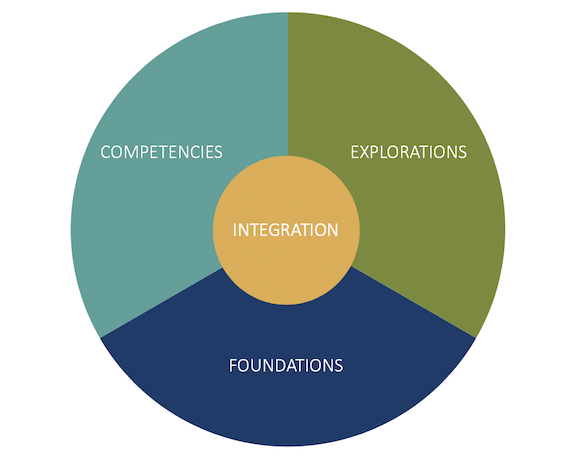
COMPETENCIES: Learn essential skills of written communication, mathematical reasoning and problem solving, second language, oral communication, critical thinking, information literacy and quantitative reasoning in order to become effective leaders.
EXPLORATIONS: Critically and creatively explore the breadth of the liberal arts, focusing on social identity, scientific literacy and personal expression through varied modes of inquiry.
FOUNDATIONS: Become individuals who, through the search for truth and goodness, uphold the dignity and aspirations of all people; and who critically and creatively explore the “big questions” about God, personal identity and social identity.
INTEGRATION: Integration at USD is multifaceted and includes courses and experiences that provide students with opportunities to make connections between disciplines, apply knowledge in a variety of contexts, make connections between curricular and co-curricular activities, and to synthesize Core competencies.
Learn More About Each Core Area
The History of the Core Revision
The core revision process at the University of San Diego began in 2011 with a task force developing the Core Action Plan, initiating discussions about the core curriculum. The process involved committees focusing on principles to align the curriculum with the university's values. Over several years, faculty feedback was gathered, subcommittees developed proposals and final recommendations were consolidated into a Core Proposal. The new core curriculum was adopted in Fall 2017, following approvals by the University Faculty Senate and undergraduate units.
The Core Curriculum is the expression of the two great traditions that animate the University of San Diego: liberal arts education and the Catholic intellectual tradition. By carrying on the humanist project of free inquiry, the liberal arts teach us to think critically. We learn to examine the world, to question assumptions and to cultivate self-reflection – habits of mind which are essential for our students as they become adults and citizens. These ideals are also essential to the spiritual and ethical values of USD's Catholic mission. The distinctive idea of a Catholic university puts particular emphasis on academic excellence in the liberal arts, and on critical reflection as a key ingredient in our spiritual welfare. By thinking about both reason and faith, our students uphold the dignity and aspirations of all people. The Core reflects these traditions, and it simultaneously turns toward the complex realities of the present. The vibrancy and relevance of a USD education depend in no small part on a Core that can evolve with its students, and with our rapidly changing, diverse world.
The core curriculum is the product of five years of work by faculty and marks the most significant adjustment to our core curriculum since 1986. We have arrived at a Core that is student-centered and that embodies the tradition and mission of USD. The new core is a recommitment to the value of a liberal arts education for all undergraduates, regardless of major.
- Integrate knowledge, insights, and skills gained through scholarly inquiry and strong community into the quest for truth as a continuous process of making connections (integrated learning);
- Become individuals who aspire to uphold the dignity and aspirations of all people in the search for truth and for the good (foundations);
- Critically and creatively explore the "big questions" about God, personal and social identity, and the world through varied modes of inquiry (foundations an explorations);
- Learn essential skills of critical thinking and information literacy, communication, mathematical reasoning and problem-solving, and quantitative reasoning (core competencies).
USD adopted a new core curriculum in Fall 2017. Read the final proposal reviewed by faculty. The Board of Trustees approved the adoption of the core curriculum in September 2016 after University Faculty Senate approval. The Board and the Senate followed the lead of each undergraduate degree-granting unit who voted during the final week of April 2016. The College of Arts & Sciences passed the curriculum with 71% voting in favor of the new curriculum and 29% opposed. In the School of Business, faculty approval was 96%. The Shiley-Marcos School of Engineering faculty voted to accept the new core with 78% in favor and 22% opposed.
- The core revision process began in summer, 2011. Attending a week-long intensive workshop, a task force developed the Core Action Plan, a working document that provided initiated campus-wide discussions about the core curriculum. It provides a broadly-based vision statement, process description, timetable, and other key elements.
- To inform the CPC of previous curricular work that had been done by faculty in 2011 related to diversity, The Diversity Curriculum Committee resubmitted their 2011 report for consideration. The Diversity Curriculum Committee updated their recommendations in response to the CPC proposal. View recommendations for the Diversity, Inclusion, and Social Justice area.
- The second year of the core revision process is guided by the Core Proposal, passed April, 2012 by the faculty in the College of Arts and Sciences, the School of Business Administration, and the Department of Engineering. It was subsequently accepted by the University Senate and reviewed by the Academic Affairs Committee of the Board of Trustees.
- By December, 2012, each task force committee had generated reports that identified key components of each principle and recommendations for how these might be implemented in the core curriculum. The final reports for each task force include: breadth, smaller core size, diversity, enhanced components, multidisciplinary clusters, and writing. The final report of the CITCC can be found on the CITCC tab.
- During the spring semester, 2013, the Core Planning Committee (CPC) worked on developing curricular applications or core models that reflect the recommendations of each task force. Additionally, the CPC established short-term and long-term timelines for the core revision process over the next several years. Discussions of core models and timelines included all faculty through attendance at the open forums. Faculty were also encouraged to post comments directly to the Imagine the Core blog.
- The 2013-2014 academic year was focused on the creation of a core curriculum identifying new opportunities for students in key areas. The core planning committee is organized into to working groups concentrating on Integration, Breadth, Catholic Intellectual Tradition, and Indispensable Competencies. Each working group submitted a proposal to the core planning committee for review. The steering committee consolidated the reports into one document for distribution to undergraduate faculty. As proposals were submitted they were accessed here: Integration (report, presentation, notes), Breadth (report, presentation, notes), Catholic Intellectual Tradition (report, notes), and Indispensable Competencies (report, table, presentation, notes). The CPC met to discuss a complete proposal that consolidates the recommendations from the various subcommittees (draft proposal, notes). December 2013 Core Report | Spring 2014 Core Report
- The Core Planning Committee met on March 25 to discuss revisions to the core proposal. CPC members gathered faculty feedback and offered recommended changes (read notes from the meeting).
- During Spring 2014, members of the Core Planning Committee listened to feedback from faculty. To help answer some key questions, subcommittee chairs created a "Frequently Asked Questions" document for their area. Those can be accessed here: (Integration, Breadth, Diversity, Inclusion, and Social Justice, and Competencies).
- The Core Proposal is composed of a set of general recommendations and an articulation of general principles for continued discussion that emerged during the first year of the revision process. Task force committees were formed for each of the six principles for deeper analysis and discussion. A separate working group, the Task Force on the Catholic Intellectual Tradition in the Core Curriculum (CITCC), was formed to develop and articulate a set of general principles to guide the design of USD's core curriculum to ensure that it reflects its Catholic identity and the Catholic intellectual tradition.
- In Spring 2015, the Core Revision Conference Committee was established by the dean to finalize details related to undergraduate units and faculty governance of the Core Curriculum. 2015 Core Curriculum Proposal
- In Summer 2015 a team went to the AAC&U Institute on General Education and Assessment to produce an Implementation Action Plan and Frequently Asked Questions about Assessment.
- In Summer 2016, a team of faculty attended the AAC&U Institute on Integrative Learning and Signature Work to develop a curricular vision for the integration outcome. Integration Action Plan
- In preparation for the 2017 incoming class, faculty developed guidelines for assessing transfer credit and AP and IB equivalencies.
- USD adopted a new core curriculum in Fall 2017. Read the final proposal reviewed by faculty. The Board of Trustees approved the adoption of the core curriculum in September 2016 after University Faculty Senate approval. The Board and the Senate followed the lead of each undergraduate degree-granting unit who voted during the final week of April 2016. The College of Arts & Sciences passed the curriculum with 71% voting in favor of the new curriculum and 29% opposed. In the School of Business, faculty approval was 96%. The Shiley-Marcos School of Engineering faculty voted to accept the new core with 78% in favor and 22% opposed.
Visit the current catalog to access record of courses approved for core attributes.