
Overview
The Integration area of the Core Curriculum includes courses and experiences that provide students with opportunities to recognize and articulate connections between different disciplines and approaches and synthesize and apply this knowledge in their daily lives.
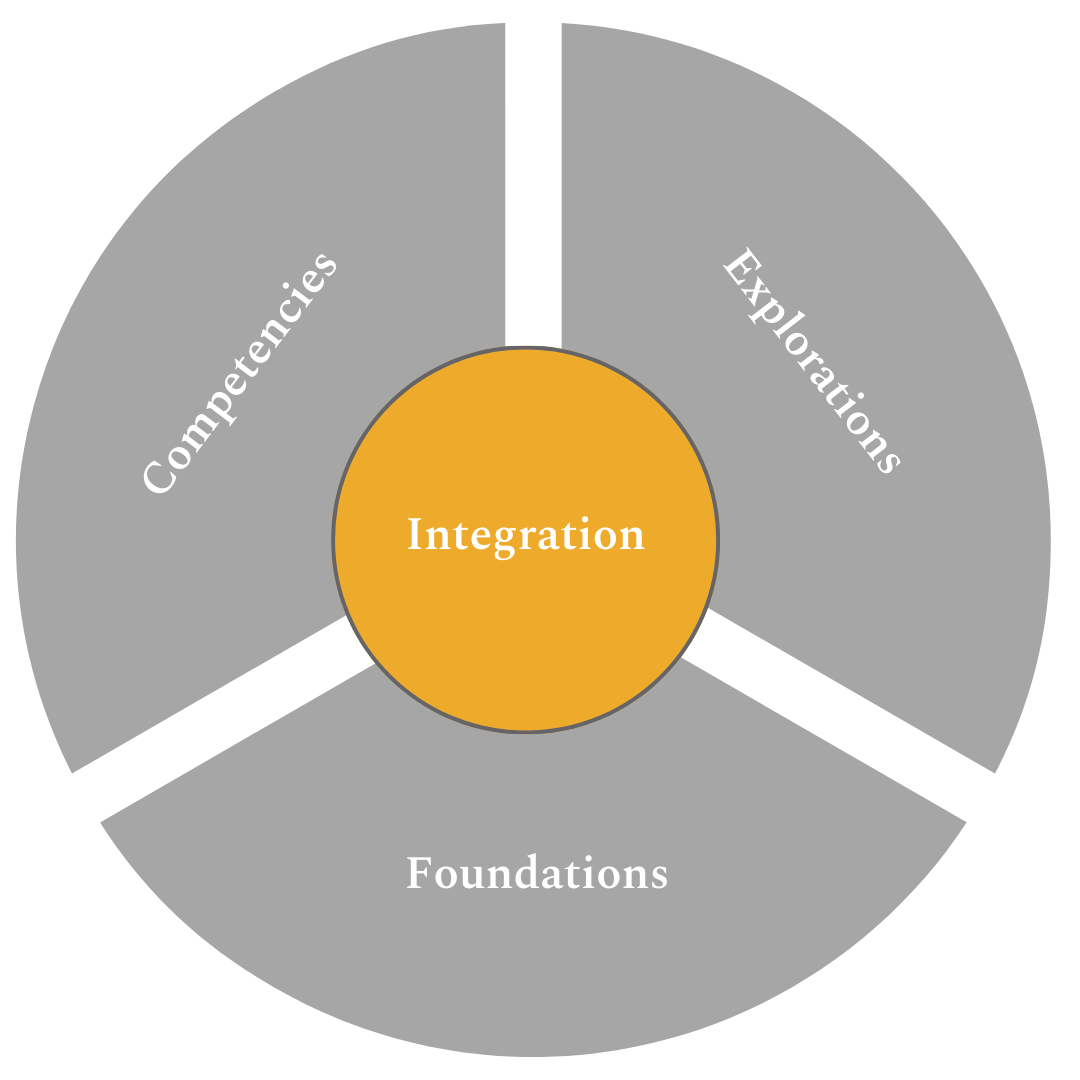
Integration Area Requirements
As a starting point to their careers at USD, students are introduced to the integrative nature of learning through courses in the Learning Communities (LC) program. Living Learning Communities (LLC) and Transfer Learning Communities (TLC) are parallel programs that allow students to be able to satisfy the Core requirement for first-year integration. Students are expected to recognize that people bring different perspectives to scholarly inquiry, discuss how real-world problem solving is inherently integrated and describe the value of multiple perspectives to scholarly inquiry and/or problem solving. Two major academic events are designed to help students achieve the learning outcomes of First Year Integration:
- Students practice First Year Integration in either the Integration Series, or an Interdisciplinary Faculty Exchange
- Students demonstrate First Year Integration in their First Year Integration Project.
Student Learning Outcomes
- Recognize broad connections between multiple disciplines, perspectives, and/or approaches to learning.
- Articulate how the integration of different disciplines, perspectives, and approaches to learning can enhance one’s understanding of practical issues and problems.
Students take one advanced course where they integrate their learning in their Integrative Core Project.
Student Learning Outcomes
- Recognize broad connections between multiple disciplines, perspectives, and/or approaches to learning.
- Articulate how the integration of different disciplines, perspectives, and approaches to learning can enhance one’s understanding of practical issues and problems.
- Synthesize knowledge and/or skills from multiple disciplines or perspectives.
- Apply knowledge and/or skills from multiple disciplines or perspectives.
Advanced Integration focuses on student learning outcomes 3 and 4 and reinforces the First-Year Integration student learning outcomes 1 and 2.
Advanced Integration Course Example
The Desert Sublime
USD students in the College of Arts and Sciences embarked on a unique journey to Death Valley, exploring the intersection of the disciplines of geology and philosophy. Led by Professor Bethany O’Shea, PhD, and Professor Brian Clack, PhD, this course, The Desert Sublime, delved into 18th-century philosopher Edmund Burke's ideas about the sublime and the beautiful. These students examined the emotional and sensory aspects of the natural world and how it connects with human experiences.