
Overview
The Explorations area of the Core Curriculum allows students to critically and creatively explore the breadth of the liberal arts, focusing on social identity, scientific literacy and personal expression through varied modes of inquiry.
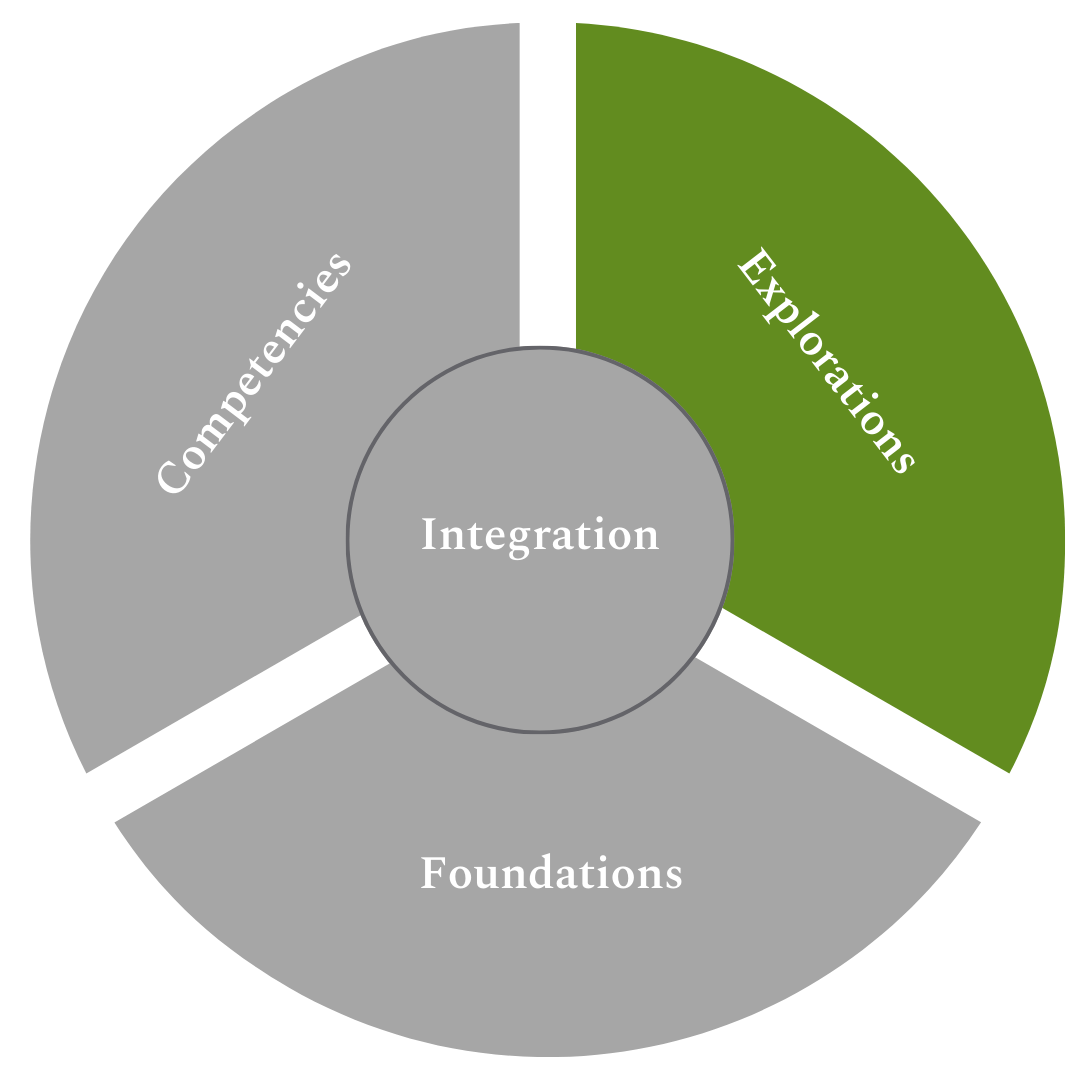
Explorations Area Requirements
Students will complete the following Core Curriculum requirements. Requirements that are “flagged” are included within other core or major/minor courses.
Students take one course in the sciences with a primary focus on laboratory/design/field experiences. Students will ask scientific questions and collect and analyze data to test hypotheses to answer questions or apply the engineering design process to develop a solution to satisfy user requirements. The lab must be affiliated with the same course.
Student Learning Outcomes
- Design and conduct an experimental and/or observational investigation to generate scientific knowledge or evaluate a technological solution to a problem.
- Analyze data using methods appropriate to the natural sciences and/or engineering in order to make valid and reliable interpretations.
- Explain the basic scientific concepts and theories relevant to the area of study.
- Identify and use appropriate and sufficient scientific evidence to evaluate claims and explanations about the natural and designed world.
Example Course Description:
CHEM 102 - Science of Food & Cooking
This course is designed for the non-science major with a focus on food, cooking and baking while introducing foundational concepts in chemistry and biochemistry. Using a variety of approaches including hands-on activities, students will learn the chemical and biochemical principles of food and cooking. Students will investigate the molecular structure and changes that take place in food and drink while cooking and baking. Topics may include: making cheese and ice cream, spices and hot sauces, caramelization and food browning reactions, molecular gastronomy, taste and smell, cakes and cookies and chocolate. Students will participate in inquiry-based laboratories integrated throughout the semester while designing and performing scientific experiments to investigate the nature of food and cooking. Two hours of lecture per week and one four hour lab every other week. No prerequisites
Students take one course that examines an historical period. Students will identify and formulate significant historical questions, analyze a range of primary sources, weigh competing scholarly interpretations and effectively communicate their findings.
Student Learning Outcomes
- Identify and formulate significant historical questions.
- Analyze a range of primary sources (texts, photographs, visual art, audio recordings, films), articulate historical context, and use these sources as evidence to support an argument.
Example Course Description:
HIST 128 - African American History
This course examines the history of African Americans from the ascendance of slavery on the West African coast to black life on the contemporary racial landscape. Who are African Americans? What realities, socio-political ideologies, and cultural practices ground African-descended people? How has and does inequality unfold in the lives of African Americans and systematic mechanisms catapult their perpetual marginalization? Through what means have black communities resisted oppression and how have these methods changed overtime? How do the positionalities of African Americans evolve across gender, class, ethnic, and regional lines? What does the black experience reveal about the pronounced American values of racial transcendence, as well as master historical narratives? How have African Americans created and influenced the contours of American society? Together, we will strive to answer these questions. Together, we will concern ourselves with the fullness of black humanity.
Students take one course that examines the human condition and will learn to take an informed stance from disciplinary knowledge and apply it to issues outside the classroom.
Student Learning Outcomes
- Articulate and compare social scientific theories as appropriate to the course/discipline.
- Evaluate the quality, objectivity, and credibility of evidence using theories, methods, or ways of thinking that define inquiry in a social science discipline.
- State a conclusion that is a logical extrapolation from the inquiry process.
- Apply the discipline-specific inquiry process to analyze new events/fact patterns representing real-world problems or issues.
Example Course Description:
COMM 130 - Introduction to Media Studies
This course offers an introduction to the examination of media and media literacy. Students learn about the origins, history, and development of mass media. Additionally, the present structure, characteristics, and challenges in the areas of radio, television and cable are addressed. Fulfills a Core Curriculum requirement in the social sciences.
Students take one course that focuses on the critical interpretation and analysis of literary texts.
Student Learning Outcomes
- Develop and demonstrate understanding of language and discourse and of methods of analysis and interpretation of textual works including fiction, nonfiction, poetry, and/or drama in filmic or literary representations.
- Perform close reading; identify the formal and aesthetic attributes of a text; and analyze the ways that written language and (in film) multi-sensory codes create meaning and various effects on readers and audiences.
- Analyze literary and/or filmic interpretations, theories, and arguments; identify and probe unexamined assumptions; demonstrate understanding of diverse theoretical movements and traditions, their fundamental characteristics, their development over time and their long-term influences.
- Contextualize literary and/or filmic movements, works, and genres with regard to their diverse cultural, historical, geographical, ethical, philosophical, social, political, economic, religious, and/or spiritual situations, impacts and claims.
- Demonstrate deep engagement with textual analysis techniques by means of oral contributions in class and writings that contain ethical insight and critical interpretation.
Example Course Description:
SPAN 142 - Topics in Literature, Film and Culture - Global
Study at the lower-division level of a topic in literature, film and/or culture with a Global Focus in translation from Spanish. This course is taught in English and will not satisfy the Language Core requirement.
Students take courses that engage students with artistic practices that reflect and shape the society in which they are produced.
Student Learning Outcomes
- Engage in the creative, performative or receptive practices of an artistic discipline. (Creative, Performative, or Receptive Practice)
- Recognize and describe the relationships between the component parts of an artistic medium using discipline-specific vocabulary and analytic systems. (Engagement with Theoretical Principles)
- Situate and contextualize artistic practices within historic and cultural frames using methods of inquiry specific to the discipline. (Historic and Cultural Contextualization)
Example Course Description:
ARTH 144 - Introduction to Cinema
This course is an introduction to film form and the historical, industrial, and cultural contexts that make form significant for analysis. This class aims to equip students to look purposefully, critically and contextually at the moving image, mindful of the ways that meaning is produced and received.