
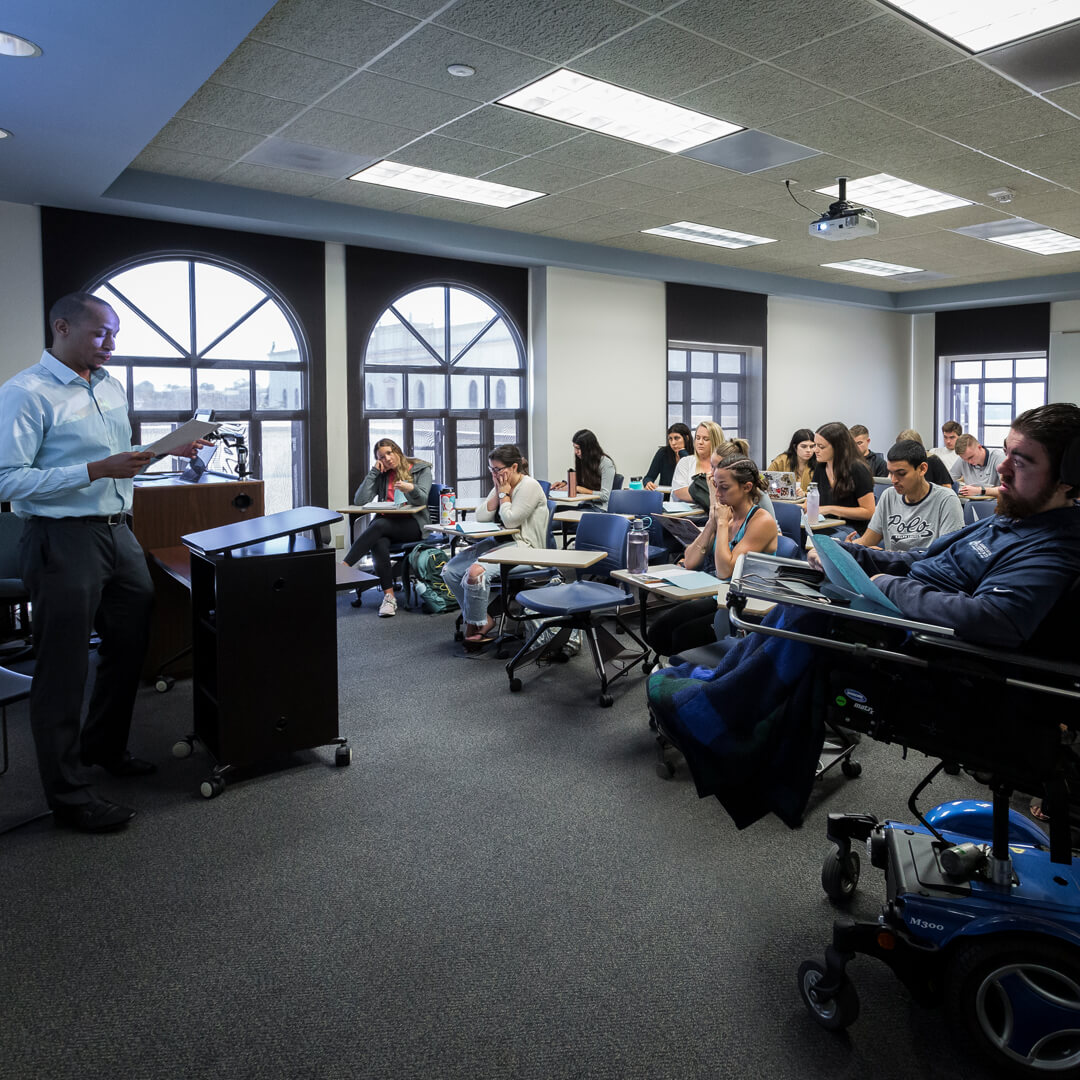
A community enriched by difference brings together multiple perspectives and experiences to enhance the learning environment, expand the thought universe and develop critical and creative thinking skills leading to more complex thinking. These opportunities should be fostered in all realms of experience: intellectual, interactional, spiritual and emotional. We hold commitments that understand learning in curricular and co-curricular contexts as linked and collaborate across divisions to realize the transformative potential of educating a whole person.
Jesse Mills ’04 (MA), ’08 (PhD)
Jesse Mills teaches introductory and advanced course in comparative ethic studies and African American studies at USD. His teaching, research, artistic and activist work focuses on topics such as Black liberation, immigration and refugee studies, social movements, Indigenous decolonization and anti-racist philanthropy. A faculty member since 2006, he said this about his time on campus: “It’s been an honor to give my time and energy unselfishly, which is what has been modeled for me from the folks that I run with here. I’m looking forward to many decades more at USD.”
My colleagues in ethnic studies hired me as a young hopeful person with a lot of ideas in 2006, and I was honored to get the job, which was about building ethnic studies as a field. My mentors have taught me how to be a better teacher and to ask, ‘Can we, as a community of educators, get on the same page? Can we hold each other, lovingly and caringly, to as high and loving a standard as we can?’
A sample of initiatives related to Student Curricular and Co-Curricular Learning:
- USD has implemented DISJ student learning outcomes in the core curriculum for undergraduate students institution-wide and for graduate students. For more information, contact the chair of the University Assessment Committee.
- The Career Development Center has created partnerships with employers and alumni who help facilitate connections for students who are exploring career paths that align with their values and identity. For more information, contact the Career Development Center director.
- The center offers a monthly series on diverse saints and holy people from various cultural backgrounds whose lives were dedicated to equity and justice. These have included figures such as Kateri Tekawidtha, Thea Bowman and Barolome de las Casas. For more information, contact the director of the Center for Catholic Thought and Culture.
- Review of applications of human subject’s research includes attention to the ethical principle of justice ensuring the equitable distribution of benefits and burdens of student and/or faculty research. For more information, contact the associate provost for Research Administration.
- Through semester-long and short-term study abroad opportunities, study abroad programs seek to expand co-curricular learning by engaging students in non-traditional learning outside of the classroom. While abroad, students attend courses and outside of the classroom engage in all types of learning, including how to navigate a new city/country as well as communicate with others in a foreign language. Through immersive experiences such as homestays and community engagement opportunities through internships and service work, students abroad experience "otherness," which leads to opportunities for faculty and staff to discuss privilege and power with students, many of whom have not had to experience this within the United States.
- The International Center’s (IC) “Identities Abroad” initiative prepares students who study abroad to explore cultural differences and identity. Through a workshop each semester, IC invites students to explore cultural differences and identity in the context of experience they might have in another country.
- Not all intercultural experiences take place abroad. For example, Collaborative Online Intercultural Learning is an opportunity for USD students to work both synchronously and asynchronously with students in partner universities abroad on a shared learning goal. These experiences allow for both groups of students to interact in culturally different academic settings without leaving their home country. The exchange of ideas between both groups allows for students to think differently about a problem and identify collaborative solutions. For more information, contact the associate provost for International Affairs.
- The Kroc School has invited its inaugural activist-in-residence, who spends three weeks engaging with students to discuss their experiences in leading social justice work. For more information, contact the dean of the Kroc School.
- The School of Law encourages students to take advantage of legal education opportunities abroad to increase their global fluency and understanding of other cultures. Through Summer Study Abroad and international educational partnerships, JD students and exchange students who study in San Diego can explore new cultures in an academic setting through a comparative perspective. International students are introduced to worldwide legal principles and the law of the respective countries through specialized courses, such as Introduction to U.S. Law. For more information, contact the director of Summer Abroad Programs in Law.
- The Copley Library created a Diversity and Inclusion LibGuide to highlight scholarly Diversity, Equity and Inclusion (DEI) resources as well as current news and events.
- Copley Library will allocate funding annually to acquire DEI and anti-racism books for the library's collection. For more information, contact the dean of University Libraries.
- The National Science Foundation (NSF) Research Experiences for Undergraduates (REU) program provides an opportunity for interdisciplinary research that integrates social justice. The goal of the NSF REU is to engage underrepresented students in multidisciplinary, high-impact chemistry research that not only asks and seeks answers to important scientific questions, but also integrates and recognizes the social impact of that work. For more information, contact the Office of Undergraduate Research.
- USD’s co-curriculum initiative is a cross-divisional committee that inventories and plans co-curricular opportunities at USD as they connect to the co-curriculum learning outcomes, one of which is identities and communities.
- Student Affairs (SA) employees participate in a scaffolded training approach that asks workers to wrestle with topics such as power and privilege, social identity, identity conscious leadership, anti-racism and racial affinity space work.
- Diversity, Equity and Inclusion (DEI) training is required for all students, utilizing EverFi technology.
- Fraternities and sororities examine power, privilege and oppression through the historical foundations of these organizations.
- The Student Org Conference is held every year and provides training for student organization leaders, including ASG. DEI topics are included.
- Annual Unit Assessment Plans include a section that encourages units to incorporate aspects of equity and inclusion into their own annual plan.
- Health Promotion works to enhance USD’s peer health education opportunities to be representative of USD’s diverse student community, as well as to redesign training for peer educators around equity, diversity and antiracism.
- Resident Assistants participate in ongoing training and programs that address various topics related to DEI work. Examples include anti-blackness/anti-racism as it relates to USD; passive election guide; a resource bank of podcasts, videos, documentaries and books; unconscious bias training; content for weekly communications on Black history, including the lived experiences of Black historical figures; women in herstory and derogatory terms. For more information, contact the vice president of Student Affairs.
- The Urgent Challenges Collective is an engaged research program that focuses on homelessness, cross border engagement, food justice, environmental justice, human trafficking and educational equity. The collective works with undergraduate students, graduate students, faculty and community partners. Each of these issue areas include how diversity, equity and inclusion intersect. For more information, contact the Office of Institutional Effectiveness and Strategic Initiatives.
Areas of Focus