
COVID Nurse
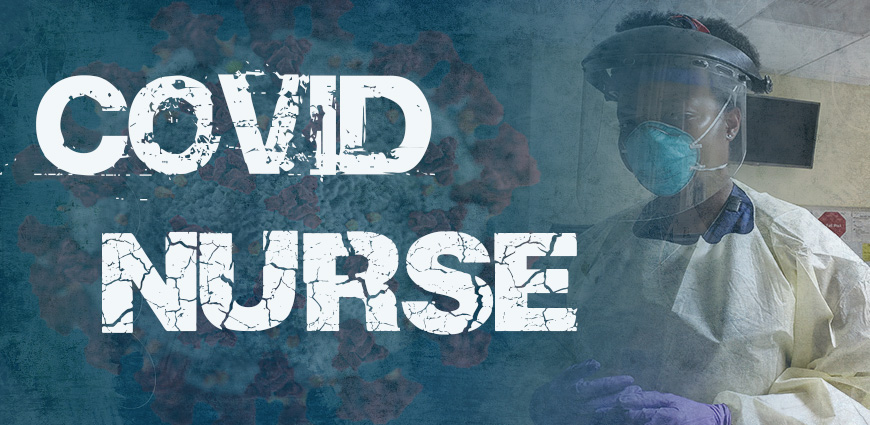
Ann Lawani is the kind of nurse you want caring for you when you are sick. She is compassionate, she is knowledgeable, and she understands the pain of personal loss.
“My undergrad was in healthcare administration,” Lawani said. “Right after my graduation, my brother passed away. And in my mother’s grief, she remembered the nurses who took care of him. I wanted to be that person for others. That’s what motivated me to go into nursing.”
Lawani graduated from the Master’s Entry in Nursing Program, or MEPN, just over two years ago. She worked for Sharp Memorial Hospital in cardio-pulmonary nursing until the pandemic hit. Then she became a COVID nurse. Because of her skills and compassion, she was recently promoted to Lead Clinical Nurse on the COVID unit at Sharp Coronado. She is also currently an ARCS scholar working toward her PhD.
“I came to USD,” she said. “I got trained by the best, and now, I’m living the dream.”
Sort of. Lawani said she never expected to face a global pandemic so early in her nursing career. In doing so, she has learned there are limits to everything.
“It’s just day by day. With school, it’s a distraction. My professors have been really supportive and encouraging because they know the situation I am in now.”
She also finds it helpful to meditate, journal, and pray.
“Sometimes it's about coming home and just crying in the shower and that's what I need that day,” she said. “It just depends on the day.”
Unfortunately, for Ann and her healthcare colleagues, those days are becoming more frequent.
“I think the energy we had as nurses when the pandemic started, we don't have quite as much of that energy anymore. It's been a couple of months; it's been a rough couple of months. So, the energy is dwindling, we're emotionally exhausted, and we're physically tired.”
Click to hear Ann discuss a typical day on the COVID floor at Sharp Memorial.
Like all hospitals, those in the Sharp HealthCare system face a serious shortage, and not just of dwindling ICU beds.
“It’s one thing not to have ICU beds,” Lawani said. “It’s another not to have enough staff. We’re severely short-staffed now because we can't get travel nurses because they go to the hot spots and now the hotspot is everywhere, so there's a shortage of nurses.”
Lawani does not see an end to that problem in the near future.
“I foresee that a lot of nurses are going to change professions. We're already exhausted, we’re burned out and we’re starting to take it personally when we’re trying to put a patient on BIPAP (Bilevel Positive Airway Pressure) and they die even on BIPAP even on that much oxygen, the patient passes away.”
Lawani said patient death is a part of being a nurse, but not at the levels she has seen over the past 10 months. She recently had a patient who was near death and wanted to speak to his granddaughter. The patient only spoke Japanese and his granddaughter was in Japan. Lawani enlisted help from others so her patient could say goodbye. Lawani got the granddaughter on an iPad and warned her that the conversation would be very brief.
“It's going to be for less than a second, if at all,” Lawani said. “And she's like, okay, I just want to tell him I love him, and I want to hear him say it back. And so we did that. I took the mask off and I tilted it to the side where he could still get some oxygen.”
Lawani’s patient was able to say a few words, then she put the oxygen mask back on. It took just a matter of seconds.
“It becomes personal,” she said. “So when I leave work and I see people without masks and I see people packed together at parties, it's very disappointing. It breaks my heart.”
Lawani worries about everyone, even those patients who do not have underlying conditions. She sees perfectly healthy people contract COVID-19 and end up in ICU on a ventilator. Some will not survive. Some will. And those who do often suffer from the effects of the virus long after discharge.
“I've seen what COVID can do to a body; it slowly destroys your lungs. It feels like you can’t breathe, it feels like you're drowning. A patient said to me, ‘I feel like I'm drowning. I feel like I'm in the water and I can't breathe. It feels like I'm underwater.’ That's what it feels like.”
Despite all the sadness and exhaustion, Lawani says her patients inspire her.
“They’ve given me the spirit of resilience,” she said. “I always knew that I was resilient, but it's a new version of me that I didn't know was in there and I'm sure it’s the same for most nurses. You know, even though I'm physically and emotionally exhausted. I want to go back to work. I want to give my best. There’s a joy in me when a patient goes from ICU to discharge.”
Ann Lawani is guided by the philosophy that kindness and knowledge are never wasted. Her PhD research focuses on palliative care and helping her patients plan for a dignified end-of-life.