
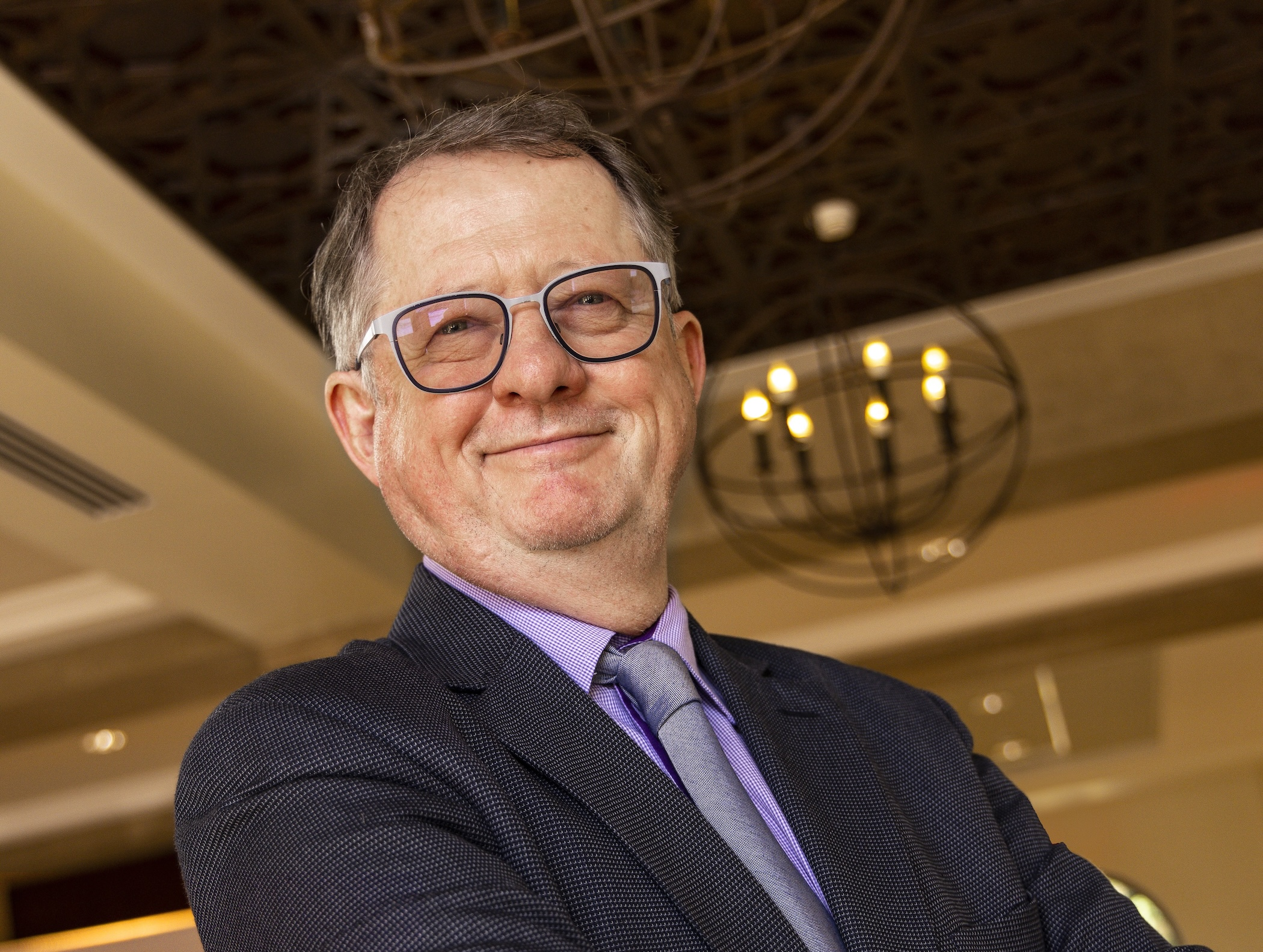
Founding Dean Chell Roberts to Step Down in 2027
The End of an Era
Last spring, Founding Dean Chell Roberts made the decision that the 2026-27 academic year would mark the end of his time in the role.
During his tenure, the Shiley-Marcos School of Engineering achieved national top 15 ranking status. “This rise in national prestige has been bolstered by his success in designing and launching a robust array of graduate programs and leading conversations with our donor community that have led to transformational giving for the school,” said Provost and Vice President for Academic Affairs James Antony, PhD.
“Beyond programmatic growth, Chell’s tenure has seen a profound physical transformation of the school’s footprint,” Antony continued. “He has overseen the modernization of myriad buildings, labs and innovative spaces that have redefined the student experience. Most notably, his leadership has been instrumental in the development of our new facilities for the Shiley STEM Initiative, which will serve as a cornerstone for interdisciplinary research and learning for decades to come.”
Roberts will continue to lead USD’s professional, continuing and online education portfolio and advise USD as it embarks on the development of the Shiley STEM Initiative.
In a wide-ranging conversation, Roberts reflected on his life and the path that led him to the University of San Diego.
Some may find it unusual that an industrial engineer wrote poetry, performed in plays and played two musical instruments as a child, but in Chell Roberts’ family that was the norm.
“To graduate from my family, you had to play two musical instruments. Nobody was on an engineering path. To be honest, their question would have been, ‘How did we end up with an engineer in the family?’”
His father, an accomplished musician, set the standard that all his children had to play the piano, and the preference was that the second instrument would be either woodwinds — “my father’s specialty” — or strings.
“I didn’t want to do either,” Roberts recalls. “I wanted to play the drums, and he told me that was outlawed in our family. Then I wanted to play the trumpet and he told me, ‘No, we're not playing the trumpet in this family.’ Eventually, I said, ‘Then I'm not playing an instrument.’”
Ultimately, he was allowed to choose the trombone. “I did well. I was first chair in high school, took private lessons and played the piano.” Before his father died, he gave instruments to all his children. “He had clarinets, a flute, an oboe, a saxophone. He came to me and said, ‘I don't have any instrument to give you because you can't play any of the instruments I play. What should I give you?’ I said, ‘I’d like your guitar.’”
By his mid-80s, Roberts’ father didn’t have lung capacity for woodwinds, so he pivoted to piano and guitar. He learned to play the latter by himself.” Today, Chell plays that guitar every day.
“There could be something genetically that brings music and engineering together,” Roberts muses. “I got that music gene, and I do see other engineers that think that same way.” In college, after getting a scholarship in engineering, he decided to pivot to acting for the next year of school.
“I can still hear my mother saying, ‘You're never going to make any money in your life as an actor. You need to be an engineer,’” Roberts recalls.
It’s hardly a spoiler that Roberts took his mother’s advice. He earned his undergraduate degree in mathematics and master’s degree in industrial engineering from the University of Utah and went on to achieve his PhD in industrial engineering from Virginia Tech.
He spent 23 years at Arizona State University (ASU) as a tenured professor and eventually became the executive dean of the school’s College of Technology and Innovation.
Roberts was hired by ASU, an R1 institution, to focus on research rather than teaching. “I taught one course every semester, but I was supposed to bring in grants. I was successful, got tenure and moved up the ladder. One day, the dean of engineering asked me to work on a grant called Bridging Engineering and Education.”
The premise of the proposal was that engineering faculty didn’t know how to teach well. “By and large, that can be true. One of the languages of engineering is math. Engineering professors in my developmental years often stood at a blackboard with their backs to students, and they could write equations and talk about engineering science and demonstrate it with math. Pedagogically, it’s not a great way to teach.”
The dean had approached Roberts to help with the grant because of his strong teaching evaluations. At one of the first meetings, the team — made up of people from both engineering and the College of Education — decided one of their first tasks would be to teach together and critique one another.
“I went into an engineering class and taught a great lecture with people observing. I’m sure I taught with my back to the audience some of the time, writing mathematical equations. I did what I normally did in my classes that gave me excellent student evaluations.”
Afterward, the team met to discuss Roberts’ method.
“They said, ‘You must feel terrible because that was not a very good lecture and that's not the way you should teach.’ I asked them, ‘What do you mean? That was really good.’ They responded, ‘No, that was not good at all.’”
That serendipitous feedback led to what Roberts calls an adventure: “How do you effectively teach? Where is that body of knowledge and how do you know if you’re doing it the best possible way?” They don't teach you that when you get a PhD. Ultimately, that quest led him to visit small private institutions across the U.S. “I started to become a bit of an expert in understanding small private universities while I was at a large public university.”
His growing reputation got the attention of then-Provost Julie Sullivan at USD. “She asked me to apply for USD. I asked, ‘Does USD have an engineering program?’ The answer was yes, but it was inside of the School of Business and it was a small program. In 23 years, there had only been 200 or so graduates with no more than 15 faculty members.”
Roberts realized that he now had insight into engineering at great private institutions and what made them thrive. "Because USD engineering was still in its early phases, it offered a rare opportunity not just to build something but to act as the architect — taking the best frameworks I’ve seen work around the world and shaping them into something entirely new."
He was hooked.
“I was able to build a school based on everything I’d learned through my research. It was a lot of hard work but it was also a lot of fun,” says Roberts. “Thirteen years later, the most exciting part is looking around at the team we’ve built — seeing who we got to hire and who chose to stay and grow this school.
In the end, it all comes down to the faculty and staff members. “We found people who take pride and ownership in the things they create. They feel empowered to do what they do because they care about students. They care about the school. They care about the university. They decided to create something special — together.”
Roberts doesn’t see the school’s success as his own personal achievement but as the shared culmination of a dream.
“If there's any legacy, they are the legacy," he says. "We have had students who came here not sure they could make it, but our faculty members took them under their wing and nurtured them until they did.”
Those efforts have a ripple effect. “It's because of our faculty, staff and leadership team that we have a great alumni group that loves the school, alongside incredibly strong relationships with our industry partners and donors. They are all deeply involved in keeping those connections alive.”
For Roberts, it has been a remarkable journey. “It's a cohesive, wonderful group of people. They came because they cared about the environment, society, people and ethics.”
He pauses, reflecting with a mix of humility and pride on what he leaves behind.
“We may not be huge in numbers but our faculty and staff enjoy their autonomy, our partners are engaged and our students thrive. If I’ve done anything, it was choosing the right people and helping to encourage an environment where everyone could succeed. In the end, I didn't just create a school — I believe I developed something that is self-sustaining and well positioned for the next generation of leadership.”