
Research Spotlight: Sidney Catto
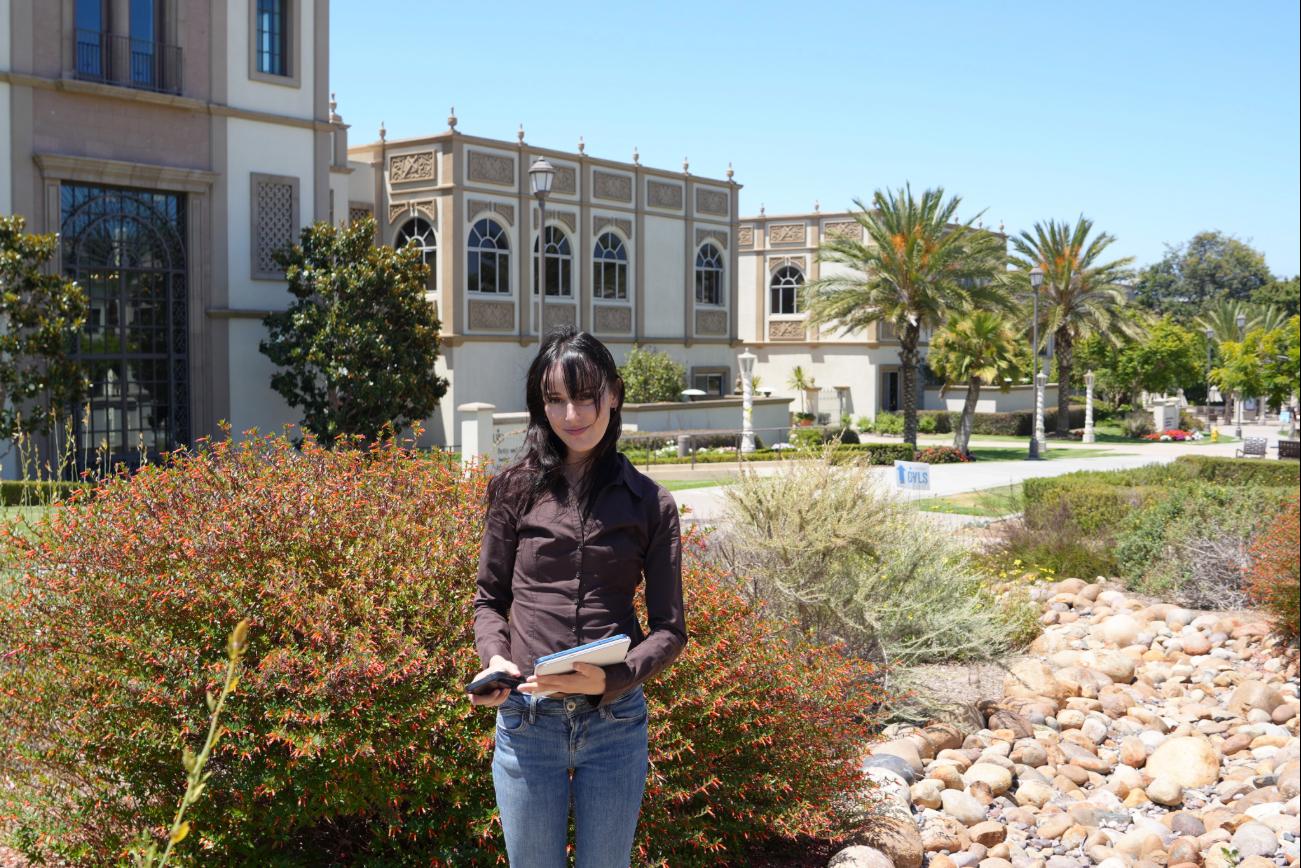
Sidney Catto, a Summer Training in Advanced Research (STAR) recipient and cognition and behavior student, has been studying spatial navigation in three dimensions. Under the guidance of Rachel Blaser, PhD, Professor of neuroscience, cognition and behavior, Catto has explored how animals use their spatial memory to navigate their environments. Traditional research on spatial navigation has been using rodents in lab settings in two-dimensional planes. By using hummingbirds, she is able to explore different flight and movement patterns.
Hummingbirds form strong connections to feeding sights and they'll adjust their patterns based on these sights. Catto is studying whether animals rely on allocentric (external landmarks) or egocentric (body centric and habitual patterns) orientation.
Catto got involved in this research project by exploring the different research possibilities at the University of San Diego. After taking an animal behavior course with Blaser, Catto was excited by the chance of being able to work in her lab. At first, they were exploring spatial navigation in rats, but wanted to add on another dimension and decided on studying hummingbirds.
Currently, Catto’s day-to-day work consists of a two-hour segment either in the morning, afternoon or evening. There are two different types of observations, first, scan sampling, which is counting the number of hummingbirds present per minute for each plant, and second picking 6-10 individual birds to follow and see their path. Eventually, Catto will construct a 3’x5’ wooden platform with 3 feeders in fixed positions, 2 distinct visual landmarks on either side and a 3-sided mesh enclosure in order to have one opening to control the hummingbird's direction of approach. Only one of the feeders will have a sucrose sugar solution and the rest will have water.
Catto will periodically rotate the mesh enclosure opening but keep the landmarks the same. “If birds rely on egocentric strategies, they are expected to approach the feeder using the same body-centered turning pattern, despite the rotation of the environment," Catto said. "If birds rely on allocentric cues, an adjustment of approach based on the location of the landmarks will be observed.”
Catto’s advice for students looking to get involved in research is that it’s fine if you aren’t jumping right into it. Take the time to talk to your professors and find what you’re interested in. As a transfer student, Catto didn’t know where to start. She attended many research talks and eventually found what she wanted to do after talking to Blaser. She aligned with Blaser's ethics and teaching style and now they make a successful research team!