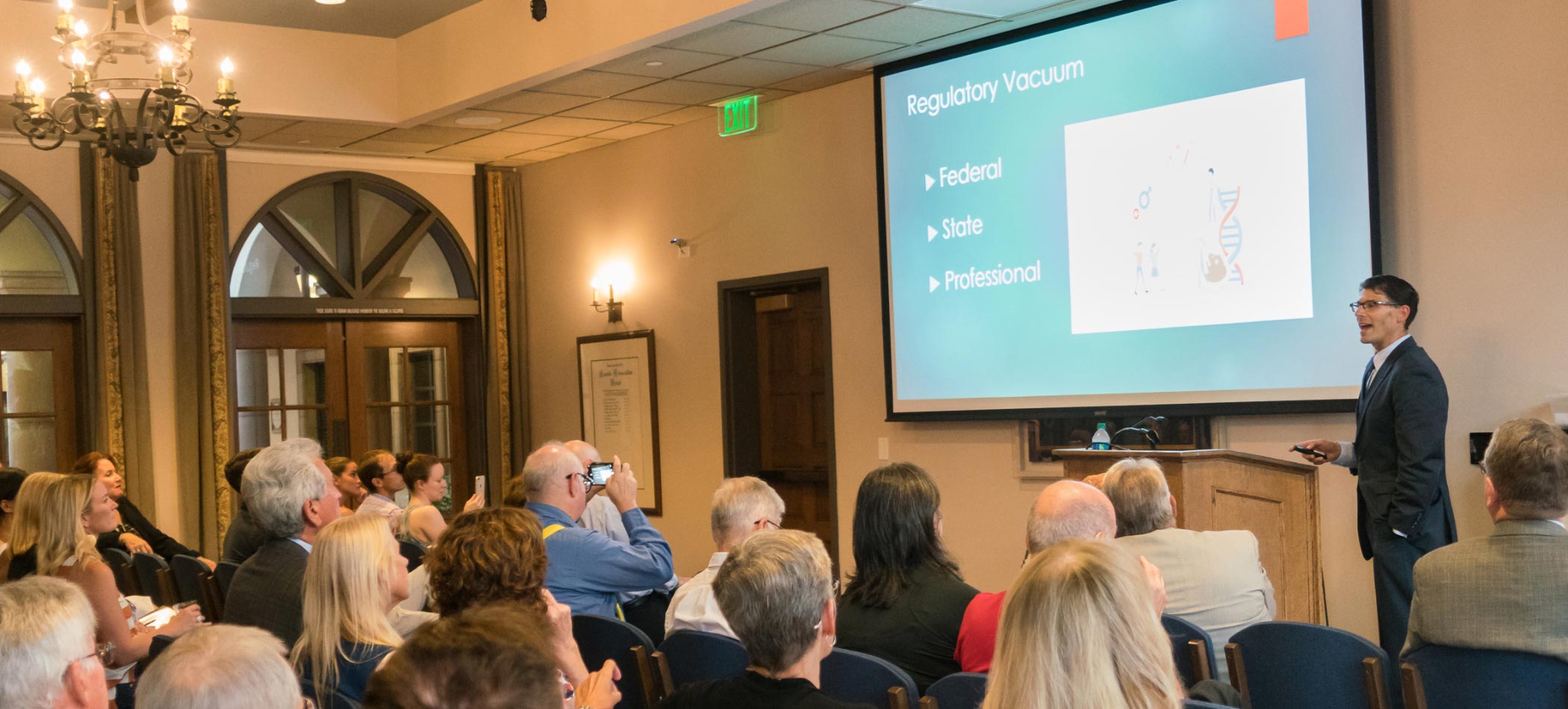
San Diego is a world leader in biotechnology and medical science, raising hard questions about how to promote or regulate these promising advances.
The Center for Health Law Policy and Bioethics brings together researchers and practitioners from local institutions including Scripps, Salk, Illumina, BIOCOM, CONNECT, UCSD, Kaiser Permanente and Rady’s Children Hospital to support research, education and policy measures of special concern to the San Diego community.
Leadership
Director
Faculty Members
Research Fellows
COVID-19 Ethics, Law & Policy Research Database
Created in response to the COVID-19 pandemic, CHLPB's COVID-19 Ethics, Law & Policy Research Database offers a collection of curated articles exploring the complex legal questions that arose from the pandemic.
Focuses
Three Focus Areas at the Center for Health Law Policy and Bioethics
Synthetic biology offers great promise for a new and improved generation of genetically engineered microbes, plants and animals… To achieve this promise, the public must be assured that the U.S. regulatory agencies are able to review these products as effectively as they have over the past two decades. [We have] identified several issues and options for policymakers to update the current U.S. regulatory system for biotechnology.
Research
Faculty, students and research fellows at the Center for Health Law Policy & Bioethics seek to resolve challenges that confront healthcare, research and biotechnology. The Center hosts an annual symposium that brings major interdisciplinary scholars from around the world to San Diego. The open-access proceedings are videotaped and published in the Journal of Contemporary Legal Issues. Recent topics have included reproductive freedom, the governance of public health, and legal restrictions on medical care.
Policy
The Center for Health Law Policy & Bioethics promotes through conferences, lectures and workshops designed to prepare white papers on pressing matters of regional importance and beyond. Recent topics of policy papers that the Center has generated for administrative and legislatives bodies included physician burnout and shortages, healthcare access for veterans, prescription drug reform, pandemic rationing, the use of neuroscience in the courtroom, and systemic barriers to pediatric, geriatric, palliative and oncology care.
Education
“Healthcare Reform,” “Mental Health Law,” and “Telemedicine and the Law” are among the curricular offerings to teach law students alongside health disciplines like medicine, nursing, public health and social work. In “Medical Malpractice,” law students work with emergency medicine residents through the anonymized record of a medical negligence case to cover both legal topics (e.g., standard of care, informed consent, causation), and medical ones (e.g., root cause analysis, morbidity & mortality conferences, clinical protocols). Engagement between the early doctors and budding lawyers culminates in mock depositions.
Media