

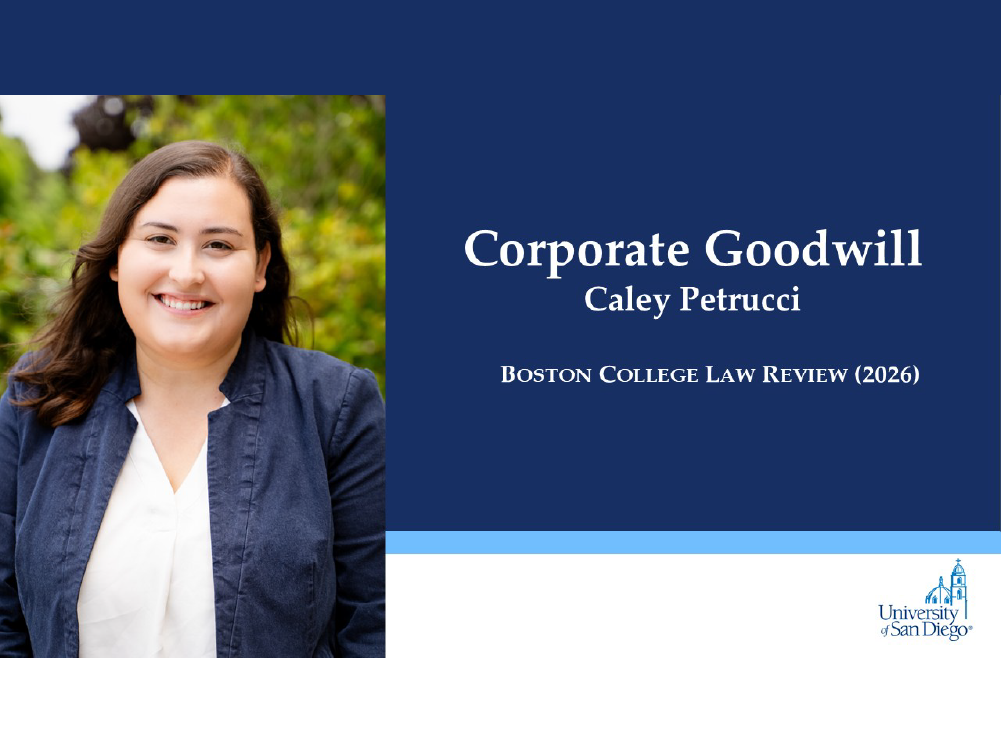
Corporate Goodwill
Author: Caley Petrucci. Boston College Law Review (2026)
Perhaps the most significant debate in corporate law today is the role of the corporation in society. Do corporations have a responsibility to their employees, local communities, and other non-shareholder constituencies? On one side of the debate, there is a vocal group of critics arguing for a shareholder primacy model of governance focused on maximizing value to shareholders. On the other side, there are corporations embracing stakeholder governance and the consideration of employees, local communities, and other non-shareholder constituencies in the ordinary course of business. Modern corporate governance, however, presents a curious phenomenon: Even the most ardent supporters of stakeholders abandon their longstanding commitments during times of change, such as dealmaking and shifts in governmental power.
The Contractual Limits of Control
Author: Caley Petrucci. Harvard Business Law Review (2025)
For centuries, the law has allowed a separation of ownership and voting power. When founders take a private company public — and benefit from access to more capital as a result — they can preserve control despite selling a majority of the company. How does this work? The primary mechanism involves a curious model of governance: multiple classes of common stock with the founder’s class having far more voting power per share. These governance structures are fraught with concerns of increased agency costs, managerial entrenchment, and economic inefficiency. As a result, they have generated a robust debate among scholars and practitioners alike. Prior commentators have examined a handful of mechanisms to limit control in isolation. But doing so necessarily creates an incomplete picture, failing to consider many other limits and overlooking a deceptively simple principle in contract law: that corporate “contracts” must be considered in their entirety.
Stakeholder Amnesia in M&A Deals
Co-Authors: Caley Petrucci and Guhan Subramanian. Journal of Corporation Law (2024)
The most fundamental and longstanding debate in corporate law—the purpose of the corporation—has found new energy in connection with broader discussions about the power of modern corporations and their role in society. Companies have increasingly embraced the consideration of employees, communities, and other stakeholders in the course of everyday business. However, these same considerations are virtually non-existent in merger and acquisition (M&A) transactions. Elon Musk’s recent acquisition of Twitter provides an illustration of this stark disconnect. Prior to the transaction, Twitter pursued numerous stakeholder-centric goals. In contrast, Musk had taken a skeptical, if not hostile, stance toward stakeholder governance. When Twitter negotiated its sale to Musk, the board succumbed to “stakeholder amnesia”—overlooking its stakeholder commitments in favor of the high-premium all-cash offer from Musk. Twitter is not alone: stakeholder amnesia is a widespread phenomenon in M&A.
Equal Treatment Agreements: Theory, Evidence & Policy
Author: Caley Petrucci. Yale Journal on Regulation (2023)
While the rise of dual class companies — companies like Facebook, Google, and Visa, which have two or more classes of common stock that differ in voting rights — has been widely observed over the past decade, prior commentators have largely overlooked the important “equal treatment” agreements that are embedded in many dual class charters. Equal treatment agreements require that stockholders are treated equally, for example by ensuring that all stockholders receive the same consideration per share in the sale of the company, thereby potentially taking away one of the most important benefits of holding the high-vote shares.
Using an original database of 312 dual class charters and their equal treatment agreements, this Article is the first to conduct a robust empirical analysis of equal (and unequal) treatment agreements in dual class companies. As a policy matter, the Article identifies when such structures are desirable and efficient from a law and economics perspective. In doing so, this Article highlights certain agreements (which I term “unequal treatment agreements”) that require equal treatment except for a fixed proportion of disparate consideration as promising structures to facilitate efficient deals, deter inefficient deals, and manage moral hazard. Based on this analysis, the Article provides implications for stakeholders including founders, investors, practitioners, and courts.
Regulatory Entrepreneurship
Co-Authors: Elizabeth Pollman and Jordan Barry. Named one of the top ten corporate and securities law articles of 2017.
This article examines what we term “regulatory entrepreneurship” — pursuing a line of business in which changing the law is a significant part of the business plan. Regulatory entrepreneurship is not new, but it has become increasingly salient in recent years as companies from Airbnb to Tesla, and from DraftKings to Uber, have become agents of legal change. We document the tactics that companies have employed, including operating in legal gray areas, growing “too big to ban,” and mobilizing users for political support. Further, we theorize the business and law-related factors that foster regulatory entrepreneurship. Well-funded, scalable, and highly connected startup businesses with mass appeal have advantages, especially when they target state and local laws and litigate them in the political sphere instead of in court.
Finally, we predict that regulatory entrepreneurship will increase, driven by significant state and local policy issues, strong institutional support for startup companies, and continued technological progress that facilitates political mobilization. We explore how this could catalyze new coalitions, lower the cost of political participation, and improve policymaking. However, it could also lead to negative consequences when companies’ interests diverge from the public interest.
How Reputations are Won and Lost in Modern Information Markets
Contributors include Twitter co-founder Biz Stone; senior executives from global companies eni, Experian and Millennium Management; prominent journalists from Reuters, the New York Times and CNBC; and professors from the Universities of San Diego, Stanford, Oxford and MIT.
Democratization of online information, always-on media and the proliferation of audiences creates distorting effects that are not well understood. This white paper seeks to identify the key challenges and opportunities for businesses and policy-makers in dealing with online information networks. Based on a conference co-hosted in San Diego by the Center for Corporate and Securities Law at the University of San Diego School of Law and the Oxford University Centre for Corporate Reputation at Saїd Business School.
Comments by Forty-Two Law Professors: SEC Study on Extraterritorial Private Rights of Action
Prepared by Frank Partnoy, and 41 other law professors.
In the aftermath of the financial crisis, one crucial question has been whether investors can recover for securities fraud if they are induced to trade by fraudulent activity in the U.S. but their trades do not take place on a U.S. exchange. Simply put, can investors who are defrauded in the U.S. recover if they trade securities outside the U.S.? In 2010, the Supreme Court said no, and Congress directed the Securities and Exchange Commission to study whether the Supreme Court was wrong. On February 18, 2011, Professor Frank Partnoy submitted an 18-page response to the SEC on behalf of himself and 41 other law professors.