
Research
We serve as a strategic partner to educational organizations engaged in piloting new learning models and other innovation initiatives. Our engagement supports:
- Strategic planning for R&D
- Fundamental research and peer-reviewed publications
- Evaluation services, including the development of logic models and data collection approaches
- Data science and learning analytics
- Annual research reports, board and conference presentations
- Playbooks, whitepapers, thought leadership articles and infographics
NSF VisMO
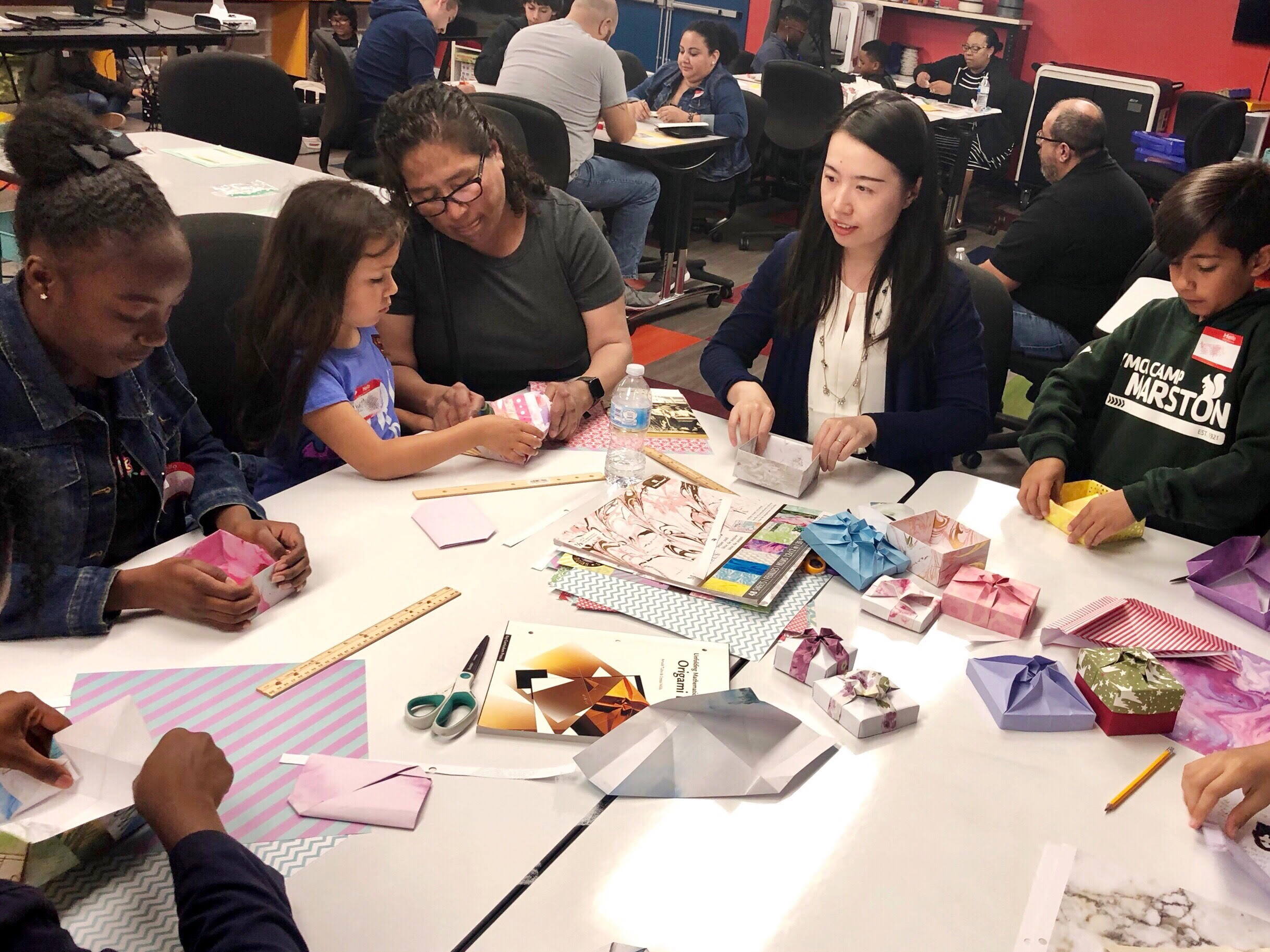
Fostering elementary school students' visuospatial skills and mathematical competencies through an origami-based program
This three-year fundamental research project investigates the causal link between children's visuospatial skills development and their longitudinal gains in mathematical competencies. This research effort brings together cognitive psychologists, learning scientists, mathematics education researchers, and origami artists to develop and evaluate an innovative origami-based program for elementary school children in South Bay Union School District. Funded by the National Science Foundation, Project VisMO.
Exemplary teaching practices
Teacher case studies of the World of Work
This research report includes six case studies, video clips and over 20 exemplary teaching practices that were identified among experienced teachers implementing the World of Work curriculum in the Cajon Valley Union School District. Findings discuss how teachers internalized the World of Work, the rewards and challenges they experienced implementing the World of Work, as well as their recommendations.
Education innovation research
Coding our future - creating computer science pathways in San Diego Unified School District
Partnering with TechSmart, USD, Lego, Classroom of the Future Foundation, and Cal State San Marcos, San Diego Unified School District will develop and implement a promising new evidence-based Computer Science Implementation Model. As the 17th largest school district in the country and the 2nd largest district in California, SDUSD is perfectly positioned to serve as a model for how large city school districts can train their teachers and empower their students to learn computer science. The Jacobs Institute will serve as the longitudinal research partner on this Education Innovation (EIR) Research Grant, conducting both formative and summative evaluations.
Junior Achievement of San Diego County
Junior Achievement (JA) is the nation's largest organization dedicated to giving young people the knowledge and skills they need to own their economic success, plan for their futures, and make smart academic and economic choices. Junior Achievement of San Diego County is providing life-changing programs to young people in San Diego aiming to develop their financial literacy, work and career readiness, and entrepreneurship.
Monarch School
Social-emotional learning
University of San Diego (USD) and Monarch School Project (MSP) partnered to assess and understand the social-emotional development of unhoused youth annually through a customized Social Emotional Learning Survey and co-designed PLC Meetings for Monarch staff to engage with the data and begin to discuss implications for practice. USD will build upon this work by supporting the Monarch School to resume the SEL data collection and analyses work as well as conducting an in-depth analysis of the historical data collected in the past years to produce a white paper that addresses unhoused youth’s social-emotional development trends.
Publications
This list consists of peer-reviewed articles, books and book chapters published.
- Khatib, L., Li, Y., Geary, D & Popov, V. (2022). Meta-analysis on the relation between visuomotor integration and academic achievement: Role of educational stage and disability. Educational Research Review, 35. https://doi.org/10.1016/j.edurev.2021.100412.
- Li, Y., Myers, P., Geary, D., Popov, V. & Robertson, T. (in press). Online hands-on learning programs fostering visuospatial skills and spatial vocabulary: a case study of Project VisMO. Learning, Design, and Technology: An International Compendium of Theory, Research, Practice and Policy. Eds. M. Specter, B. Lockee, and M. Childress. Springer.
- Jiang, Y., Popov, V., & Li, Y. (2021). "It's like I'm really there": Using VR experiences for STEM career development. Journal of Science Education and Technology, 6.
- Callan, G. L., Rubenstein, L. D., Ridgley, L. M., Speirs Neumeister, K., Hernandez Finch, M. E., & Longhurst, D. (2021). Measuring and predicting divergent thinking with a self-report questionnaire, teacher rating scale, and self-regulated learning microanalysis. Journal of Psychoeducational Assessment.
- Callan, G. L., Rubenstein, L. D., Ridgley, L. M., Speirs Neumeister, K. L., & Hernández Finch, M. E. (2021) Self-regulated learning as a cyclical process and predictor of creative problem solving. Educational Psychology.
- Li, Y., Popov, V., Myers, P., Spencer, J., Dalrymple, O. & Lundergan, S. (2020). Fifth-grade students’ problem-solving strategies and “Aha! moments” in an authentic informal STEM environment. In Proceedings of the 10 the International Conference on Learning Analytics & Knowledge (LAK’20). ACM, Frankfurt, Germany, 450-454.
- Popov, V., Biemans, H. J. A., Fortuin, K. P.J., van Vliet, A. J.H., Erkens, G., Mulder, M., & Li, Y. (2019). Effects of an Interculturally Enriched CSCL Script on Students’ Attitudes, Behavior and Performance. Learning, Culture and Social Interaction, 21, 100-123. doi.org/10.1016/j.lcsi.2019.02.004
- Popov, V., Van Leeuwen, A., & Rybska, E. (2019). Short Collaboration Tasks in Higher Education: Is Putting Yourself in Another’s Shoes Essential for Joint Knowledge Building. M.E. Auer and T. Tsiatsos (Eds.): ICL 2018, AISC 917. The Challenges of the Digital Transformation in Education. Springer Nature Switzerland, pp. 353-359. https://link.springer.com/chapter/10.1007/978-3-030-11935-5_34
- Zhu, G., Xing, W., & Popov, V. (2019). Uncovering the Sequential Patterns in Transformative and non-Transformative Discourse during Collaborative Inquiry Learning. The Internet and Higher Education, 41, 51-61. doi.org/10.1016/j.iheduc.2019.02.001
- Li, Y., Garza, V., Keicher, A., & Popov, V. (2018). Predicting High School Teacher Use of Technology: Pedagogical Beliefs, Technological Beliefs and Attitudes, and Teacher Training. Technology, Knowledge and Learning. 1-18. https://link.springer.com/article/10.1007/s10758-018-9355-2
- Li, Y., Sheldon, K. M., Rouder, J. N., Bergin, D. A., & Geary, D. C. (2018). Long-Term Prospects and College Students’ Academic Performance. Journal of Psychoeducational Assessment, 0734282918764202. https://journals.sagepub.com/doi/full/10.1177/0734282918764202
- Popov, V., Xing, W., Zhu, G., Horwitz, P., & McIntyre, C. (2018). The Influence of Students’ Transformative and non-Transformative Contributions on Their Problem Solving in Collaborative Inquiry Learning. In Kay, J. and Luckin, R. (Eds.) Rethinking Learning in the Digital Age: Making the Learning Sciences Count, 13th International Conference of the Learning Sciences (ICLS) 2018, Volume 2. London, UK: International Society of the Learning Sciences. Paper is available at https://repository.isls.org/bitstream/1/507/1/189.pdf
- Popov, V., & Tinkler, T. (2018). The Role of Books and Reading in STEM: An Overview of the Benefits for Children and Opportunities to Enhance the Field. Report prepared for STEM Next Opportunity Fund. Access: digital.sandiego.edu/npi-youth/2
Tools
For assistance with our research tools and instruments, please get in touch with us at jiadmin@sandiego.edu.
Family Engagement and Trust (FEAT) Survey
The Jacobs Institute for Innovation in Education (JI) developed an open-access survey tool, the Family Engagement and Trust (FEAT) Survey, for schools and districts in California. The FEAT Survey is grounded in research (e.g. Bryk & Schneider, 2002) and was refined and validated through a longitudinal multi-cohort family engagement evaluation project. If you are a school/district administrator and interested in using this survey, please feel free to contact the JI for more support and resources that are available.
Technology Integration Panel (TIP)
The Technology Integration Panel (TIP) is a research-based classroom observation tool to provide information to school and district administrators and researchers about the capacity of using technology to support student-centered learning in K12 classrooms. Grounded in scientific research and refined, TIP is comprised of both theoretical guidelines and practical rubrics to help researchers and practitioners understand the unique factors that contribute to the capacity of using technology to support student-centered learning.