

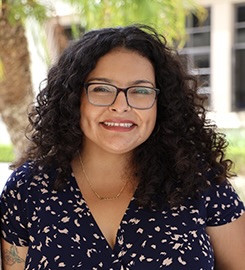
Assistant Professor, Environmental and Ocean Sciences
- Postdoctoral Fellow, Stanford University Doerr School of Sustainability, Earth System Science
- PhD, University of California Riverside, Environmental Sciences
- BS, University of California Riverside, Environmental Sciences
- AS (with Distinction), Riverside City College, Math and Science
- AA (with Distinction), Riverside City College, Social and Behavioral Studies
Claudia Avila, PhD, is a soil biogeochemist investigating carbon dynamics and metal transformations within native and agricultural soils. Claudia is an interdisciplinary researcher guided by environmental justice issues and a passionate teacher. Her research focuses on soils as a resource and the fundamental biogeochemical processes controlling a soil's ability to store carbon and/or release naturally occurring contaminants. She hopes to inspire students to pursue environmental science careers and causes. She teaches EOSC 175 (Sustainability and Climate Change) and EOSC 300 (Environmental Issues) as well as a Soils and Society course. Claudia is building her XingonxDirtSci Lab and welcomes undergraduate researchers looking for lab experience. Please note that the USD EOS department does not have a PhD program.
Areas of Expertise
Soil Biogeochemistry
Scholarly Work
Soils are arguably one of the most important yet overlooked resources on Earth. Soils are living, dynamic bodies of inorganic and organic components that filter water, provide medium for crop and vegetative growth, are used as engineering medium, and are necessary for a functioning ecosystem and society. The components of soil (carbon + metals) are impacted by human activity. Here are two main research themes that motivate the XingonxDirtSci Lab in (1) carbon and (2) metals;
(1) When soils are healthy, in terms of ecosystem services, they recycle nutrients and store carbon. Soils are the largest terrestrial carbon sink and are the medium that provide 475 million metric tons of grain per year in the US alone (USDA. 2019). But human activities, including land use change and agriculture itself, threaten the longevity and carbon sequestering capacity of this resource. Carbon, when stored in soil, enhances soil health where higher carbon content increases a soil’s ability to maintain soil structure resulting in greater infiltration, reduced soil erosion, nutrient retention, and a number of other factors that contribute to maintaining productive agricultural soils. The conversion of native soils for cultivation currently accounts for 10% of global greenhouse gas emissions but will likely intensify as more arable land is degraded (FAO, 2015). In addition, water scarcity resulting from climate change threatens food security which could lead to intensifying malnutrition in already vulnerable regions. Droughts are projected to be more frequent and intense (Marvel et al., 2019) and adaptation to this change through water conservation has become more and more common; however, what are the impacts of these conservation methods on biogeochemical cycling of soil carbon including flux of carbon back to the atmosphere? What effect do droughts have on communities that have less access to agricultural water? What are ways to mitigate the gap in water access? Though Claudia had the chance to explore answers to the first question thoroughly during her graduate career, her long-term goal is to understand and resolve the impacts of drought on agriculture through future research opportunities. Gearing agricultural soil carbon research to enhance soil health in part by enhancing access to information and technology in under-supported communities and nations is a task that her group aims to accomplish.
(2) A ubiquitous component in soils are metals that are derived from the decomposition of rocks and minerals. Many of these metals are redox active, meaning that their behavior changes when they are oxidized and/or reduced. The environment, such as drying and rewetting cycles, can make metals precipitate or solubilize depending on their oxidation state. Both geogenic (rock/soil sourced) and anthropogenic (human made; deposited) metals can be toxic depending on the oxidation state and their fate and transport. As a source of metals, the mechanisms for metal transformations within soils are incredibly important to understand. Fire, among many concerning environmental impacts, can catalyze both beneficial and detrimental effects on an ecosystem. As a postdoc in the Fendorf group at Stanford University, Claudia has worked to understand the role of fire on soils and the environment and, specifically, how does overlying vegetation influence Cr and Ni speciation? How toxic is dust and ash generated from burned soils? How are increasing wildfires (both in severity and duration) mobilizing geogenic contaminants? And most importantly, who is MOST vulnerable to wildfire smoke inhalation?
Although Claudia uses soil biogeochemistry as a tool, her central research focus is environmental justice and aims to build community around identifying and resolving issues at the intersection of people and environment and to understand the role that soils play in society.
Office Hours
| Section 50 | |||
| 9/01 - 12/11 | M | 9:30 am - 11:30 am | SCST 266 |
| 9/01 - 12/11 | T | 11:00 am - 12:00 pm | SCST 266 |
| 9/01 - 12/11 | W | 1:30 pm - 3:30 pm | |
| Section 70 | |||
| 9/01 - 12/11 | M | 9:30 am - 11:30 am | SCST 266 |
| 9/01 - 12/11 | T | 11:00 am - 12:00 pm | SCST 266 |
| 9/01 - 12/11 | W | 1:30 pm - 3:30 pm | |