

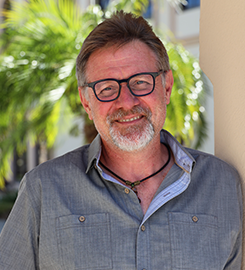
Chair and Professor, Anthropology
- PhD, Rice University, Cultural Anthropology
- BA, Cornell College, History and English
David’s research, teaching, and community service focuses on humanistic approaches to resilient food systems, human-environment relationships, globalization and craftwork, sustainability as a theoretical framework and practical approach to addressing contemporary issues of social inequality, and participatory media creation with community groups. This agenda emerges from his earlier work on human perceptions of the landscape, and from the work he did for some years in the environmental nonprofit sector. He pursues these interests in a number of directions, including research within the United States and in Ecuador. He has conducted major community scholarship research on sustainable regional food systems in the Western Great Lakes. He regularly conducts fieldwork in Saraguro, Ecuador, and creates participatory media pieces (films and digital stories) with the indigenous community he works with there. In addition, he has taught participatory media making, specifically digital storytelling, to community groups. David’s current research focus is on the transdisciplinary intersection of the arts, sciences, social sciences, and humanities as we grapple with environmental and social challenges created by globalization and climate change.
Working with Students and Community
David strongly encourages undergraduates at any level with an interest in doing hands-on ethnographic research to work with him. Reach out with ideas.
In addition, David invites community organizations who might see value in anthropological work in collaboration with him and students at USD to contact him. You can see an example of a student-community partner project at this link: Making a Garden, Making Community, Linda Vista Community Garden.
Professional Experience
Co-editor Emeritus of Anthropology and Humanism, a publication of the American Anthropology Association (served as Editor-in-Chief from 2015-2020)
Founder, The Participatory Ethnography Lab/Studio@USD
Board Member (Starting Nov. 2021), Society for Humanistic Anthropology
Board Member (Starting Nov. 2021), Society for Visual Anthropology
2021-2022, Convener (with Dr. Jennifer Liang, Dr. Katy Chapman, and Dr. Peter Levin), “Transdisciplinary Engagements with Contemporary Indigenous Thinkers,” Faculty Collaborative, Institute for Advanced Study
Scholarly Work
Books
2023: The Companion to the Anthropology of Performance, co-editor with Lauren Miller. Routledge.
2015 With the Saraguros: The Blended Life in a Transnational World. University of Texas Press.
2001 Places in the World a Person Could Walk: Family, Stories, Home and Place in the Texas Hill Country. University of Texas Press.
Articles,
Book Chapters, Reviews & Reports
Forthcoming 2024: “Attending to Animal Stories, Listening for Lines.” In The Creative Ethnographer’s Notebook: Exercises for Writing, Visualizing, Sounding and Performing Data, edited by Melisa Cahnmann-Taylor and Kristina Jacobsen. Routledge.
2023: with Lauren Miller, “Introduction: Performance as Anthropological Focus and Framework.” In The Companion to the Anthropology of Performance, edited by Lauren Miller and David Syring. Pp. 1-17. Routledge.
2023: “Propia de Saraguro: Performance in an Indigenous Andean Community Creating 21st Century Vitality.” In The Companion to the Anthropology of Performance, edited by Lauren Miller and David Syring. Pp. 223-239. Routledge.
2023: “Tuning in to Matizada: Attending to Micro-moments of Aesthetic Enculturation.” In Appendix of The Companion to the Anthropology of Performance, edited by Lauren Miller and David Syring. Pp. 506-507. Routledge.
2022: “Exploring the Ecotone of Poetry and Anthropology,” Anthropology News, March 24.
2021: “Humanistic Anthropology: Diverse Weavings about the Many Ways to Be Human.” Chapter in The SAGE Handbook of Cultural Anthropology, edited by Lene Pedersen and Lisa Cliggett
2020: “Genres, Experiments, and Blog Posts Re‐Curated: Three Edited Volumes on Anthropological Writing.” Review Essay, Anthropology and Humanism 45(2):379-405.
2020: “Golden Animals: A Lyric Essay on Animacy and Resilience.” Anthropologica 62(1).
2014: “Service-Learning, Sustainability and the Need for Cosmopolitan Experiences in Undergraduate Education: A View from Anthropology.” eJournal of Public Affairs Vol. 3(3).
2012: “Exploring the Potential for a More Local Food System in the Western Lake Superior Region.” CURA Reporter 42(3):10-16.
2010: “Defining the Agricultural Landscape of the Western Lake Superior Region: Realities and potentials for a healthy local food system for healthy people.” Report prepared for The Healthy Food, Healthy Lives Institute, Dept. of Food Science and Nutrition, University of Minnesota Twin Cities
2009: “La Vida Matizada: Time Sense, Everyday Rhythms and an Emergent Critique of Globalized Ideas of Work.” Anthropology and Humanism 34(2):119-142. Lead article and cover photo for issue.
2008: Success Stories: Great Lakes Restoration. Prepared for the Great Lakes Aquatic Habitat Network and Fund.
2007: “Sweet Water and Exotic Fish: Ethnographic Reflections of Environmental Imaginations in Ecuador and the Great Lakes.” Anthropology and Humanism 32(1):62-80. Cover photo for issue.
Media
2011-ongoing: Participatory Media Production with the Saraguros of Ecuador. Alternative method of reporting on on-going ethnographic fieldwork using enriched media (photos/videos/sound) to communicate about my research to the public. Video of traditional dances of the Saraguros.
This and other examples may be found on my Youtube channel at: http://www.youtube.com/user/professornmarion/videos.
Areas of Interest
Cultural Anthropology, Ethnobotany, Digital and Participatory Research Methods, Anthropology and Environment, Latin American Cultures, Myth and Sacred Symbol, Cultural Theory for Wicked Problems, Anthropology Senior Seminar, Exploring Sustainability in Ecuador, Exploring Sustainability in Costa Rica
Office Hours
| Section 01 | |||
| 9/08 - 12/11 | W | 1:30 pm - 2:30 pm | Saints Hall 218A |
| 9/08 - 12/11 | T TH | 10:00 am - 12:00 pm | Saints Hall 218A |