
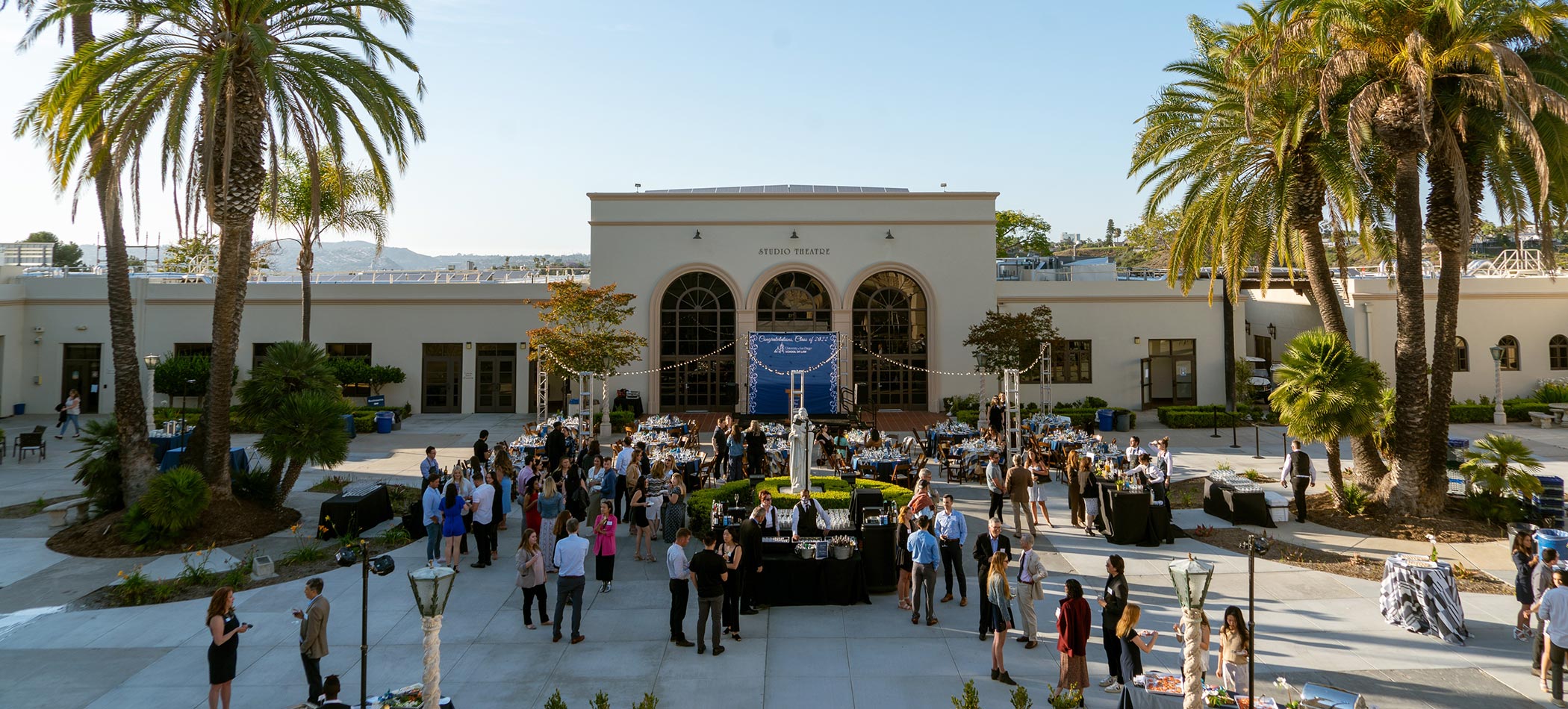
An event on the usd campus

Evolving Doctrine Lecture Series

The Evolving Doctrine Lecture Series was established in 2023 to give modern perspectives on doctrinal lectures. This series aims to provide social and historical context to 1L doctrinal courses and give students a better understanding of past and present impacts of doctrinal law on society, with a focus on marginalized groups. We hope this series will supplement our doctrinal courses by connecting 1L studies to current affairs and socio-legal challenges.

The Evolving Doctrine Lecture Series is generously supported by the Jane Ellen Bergman and Nathaniel L. Nathanson endowments. The Bergman endowment presents opportunities for USD students, faculty, and staff to hear distinguished lecturers speak about issues concerning women, children, and human rights. The Nathanson endowment brings distinguished speakers in the field of constitutional or administrative law or civil liberties and human rights to the University of San Diego to discuss issues of national significance.

October 22, 2026 from 12:00 to 12:50 P.M. in Warren Hall, Grace Courtroom

Khiara M. Bridges

Earl Warren Professor of Public Law at UC Berkeley School of Law

"Letting Die: Black Maternal and Infant Deaths After Students for Fair Admissions

Bridges is a nationally-recognized expert on the intersection of race, class, and reproductive rights. Her scholarship has appeared in the most influential law reviews in the country, including the flagship law journals at Harvard, Yale, Stanford, and UC Berkeley, among many others. She is also the author of three books: Reproducing Race: An Ethnography of Pregnancy as a Site of Racialization (2011), The Poverty of Privacy Rights (2017), and Critical Race Theory: A Primer (2019, 2026). Her fourth book, Expecting Inequity: How the Maternal Health Crisis Affects Even the Wealthiest Black Americans, was released in March 2026.

Bridges graduated as valedictorian from Spelman College, receiving her degree in three years. She received her J.D. from Columbia Law School and her Ph.D., with distinction, from Columbia University’s Department of Anthropology. She speaks fluent Spanish and basic Arabic, and she is a classically-trained ballet dancer who danced professionally in New York City for twenty years before moving to the Bay Area.

She will discuss that at present, black people die from pregnancy-related causes at more than three times the rate of their white counterparts, and black babies die at twice white babies' rate. This talk examines the legality of race-conscious efforts to diminish these racial disparities in maternal and infant mortality — ultimately concluding that Students for Fair Admissions, which struck down the race-based affirmative action programs at the University of North Carolina and Harvard College, does not foreclose many race-conscious efforts to save black maternal and infant lives.

Spring 2027

TBD

Pamela S. Karlan

Kenneth and Harle Montgomery Professor of Public Interest Law; Co-Director, Supreme Court Litigation Clinic at Stanford Law School

A productive scholar and an award-winning teacher, Pamela S. Karlan is co-director of the school’s Supreme Court Litigation Clinic, where students litigate live cases before the Court. One of the nation’s leading experts on voting and the political process, she has served as a commissioner on the California Fair Political Practices Commission, an assistant counsel and cooperating attorney for the NAACP Legal Defense Fund, and (twice) as a Deputy Assistant Attorney General in the Civil Rights Division of the U.S. Department of Justice (where she received the Attorney General’s Award for Exceptional Service – the department’s highest award for employee performance – as part of the team responsible for implementing the Supreme Court’s decision in United States v. Windsor). Professor Karlan is the co-author of leading casebooks on constitutional law, constitutional litigation, and the law of democracy, as well as numerous scholarly articles. She is co-reporter on the American Law Institute’s forthcoming Restatement on Constitutional Torts.

Before joining the Stanford Law School faculty in 1998, she was a professor of law at the University of Virginia School of Law and served as a law clerk to Justice Harry A. Blackmun of the U.S. Supreme Court and Judge Abraham D. Sofaer of the U.S. District Court for the Southern District of New York. Karlan is a member of the American Academy of Arts and Sciences and the American Law Institute.

April 15, 2027 from 12:00 to 12:50 P.M.

Elizabeth Hidalgo Reese

Associate Professor of Law, Stanford Law School

Elizabeth Hidalgo Reese, Yunpoví (Tewa: Willow Flower) is a scholar of American Indian tribal law, federal Indian law, and constitutional law focusing on the intersection of identity, race, citizenship, and government structure. Her scholarship examines the way government structures, citizen identity, and the history that is taught in schools, can impact the rights and powers of oppressed racial minorities within American law.

Professor Hidalgo Reese is a nationally recognized expert on tribal law and federal Indian law and frequent media commentator on developments within the doctrine, particularly at the U.S. Supreme Court. Professor Hidalgo Reese is also a prominent Native policy expert and advocate. From 2023-2024, she served as the Senior Policy Advisor for Native Affairs at the White House, working within the Domestic Policy Council. In that role, she advised President Biden on all matters involving Tribal Nations and coordinated, spearheaded, or shaped Native policy development across federal agencies. Hidalgo Reese oversaw the Administration’s preparations for the Supreme Court’s decision in Brackeen v. Haaland, assisted with the designation of Baaj Nwaavjo I’tah Kukveni National Monument, advised the President on supporting the Haudenosaunee Nationals Lacrosse Team’s participation in the Olympics, and helped develop and shape Executive Order 14112: Reforming Federal Funding and Support for Tribal Nations To Better Embrace Our Trust Responsibilities and Promote the Next Era of Tribal Self-Determination.

Prior to joining SLS, she served as the Harry A. Bigelow Teaching Fellow and Lecturer in Law at the University of Chicago. Previously, Professor Hidalgo Reese worked at the National Congress of American Indians where she supported tribal governments across the country as they implemented expanded criminal jurisdiction over non-Indians under the 2013 Violence Against Women Act. Her comprehensive five-year report on the tribal prosecutions thus far—which documented not only outcomes and unforeseen complications but the surge of tribal law innovation brought on by expanded jurisdiction—has been widely cited everywhere from Congress to Supreme Court briefs. Hidalgo Reese began her legal career as a civil rights litigator at the NAACP Legal Defense and Educational Fund where she led a desegregation case in one of the largest school districts in Florida and worked on the challenge to Alabama’s Voter ID law.

Hidalgo Reese served as a law clerk to Judge Diane Wood on the United States Court of Appeals for the Seventh Circuit and Judge Amul Thapar on the Eastern District of Kentucky Court (now the Sixth Circuit). She also was a fellow at the Senate Judiciary Committee, and at the U.S. Department of Justice in the Civil Rights Division’s Appellate Section.