
What is Active Learning?
Watch faculty from different practices explain what active learning is inside their classroom.
Why Use Active Learning?
Watch the video to see the data behind why faculty use active learning in the classroom.
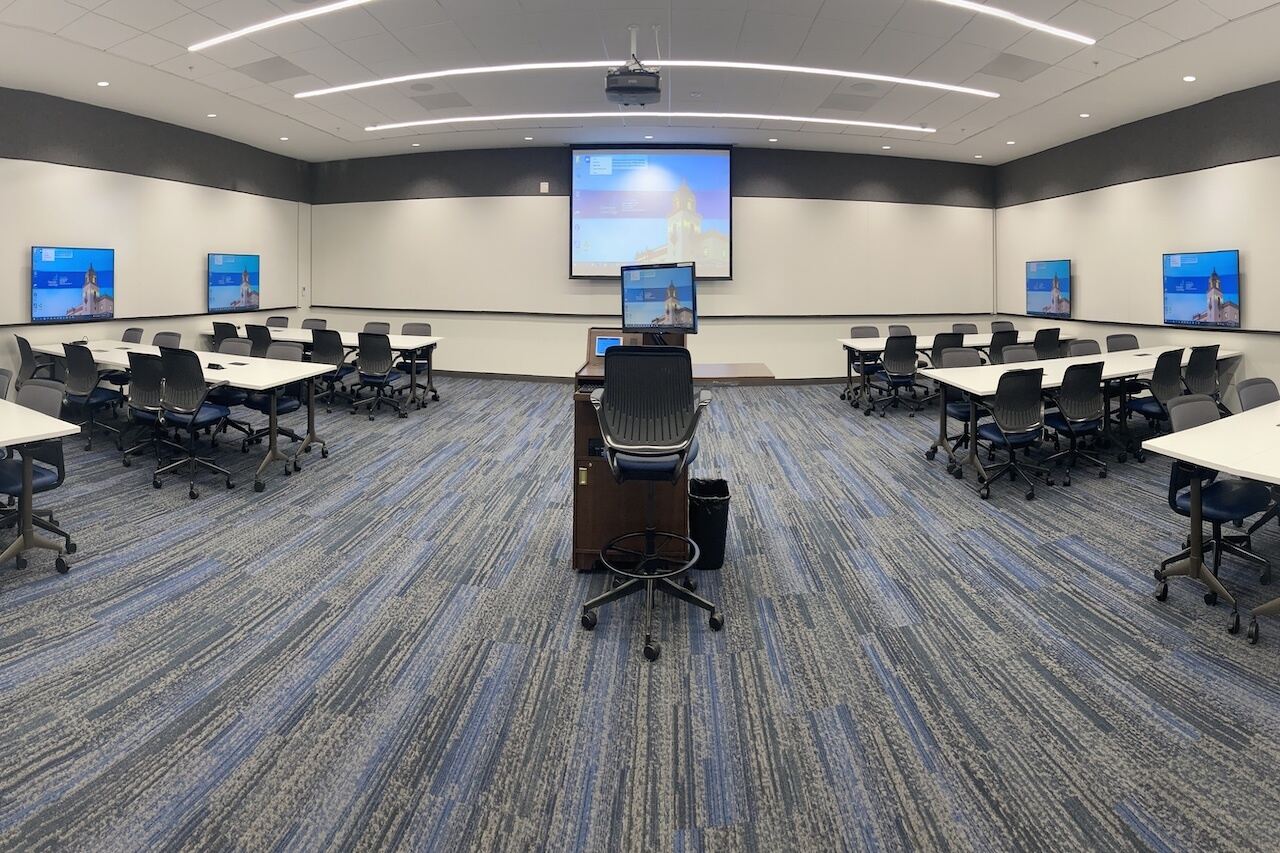
KCBE Active Classroom
Active Learning Spaces are located in Knauss Center for Business Education rooms 102, 104, 106, 124, and 324.
Tell me and I forget, teach me and I may remember, involve me and I learn
Active learning is a term used to describe instructional strategies that promote students’ active participation in knowledge construction processes. Such strategies may include hands-on activities, brief writing, and discussion assignments, problem-solving tasks, information gathering and synthesis, question generation, and reflection-based activities, among others. Together, these approaches seek to engage learners’ higher-order thinking skills through the production and articulation of knowledge, as opposed to through the passive transmission of facts and ideas.
With the flipped classroom idea, the model essentially ‘flips’ the two fundamental stages of traditional learning. Instead of students being taught the foundations of a topic in the classroom and then using homework and assignments to expand and explore the topic individually, the flipped classroom model requires students to acquire foundational knowledge through self-study at home before using class time to delve deeper into the topic under the guidance of the teacher. The teacher can then use class time for discussions, debate, or do one of the many ideas we have listed below, to engage learners and deepen knowledge.
Both of these learning concepts should be explained to your students before classes begin so they know what is expected of them for the semester.
Below we have gathered links to other resources for examples of how teachers are accomplishing active learning and flipping the classroom. We have included teaching tips and best examples of what to do in the classroom, for homework, and other ideas.
Active Learning
Why use Active Learning?
Although lecture remains the predominant mode of instruction, more and more instructors are recognizing the benefits of making the classroom learner-focused. Active learning helps students reflect on their understanding by encouraging them to make connections between their prior knowledge and new concepts. Often, active learning tasks ask students to make their thinking explicit, which also allows instructors to gauge student learning.
Features of an Active Learning Classroom:
- Teaching strategies that require participation and collaboration
- The ability of instructors to monitor student activities and coach effectively
- Technology that allows instructors and students to share and present seamlessly
- Flexible furniture arrangements and multiple writing surfaces to support team activities
Ten Benefits of Active Learning
- Students are more likely to access their own prior knowledge, which is a key to learning.
- Students are more likely to find personally meaningful problem solutions or interpretations.
- Students receive more frequent and immediate feedback.
- The need to produce forces learners to retrieve information from memory rather than simply recognizing a correct statement.
- Students increase their self-confidence and self-reliance.
- For most learners, it is more motivating to be active than passive.
- A task that you have done yourself or as part of a group is more highly valued.
- Student conceptions of knowledge change, which in turn has implications for cognitive development.
- Students who work together on active learning tasks learn to work with other people of different backgrounds and attitudes.
- Students learn strategies for learning itself by observing others.
- Activities like discussion, idea mapping and debate require students to construct knowledge through higher-order thinking (such as recalling, applying, analyzing, evaluating, synthesizing, and verbalizing concepts). This contrasts with knowledge passively transmitted to students solely via listening, transcribing, memorizing, and reading.
- An instructor of mathematics sets a challenging problem, and tasks student teams to work out the problem on their individual whiteboards. Teams then share their process, solutions, and how they overcame challenging moments.
- An instructor of public health disperses a case study to student groups through digital displays and laptops at each table. Student groups work through the case study simultaneously, pausing to share their strategies and findings with the class.
- An instructor of English copies different quotations from literature on whiteboards around the room. Students are asked to roam the room and note similarities and differences in tone, style, and imagery. Students return to their tables and discuss their findings. Then students perform a jigsaw, rearranging their groups and sharing their previous groups’ discussions in their new circles.
- Clarification pauses and collaborative note-taking - The instructor pauses during the lecture and asks students to take a few minutes to summarize in writing what they have just learned and/or consolidate their notes. Students may then exchange notes with a partner to compare, in order to catch key ideas that a student might have missed or misunderstood. The instructor can then field clarifying questions.
- Retrieval practice / one-minute papers - At the start of class, students write down major points they can remember from the previous class. Similarly, at the end of class students write down key takeaways and consider logical next steps. The instructor might review responses in class and encourage questions.
- Think-pair-share activities - Students work individually on an active learning assignment or formative assessment activity (such as one-minute papers or an example problem). They then compare their responses with a partner and synthesize a joint solution, and then share it with the entire class.
- Demonstrations - Students predict the outcomes of a demonstration. After the demonstration, the instructor asks them to discuss the observed result and how it may have differed from their prediction. The instructor then follows up with a detailed explanation.
- Polls - Utilizing PollEverywhere or some other audience response system, the instructor poses a multiple-choice question. Students work on the problem individually or in think-pair-share small groups, and use clickers or online surveys to report their answers. The instructor shows the class distribution and explains the solution.
- Large-Group Discussion - Students discuss a topic in class based on a reading, video, or problem. The instructor may prepare a list of questions to facilitate discussion.
- Sequence reconstruction - The instructor gives students jumbled steps in a process, and asks them to work together to reconstruct the proper sequence. More ideas about this and related group work techniques can be found here.
- Error identification - The instructor provides statements, readings, proofs, or other material that contains errors. Students must find and correct the errors.
- Concept map - Students are provided with a list of terms and must arrange the terms on paper, drawing arrows between related concepts and labeling each arrow to explain the relationship. Alternatively, students can use software like MindMeister (link is external) or bubbl.us to project their maps on a screen or share with the class.
- Categorizing grids - The instructor gives students several important categories and a list of scrambled terms, images, equations, or other items. Students sort the terms into the correct categories.
- Interactive Lecture - The instructor breaks up the lecture at least once per class for an activity that lets all students work directly with the material. More information on effective lectures can be found here.
- Active Review Sessions - The instructor poses a question that students work on in groups or individually. Students are asked to show their responses to the class and discuss any differences.
- Inquiry Learning - The instructor presents a major concept and then asks students to make observations, pose hypotheses, and speculate on conclusions.
- Brainstorming - The instructor provides a topic or problem and then asks for student input. After a few minutes, the instructor asks for responses and records them on the board.
- Role Playing - Students use dramatic techniques to get a better idea of the concepts and theories being discussed. They might stage dialogue in a case study, act out a scene in a literature class, produce a mock debate of a historic issue, or present (within a safe context) problematic social responses requiring discussion.
- Jigsaw Discussion - Students are divided into small groups that discuss different but related topics. Students then shuffle to create new groups with one student from each of the original groups. In these new groups, each student is responsible for sharing key aspects of their original discussion. The second group must synthesize and use all of the ideas from the first set of discussions in order to complete a new or more advanced task. More information about this and related discussion techniques can be found here.
- Learning goals - Students create a list of skills and topics they would like to cover in the course, and air any concerns they have about the syllabus and course design. Instructors can also share and explain their own intended learning outcomes and invite students to add their own. Often, activities like these can be particularly effective in the first class / first five minutes of a class session.
- Ice breakers - Students learn each other’s names and interests to facilitate group/partner work later in the semester.
- Case studies - The instructor engages students with real-life stories that help them integrate their classroom knowledge with their knowledge of real-world situations, actions, and consequences. Case-based learning is common in management, law, and medicine, but can be utilized in a variety of settings.
- Experiential Learning - The instructor facilitates site visits that allow students to see and apply theories and concepts. For example, students can visit museums or libraries, engage in field research, or work with the local community.
- Self-Assessment - Students receive a quiz (ungraded) or a checklist of ideas to assess their understanding of the subject. Instructors can consider formative assessment, which offers opportunities for reflection during learning and class, or summative assessment, which examines knowledge gained at the end of a unit or term.
- Student-generated test questions - The instructor provides students with a copy of learning goals for a particular unit and a figure summarizing Bloom’s Taxonomy. Groups of students create test questions corresponding to the learning goals and different levels of the taxonomy.
- Peer Review - Students complete an individual homework assignment or short paper. Before the assignment is due, students submit one copy to their partner or group and then provide each other with critical feedback.
- Active Learning | Learning Activities | Teaching Guides | Teaching Commons | DePaul University, Chicago
- Examples of Active Learning Activities (queensu.ca)
- Active Learning | Center for Educational Innovation (umn.edu)
- Interactive Classroom Activities | Sheridan Center | Brown University
- Active Learning: Teaching Guide » Center for Teaching & Learning | Boston University (bu.edu)
- Active Learning Spaces: Lessons Learned in the United States | EDUCAUSE
- Active Learning Classrooms
Being a student is easy. Learning requires actual work.
The Flipped Classroom
A flipped classroom is structured around the idea that lecture or direct instruction is not the best use of class time. Instead, students encounter information before class, freeing class time for activities that involve higher-order thinking.

Some of the benefits of a flipped classroom are:
- students take responsibility for their learning
- students learn rather than encounter material in class
- there are more opportunities for higher-level learning
- it does not waste time transferring information to students when that information is available to them in books or online
- instructors work more closely with students, getting to know students better and providing better assistance
- increased collaboration between students
Many teachers think that creating sources for students to use outside of class is the most difficult part of implementing a flipped classroom. However, most of the benefits of a flipped classroom depend on what happens in the classroom instead of lecture. That makes it necessary to first plan how you will use class time before you begin to look for resources for students to use at home. A flipped classroom model involves a lot of work by students outside of class. Students will resent this work if they do not see how it frees class time to do things that help them learn.
- Decide how you will use your class time and design those activities.
- Find or create resources for students to use at home. These could be readings, audio files, websites, or videos. You do not need to create these sources, but you must make sure that all students have a way to access these materials. If you create the materials for students to use at home, use their feedback to revise them. You can create podcasts and lectures using Panopto at home or in the USD Faculty Teaching Studio.
- Teach students how to use the material at home. Unlike when they are in a lecture, students cannot ask questions as they arise so making note taking especially important. Make sure students have an incentive for doing the work on their own.
Goals for different use of class time
- Are there class sessions where you always run out of time?
- Are there active learning exercises (case discussions, simulations, debates, group work) that you wish to incorporate but can’t fit in because of time constraints?
Student engagement
- On what materials have students been resistant, bored, or unmotivated to engage?
- On what aspects of your course would it be helpful to surface and engage students’ relevant prior knowledge and background?
Managing heterogeneity
- On what class concepts do the differences in background and preparation of your students create the biggest problems?
- What material do you wish students could engage with at their own pace, or return to multiple times?
- What component skills or background information do you wish students could be exposed to before engaging with more complex topics in class?
Taking advantage of digital
- On what material would it be helpful to give students an opportunity to practice and get feedback?
- Where might there be material in your class that would benefit from visualization – that would be more engaging or more understandable to students if it had more visual dimensions to it?
Step 1. Planning
The material you select for your flip, and the way you conceive of the learning experience will help guide the creation, assessment, and active learning steps. We suggest using the following fillable worksheet to assist in planning your first flip. Undertake this step about four weeks before your teach date for the flipped material, and select a chunk of about 20 minutes of lecture content for your first flip.
The question that is most relevant to this first step, Planning, is number 3.
What are the learning objectives for the online portion of your flipped class learning experience? List 1-3 of the most important learning objectives.
It may help to ask yourself: What do you wish all students were familiar with when they step into the room? Try to be specific. For example:
“I wish my students were familiar with tools for decision analysis” may be too broad.
“I wish my students could all build and solve a decision tree with 1-2 decision nodes, using expected values” is more helpful for an initial flipping project. You can cover the topic in ~20 minutes, assess it accurately, and build on it in class.
The learning objectives you identify will form the backbone of your flip. Think about how students will come to know/understand/be able to do each objective. This backward design step will help ensure that the online materials you create directly connect to your more important instructional goals.
The answers to other questions on the planning worksheet will be inputs into later steps of the flipping process.
Step 2. Create Your Flipped Class Content
The next step is to create your flipped class content, often in the form of content videos, and post this material online for students to access. This should happen about three weeks before your expected teach date, to leave time for the process of creation, and any learning curve around the tools you intend to use.
We suggest four potential methods for creating digital explanations of course content: slidedecks with narration; tablet writing; screencasting; and talking head video. These techniques use common office/home technology and a few pieces of software, and can be "mixed and matched" or used independently. Best practices in multimedia and learning suggest chunking your lecture content into digestible parts. Research also suggests keeping video clips to 6 minutes or less.
Step 3. Gather Data to Use in Teaching
One of the most exciting aspects of the flipping approach is the opportunity to gather useful information via the digital content delivery method. By incorporating data collection, you are building a "window" into the online experiences of your students, and this can help you to meet students exactly where they are. Think about data collection about two weeks before the teach date for the flipped segment, to make sure you have time to work through the potential uses of the data. For example, if you suspect the data might show that students have difficulty with a certain concept, you might decide to work on some new teaching materials to cover that concept in class.
Step 4. Engage in Active Learning
The primary purpose of flipped class pedagogy is to make better use of class time. We suggest considering new in-class strategies to engage in active learning about one week before the teach date for your flip.The Carl Wieman Science Education Initiative offers a worksheet on creating class activities.
Step 5. Reflect, Revise, Retry
The final step is to take stock of your first experience with the flipped technique. The notes you make about this experience may inform future revisions or inspire new flipped experiments. We recommend undertaking a reflective process directly after you teach your first flip, while the experience is fresh and front-of-mind.
The flipped classroom has the potential to open up class time and encourage interactive learning in a way never before possible. For many classes, that interactivity creates the chance to put the students in the spotlight — and ask them to really show what they know.
Panopto makes flipping the classroom easy, with flexible video presentation software that teachers and students alike can use to record lectures and presentations anytime, anywhere, from any device, and share them instantly with students, teachers, and peers on a secure, searchable video library.
Try adding a quiz to your videos or use a Panopto video as a quiz in Canvas!
Explore these Panopto videos to spark more ideas on using Panopto in a flipped classroom:
- Myths and Facts About Flipped Learning | EDUCAUSE
- 8 Flipped Classroom Examples - ViewSonic Library
- Guides » Center for Teaching & Learning | Boston University (bu.edu)
- 7 Unique Flipped Classroom Examples: Which Approach Is Best for You? (panopto.com)
- The Best Way to Record Class Lectures Online
- Flipped Classrooms
- Active Learning spaces: Lessons Learned in the United States
- Harvard - Flipped Classrooms
- THE HARVARD KENNEDY SCHOOL'S "FLIPPING KIT"
- FLIPPING THE CLASSROOM" FROM VANDERBILT'S CENTER FOR TEACHING