
Frequently Asked Questions
Please utilize the following buttons to navigate to FAQs specific to prospective students, current students and general questions.
Prospective Students
Academics
- Small, seminar-sized classes (capped at 20), allowing for more interactive discussions and projects.
- Deep dives into fascinating subject matter. We offer a challenging, enriching and interdisciplinary curriculum that will prepare you for excellent careers, graduate school and/or professional programs.
- Direct interaction with exceptional faculty in and outside the classroom, allowing for the kind of intellectual and personal relationships usually reserved for graduate school.
- The unique chance to conduct your own original research for your Honors Thesis and to publish it in USD's digital library.
- The opportunity to present your Honors Thesis publicly at USD's Honors Colloquium.
- Access to one-on-one advising from the Honors Program staff.
- Early priority registration, giving you a better chance to enroll in highly sought-after classes.
- Opportunity to live in the Honors Living-Learning Community (LLC) during your first year.
- Extracurricular activities offered by the Honors Program, such as speakers, student-faculty gatherings, excursions and social events.
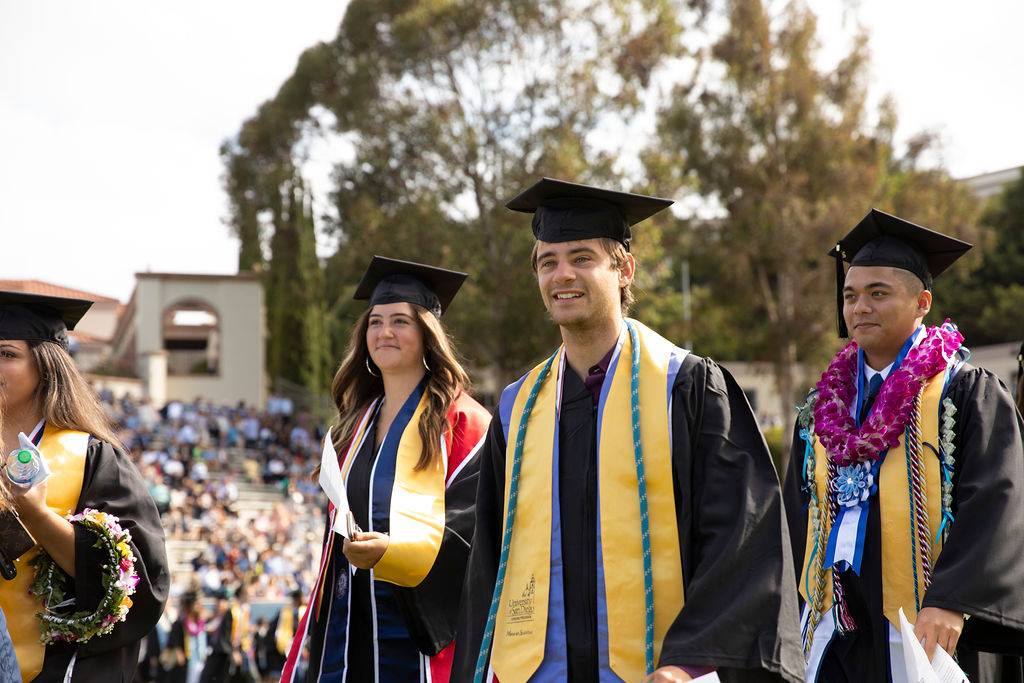
- Recognition at Commencement with an Honors Diploma, as well as participation in special Honors ceremonies and receptions.
Students navigate the program in many different ways, but on average, Honors students take one Honors course each semester.
Honors courses are special because they are smaller, allowing professors to give more time to individual students. All Honors courses (single instructor and team-taught) are capped at 20 students, which allows for thoughtful, sophisticated classroom discussion. Honors courses are not designed to be more work; quality rather than quantity separates Honors from non-Honors courses. To learn more about what makes a class Honors, please reference our What is an Honors Course handout.
The Honors curriculum generally fits into a student's Core Curriculum, and in some instances, one's major or minor. Therefore, Honors classes are not considered "extra" classes.
Most (but not all) majors offer Honors courses, but not every semester. Because there are many more majors than there are Honors classes in a given semester, some students may have little opportunity to take an Honors class in their major. However, nearly every class offered in the Honors Program fulfills at least one Core Curriculum requirement, making honors classes attractive to both majors and non-majors alike. Moreover, Honors team-taught classes are intended to move students out of their disciplines to engage with topic areas beyond their existing educational background. In this way, students grow intellectually and reap the benefits of a liberal arts education.
Yes, Honors students have access to early registration based on the number of units completed (not including units in progress). In general, senior Honors students register before other seniors, junior Honors students register before other juniors, etc. However, some students might have enough units to register ahead of their class level. For instance, a second-year student might be considered a 'junior' based on accrued units.
We post the early registration chart in our weekly emailed newsletter (Honors Weekly Mail) so that students know exactly which time/day they are eligible to register for classes. (All Honors students automatically receive the Honors Weekly Mail in their @sandiego.edu email inbox. If you are not receiving this weekly email, please let us know.)
Most students do at least as well in their Honors courses as in their non-Honors classes, and most find their Honors courses to be among the very best they take at USD.
We understand that circumstances may occur that cause a student to have a GPA lower than the 3.4 benchmark. If a student's cumulative GPA falls below 3.4, he or she is given another semester to improve and to meet with the director to discuss any extenuating circumstances which led to a lowered GPA. Most students successfully raise their GPAs and complete the program in good standing.
To graduate from the Honors Program, every Honors student must complete an Honors thesis project. The scholarly activity that constitutes an Honors thesis is conducted in conjunction with a faculty member in the student's major field of study, and the presentation of this work generally occurs in the last two semesters of the student's career at USD. Most students find their thesis projects to be their favorite part of their Honors experience; the chance to work on one's own original project in close collaboration with a faculty mentor is an invaluable experience as an undergraduate.
Absolutely. In fact, we encourage it by waiving units from Honors Program graduation requirements for students who participate in semester-long study abroad program. Please note that because these units are waived, not earned, they do not count towards the 124 required units to graduate from USD. We simply reduce the number of Honors units that students must complete to graduate from the Honors Program.
Some students cannot study abroad for a full semester, but they might take a course over Intercession or Summer. We allow students to receive Honors credit for a short-term study abroad class taught by a USD faculty if the student petitions to contract the course. (This option is only available once during your time at USD). Please go here to learn more about the Honors Option Contract.
Admissions
Are you the kind of person who finds yourself asking questions that don't have easy answers? Do you appreciate conversations that reveal complexity and diversity of opinions? Do you enjoy spending time with motivated, curious and engaged peers? If, so you are the type of student who would thrive as a member of USD's Honors community.
We seek motivated, compassionate and intellectually curious students who will benefit from a liberal arts-grounded, interdisciplinary-focused Honors curriculum. Involvement in community, school and leadership activities and evidence of a sustained desire to do excellent academic work are the most important indicators of a potential Honors student's ability to succeed in the program.
High school seniors who have been accepted to the University of San Diego are eligible to apply in the Spring prior to entering USD. Students receiving the Alcalá Merit award will find the application materials on their USD portal. All other students should send a brief email to honors@sandiego.edu to request the application. The Honors Program reviews Honors applications within 2-3 weeks of their submission. We accept approximately 100 incoming students.
We realize there are many wonderful students who either miss or do not receive the initial invitation to apply, so we offer a second round of admissions in the Spring once students are on campus. To apply mid-year, students contact the Honors office in the Fall semester to fill out an application. We review their Honors application, current grades at USD and a letter of recommendation from a USD faculty member. If admitted, we work with students to add an Honors course to their Spring schedule.
Students accepted mid-year thrive in the Honors Program. We waive one (1) Honors unit for these students, which helps them graduate in a timely manner. The main difference in joining mid-year versus Fall is that students admitted mid-year live in a different LLC their first year; we do not disrupt their housing arrangements/roommate assignments. That said, students admitted mid-year are invited to participate in all spring Honors events and activities.
Yes, transfer students can apply for the Honors Program, and they follow the mid-year admissions procedures. Students are generally not admitted to the program after their third semester, unless satisfactory arrangements can be made to ensure that they will be able to complete the Honors curriculum by May of their senior year. It's especially helpful if transfer students bring Honors credits from their previous school. A maximum of 13 Honors units taken at another college or university may be counted toward the USD Honors diploma. If you are transferring to USD and wish to apply for the Honors Program, please email honors@sandiego.edu.
Yes, we have a diverse group of majors. The Honors Program includes undergraduate students from the College of Arts and Sciences, Knauss School of Business and Shiley-Marcos School of Engineering. There is only one Honors Program at USD.
Housing
First-year students in the Honors Program join the Illuminate Living Learning Community (LLC). The Illuminate LLC allows incoming Honors students to establish an immediate sense of community with faculty and fellow residents. The idea is for students to live and learn together. They participate in various LLC activities, coordinate study groups in their dorms, attend classes together and develop close friendships that last throughout their college career.
Within the Illuminate LLC, first-year Honors students take two Honors LLC courses tied to the "Illuminate" theme: one in the Fall semester and another LLC course in the Spring semester. These LLC courses are offered within various departments across the university, and they all fulfill at least one Core requirement. For many students, these LLC courses also offer the chance to explore a major or field of study in which they are interested. Find more information about the Illuminate LLC linked courses.
Please note that the instructor for students' Fall LLC course serves as their academic advisor until they declare their major. First-year students who enter mid-year may choose to take a Spring Honors LLC course if they wish, but are not required to do so.
Honors first-year students live together in the Illuminate Living Learning Community. This residential community is located on the main USD campus, providing students a short walk to class, dining areas, Founders Chapel and Copley Library.
All incoming first-year Honors students are required to live together in the Illuminate LLC. Because students' first Honors course at USD is an LLC course, it is directly tied to their residential LLC experience. This allows students to develop fast and close relationships with their Honors cohort and advance in the Honors Program from the start. Being in the Illuminate LLC is frequently students' favorite part of their first-year experience at USD.
Even though incoming Honors students are automatically placed in the Illuminate LLC, they still must complete a housing application over the summer. Residential Life, not the Honors Program, handles all issues regarding housing, roommate placement and other residential affairs.
The housing application requests information about personal, academic and social preferences to better understand students' preferred living environment. Residential Life uses the information students provide to create roommate matches for all first-year students. Therefore, students do not choose their roommates themselves. This is the same process for all incoming first years, not just the Honors students.
Residential Life uses advanced software to find the most compatible person possible for students within their LLC. If a student is uncomfortable with his/her roommate situation, he/she can request a change with Housing. However, changes will not be made until after the first two weeks of the semester. Any room changes that are processed during the academic year will be completed within the same LLC/housing area. Changes are not guaranteed by Residential Life.
Please visit Residential Life for more information on the room change request process.
Special Opportunities
Unfortunately, the Honors Program does not offer any additional scholarships at this time. However, once at USD, students can apply for the Lawrence Hinman Research Grant in their junior and senior year to help fund their Honors thesis projects. Additionally, we encourage students to seek funding through the Office of Undergraduate Research and Associated Students.
Every first-year Honors student gets placed into an Honors Fall LLC course. The instructor of that course serves as their academic advisor until students declare their major. So from the very beginning, Honors students have a faculty advisor in Honors. After the first year, it is very common for Honors students to consult with multiple advisors (especially if they have more than one major or minor).
Additionally, Honors students benefit from one-on-one advising from the Honors Program staff, who can help guide students through the Honors curriculum.
Yes! This trip is led by student guides in the Honors Program and is specifically for first-year students enrolled in the Honors Program. Please find more details about Honors Pre-O on the Outdoor Adventure website.
Current Students
Advising
We hold mandatory advising meetings for all grade levels in the Fall and Spring semesters. Be sure to read the Honors Weekly Mail e-newsletter to find the dates and times. (All Honors students automatically receive the Honors Weekly Mail in their @sandiego.edu email inbox. If you are not receiving this weekly email, please let us know). Students can also drop by the Honors Office to meet with the Honors Program administrators. You can find their office hours in the Honors Weekly Mail, or you can email honors@sandiego.edu to schedule an advising appointment. Lastly, visit Honors Curriculum for more information.
Students can browse upcoming Honors team-taught courses on our website. Honors courses taught by single instructors are posted as they become available, frequently not until the semester before they will be offered. As registration approaches, the Honors Program publishes a comprehensive list of single instructor and team-taught courses in the Weekly Mail newsletter. (All Honors students automatically receive the Honors Weekly Mail in their @sandiego.edu email inbox. If you are not receiving this weekly email, please let us know.) When searching for Honors courses on the Portal, students should remember to filter by 'attribute' and not by 'department.' If one searches by department (Honors), only team-taught courses and the Honors thesis seminar (e.g., HNRS 324/325, HNRS 495) will show up. When students search by attribute (Honors), they will find all Honors courses including single instructor classes (e.g., PHIL 110, ENGL 240).
A team-taught Honors course is one in which two individual faculty members from different disciplines co-instruct a single Honors course, offering students an interdisciplinary understanding of a common topic or problem. These classes provide a multi-faceted perspective on life, as issues and problems in the real world are seldom addressed by a single subject. Due to the creative and experiential nature of these courses, many students list team-taught courses as one of their favorite features of the Honors Program.
The Honors Program typically offers four (4) team-taught courses each semester, all of which fulfill the Core requirement for Integration (CINT). Some team-taught courses also fulfill other Core or major requirements. You may review the list of upcoming Team-Taught courses, including information about the Core or major requirements they may fill.
All Honors team-taught courses are upper-division, so students must have earned at least 45 units to enroll. Every team-taught course is 4 units. Students must enroll in the department section for which they wish to earn credit. For instance, if a student is taking Women in Islam and Confucianism (HNRS 364/365) and wants to satisfy Core THRS, he/she should enroll in HNRS 365, the Theology and Religion Studies (THRS) section. Credit distributions are posted on the Honors Program website, as well as in Honors Weekly Mail.
No, a non-Honors team-taught course does not satisfy your Honors team-taught course requirement. Students can certainly take a non-Honors team taught, but the course would not earn Honors credit.
A linked Honors course constitutes an individual Honors course, taught by single instructor, that is linked together with another Honors course(s) in a different major based on a common theme, concept or problem. Linked courses are scheduled simultaneously so that students in each linked Honors class might meet together for interdisciplinary group projects, joint discussions, guest speakers and other common activities.
Although any Honors student enrolled in a linked Honors class will earn Honors units, only students who declare their major under the 2019 catalog or later will be able to earn units toward the Honors Program requirement for interdisciplinary courses by taking a linked class.
The Honors Option Contract converts one regular 3-unit course at USD into an Honors course. In order to make the class "Honors," the professor works with the student to create an additional project or experience for the student to move deeper into course material.
In addition to contracting one non-Honors course on campus to convert it to an Honors course, students may also contract one short-term study abroad experience (e.g., Intercession, Summer) if the 3-unit course is taught by a USD faculty member.
Learn more details about the Honors Option Contract.
See instructions on how convert a regular course into Honors.
Fill out form to convert a regular course into Honors.
We post the early registration chart for Honors students in the Honors weekly newsletter, so that students know exactly which time/day to register for courses. (All Honors students automatically receive the Weekly Mail in their @sandiego.edu email inbox. If you are not receiving this weekly email, please let us know.)
Remember that early registration is based on the number of units students have completed, not including those units that are in progress. In general, senior Honors students register before other seniors, junior Honors students register before other juniors, etc. However, some students might have earned enough units to register ahead of their class level. For instance, a second-year student might be considered a 'junior' based on units earned.
Honors classes are frequently misplaced in Degree Works. If Honors units are not reflected properly in your Degree Works audit, please email honors@sandiego.edu with your USD student ID number and specify the issue. Be sure to include the course title/s and semester/s taken.
Yes! Many Honors students participate in study abroad, which we support by waiving four units of Honors credit for semester-long study abroad programs, thus reducing the number of Honors units that students must complete to graduate from the Honors Program.
Note: Students must still earn the requisite 124 total units to graduate from USD.
When students enroll in HNRS 495: Honors Thesis Seminar, the Honors Program conducts a Degree Works audit. At that time, we adjust students' unit requirements to reflect their study abroad experience.
We realize that some students cannot or do not wish to spend a full semester abroad. Instead, they might take a class or two abroad over Summer or during Intercession. We allow students to contract a short-term study abroad class taught by a USD faculty to receive Honors credit. In these instances, students can earn 3 Honors units by contracting a short-term study abroad class, (not to be confused with the unit waiver received for a semester of study abroad).
We understand that circumstances sometimes cause a student to have a GPA lower than the 3.4 benchmark. Students who drop below a 3.4 cumulative GPA are placed on probationary status, which means they are given another semester to improve. During this time, they meet with the Director to discuss strategies and resources that they may find helpful. Most students successfully raise their GPA and complete the program in good standing.
Students who are unsure about completing the Honors Program should consult their academic advisor and the Honors Office. Sometimes students don't realize they can finish the units, so it's helpful to meet with the Honors administrators to discuss options.
If students are certain they cannot or do not wish to complete the Honors Program, they need to email honors@sandiego.edu to formally withdraw. The Honors Program Office can only remove students' Honors affiliation on Degree Works and with the USD Registrar if they fill out the Honors Exit Questionnaire.
Thesis Research
Honors thesis projects offer students the chance to focus on a particular topic of interest, passion or conviction. These projects may take the form of a scholarly paper, original writing (plays, poems, short stories), artistic composition or design, science experiment, a curricular module or other project that meets academic standards for originality in a student's major discipline. Many students build on projects they began in other classes, in a lab or field experience, or choose a topic they in which they are personally or intellectually invested. Each student selects a thesis mentor to help guide them as they design, execute and write up their thesis projects. All thesis projects are formally completed in the semester in which students enroll in HNRS 495 Honors Thesis Seminar, and they are publicly presented at the Honors Colloquium.
Some students create entirely new projects, while others build on projects they have begun in other courses or in independent research or work experiences. Students who choose to extend an existing project must add a unique component or level of depth/analysis that qualifies the Honors Thesis as a distinctive intellectual project, and they must explain this extension in detail in the Prospectus (turned into the Honors Director as part of HNRS 495 seminar).
Because students are expected to complete the Honors thesis project in either fall or spring of their senior year, starting the research process early is strongly encouraged, and typically yields higher-quality work. Some students conceptualize their projects as early as their first or second year at USD while in a lab or class. Others formalize their projects after engaging more deeply in their major course work over their sophomore and junior year. In all cases, working on the Honors thesis project at least by the summer preceding the senior year is highly advised.
While students formally complete, turn in and orally present their Honors thesis project as part of the enrollment requirements for HNRS 495 Honors Thesis Seminar, they are encouraged (though not required) to enroll in an independent study, research course or a senior project course associated with their major prior to their senior spring. The goal is to make significant progress on the thesis research before enrolling in the HNRS 495 thesis seminar.
To learn more about the thesis experience, students should attend the Honors advising meetings in the Fall and Spring. We also have created various resources to guide students through the thesis process. Be sure to check out our advising handout for students.
Yes, students can earn up to three (3) Honors units for research supporting their Honors thesis project. Before enrolling in HNRS 495: Honors Thesis Seminar, students are encouraged (but not required) to enroll in either an independent study (499) or research course (496) in their major.
Alternatively, some majors offer a senior project or capstone course that can serve as a springboard for their thesis work. Please check with your own advisor to determine which is the right choice for you.
Honors students may receive up to three (3) Honors units for research going towards their Honors thesis project by:
- Enrolling in an independent study (499) with their thesis advisor. Students fill out the independent study form in their discipline with their thesis advisor before the add/drop period ends. Honors student must check “Yes” at the top of the form, where it asks if you are a member of the Honors Program, and if you’d like to receive honors credit for the 499.
If the 499 is with a faculty advisor in the College of Arts and Sciences, contact the Executive Assistant of that department to initiate the approval process via Docusign.
If the 499 is in ENGR or BUSN, electronically fill out the form and collect signatures from the advisor and department chair before sending it to Honors for our signature. Be sure to copy everyone who signs the form when you email the final document to the Dean (listed below).
- Shiley-Marcos School of Engineering: Dr. Rick Olson, SMSEadvising@sandiego.edu
- USD School of Business: Dr. Kacy Hayes, sb.studentsuccess@sandiego.edu
- Enrolling in a research course in their major (496). If a 496H does not exist and students are conducting research for their Honors thesis (e.g., a capstone class), they may be eligible for Honors research units. Contact the Department Chair, faculty advisor and the Honors Program to find out if this is possible, since not all classes are eligible. If it is possible to receive credit, the Honors Program will contact the registrar to make changes to students' DegreeWorks audit. The earned research units will show after the semester has been completed (and the final grade is posted).
- Expanding upon a project completed in the capstone course in their major. Students should consult their faculty advisor and the Honors office to determine if this is an option. If so, students provide the Honors office with the following information: Student ID number, capstone course title and semester taken. The Honors Office notifies the Registrar, who adds the "H" attribute to the capstone course at the end of the semester (after the final grade is posted).
Yes, Honors students are eligible to apply for the Lawrence Hinman Research Grant in their Junior and Senior year to help fund their Honors thesis projects. Award winners receive up to $1,000, which can be spent on research supplies, a presentation for a conference or travel to present at a conference. Students can apply for the Hinman Grant in the Fall or Spring. Application deadlines will be posted in the Honors Weekly Mail.
Students can also seek alternative funding sources for their thesis projects by consulting the Office of Undergraduate Research and Associated Students.
Students are free to select an Honors thesis advisor of their choice. Sometimes the fit is obvious because a student is already working with a faculty member in a lab, in the field or on a project. Other times, a student might identify a potential thesis advisor based on his/her academic work and approach him/her to discuss the thesis project idea.
When looking for an advisor, students might consider the following questions:
- Do I enjoy working with this faculty member? Do we communicate effectively and have a good rapport?
- Is this faculty member in my field of study? Will s/he be interested in my project and able to guide me through this research process?
- Will this faculty member be on campus? Is s/he able to commit to this role right now?
Some of these questions will be best answered by going to the faculty member's office to have an informal conversation. It can be helpful to bring a copy of the thesis advisor handout, so faculty understand what that role entails. We recommend having these conversations as early as sophomore year.
If students have no idea who might serve as a suitable thesis advisor, they might try:
- Attending Creative Collaborations, USD's undergraduate research conference, in the spring. Explore projects in your field/s and ask students about their research experience. Who was their advisor? How did they meet? Then connect with those faculty.
- Visiting faculty in their major department during office hours to learn about their research. Many faculty members are working on an exciting project and looking for student researchers.
- Browse the Honors thesis library in the Learning Commons 201. Flip through projects in your field to see which faculty members advised students. Then connect with those faculty.
- Talk to the Honors Director and other faculty about your interests; they may be able to offer suggestions.
Students should solidify their advisor-advisee relationship with their Honors thesis advisors no later than the spring semester of their junior year.
Many students complete interdisciplinary projects for the Honors thesis. In these situations, students can work with more than one faculty advisor. However, they must select one faculty member to be their primary advisor, who will sign off on the final project.
Although students are free to work with researchers at other schools or institutions, every Honors student must have one USD faculty member as his or her official Honors thesis advisor. This thesis advisor will sign off on the final thesis project.
The major tasks of an Honors thesis advisor include:
- Guiding students to an appropriate topic/research question that can be accomplished within a year-long project
- Pointing students to appropriate resources for project, including grant opportunities
- Instructing student about the guidelines of their discipline (e.g., writing style, discipline specific requirements for a research paper)
- Meeting with student regularly, providing advice and guidance throughout the process
- Providing feedback on thesis drafts
- Helping students prepare an oral presentation for a general audience
- Attending the presentation or reviewing a recording of the presentation
- Advising and evaluating 496 or 499 credit (if applicable)
In order to graduate from the Honors Program, students must complete HNRS 495: Honors Thesis Seminar. This course is offered in both the Fall and Spring semesters. Students may take the seminar for either 1 or 3 Honors units; the course is the same class regardless of the number of units offered. We provide the 1 unit option for financial purposes, since some students are enrolled in many other units.
The seminar aims to facilitate students' progress on, and ultimately the completion of, the Thesis Project. It also provides instruction on and opportunities for public presentation of the thesis project at Creative Collaborations and the Honors Colloquium.
Theses vary in length and style, depending on the project and the discipline. We encourage students to check out former students' work both by reading examples and attending the Honors Colloquium (see below). We have tangible copies of Honors theses, organized by year and discipline, in the Honors Office. Students can also browse Copley's online catalog, Digital USD, where Honors graduates can publish their work.
The Honors Colloquium takes place in the Fall and Spring semesters. At the Colloquium, students enrolled in HNRS 495 offer a 15-minute presentation on their thesis. They develop the presentation so that it is comprehensible and accessible to a general (educated but non-expert) audience comprised of Honors Program students, faculty and guests. Students may have to spend time educating the audience on background material or the jargon of the field before discussing the heart of their research. Thesis advisors can help students determine how to organize their presentation and determine what is most important to share.
Networking
Our new platform, T.E.A.M. (Torero Employer and Alumni Mentors), offers easy ways for both alumni and students to network, share career advice, and learn about best practices and professional opportunities. The Career Development Center at USD has designed this platform exclusively for the Torero community worldwide. The site is integrated with LinkedIn, which makes joining easy and quick.
T.E.A.M. is a dedicated online network where you can connect with Toreros in your city or industry of interest, choose to mentor (or be mentored) through a "flash" meeting or for a longer sustained period of time, access skilled students and alumni to fill open positions, and share exciting new professional opportunities including internships and shadowing experiences.
Visit mentoring.sandiego.edu to get started - it only takes a couple minutes to register. When you sign up, please make sure to join the USD Honors Program under the "Groups" page to receive updates and share your news.
There are many ways to get involved and to meet other students in the Honors Program. Honors students are always welcome to come hang out in the Honors Office in Learning Commons 201. We have a cozy lounge with a Keurig coffee machine, a beautiful seminar room that doubles as a study space. We also host various events throughout the year (e.g., Tea with the President, brown bag lunches, alumni panels, major mixers, holiday parties, dinners with the director), so be sure to read the Honors Weekly Mail and check the Honors home page to RSVP. (All Honors students automatically receive the Honors Weekly Mail in their @sandiego.edu email inbox. If you are not receiving this weekly email, please let us know.)
General
A linked Honors course is a single instructor Honors course that is linked together with another Honors course in a different major based on a common theme, concept or problem. It offers a unique form of interdisciplinary learning, while allowing students to earn units in a single discipline. Linked courses are scheduled simultaneously, so that students in each linked Honors class meet together a few times a semester for group projects, joint discussions, guest speakers and other common activities.
See Linked Courses
If you enroll in one of these courses, not only will you earn three (3) Honors units of Core credit, but you will also satisfy one of the requirements for interdisciplinary coursework in Honors.We hope to offer more linked courses in coming semesters and will post them on the Honors website as they are added. Additionally, when you browse through the list of classes with the Honors attribute, the "Syllabus" tab will contain information that indicates which classes are linked and which are single-instructor.
- If you choose to select the 2019-2020 catalog with the new changes, bear in mind that you will be selecting ANY AND ALL changes in the 2019-2020 catalog across all university units and majors that are relevant to you.
- This means, for example, that if your major or minor has added or changed required courses in the new 2019-2020 catalog, you will need to abide by those new requirements as well. It's not uncommon for major/minor requirements to change between catalog years, and those changes can be important.
- Students in their 1st and 2nd year might consider switching catalog years if they anticipate the possibility of enrolling in a linked class.
- Students who plan to take two (2) team-taught courses have no good reason at this point to switch their catalog year.
- We recommend that juniors and seniors do not switch to the 2019-2020 catalog without very good reason, because you are more likely to encounter new requirements in your major/minor by switching catalog years. You are encouraged to speak with your faculty advisor to learn what might change in 2019-2020 in your major(s)/minor(s) to see if switching catalog years would have detrimental implications.
No. It's fine to take one of the Honors classes that is linked even if you are under a 2015-2018 course catalog. However, should you wish to count the linked course as one of the interdisciplinary requirements for Honors, you will need to switch catalog years (and thus, you will also have to accept all of the other changes in your major/minor that are implemented in your major(s)/minor(s) for 2019.
You can switch catalog years almost any time between now and graduation, and you can get a preview of your new degree requirements using the "What-If" function in Degree Works. Usually, it's easier to switch as soon as you know which catalog year you'd like to declare under. No mixing requirements between catalogs!
Talk to your advisor in your major(s) and minor(s) to determine if any changes are being made to their curriculum in the new catalog 2019-2020. If nothing will change, then you may want to switch. If there are changes, consider whether these are desirable for you or not, and determine the best course of action. Either way, you are highly encouraged to consult with your faculty advisor before switching catalog years. If you have any remaining questions, please stop by the director or assistant director's office hours in the Honors Program Office in the Learning Commons 201, or email honors@sandiego.edu.