
Art Illuminated II
The Conflicts that Shape Us
On view in the Honors Program Suite, Learning Commons 201
January 26 - May 15, 2023
At a time when global conflicts are overwhelming us, this exhibition acknowledges the uncertainty that international events have imposed upon students. The three works presented as part of Art Illuminated: The Conflicts that Shape Us speak to the impact of global events and act as a call to change the world. More importantly, they reflect how our generation is defining itself amidst the unpredictability of the state of the world and its future. Most current USD students, including ourselves, were born in the context of September 11th and grew up during the United States’ “global war on terror” in the Middle East. Our global struggles have only multiplied: the COVID-19 pandemic, racial injustice, political divergence in America, the subsequent January 6th insurrection at the U.S. Capitol, the war in Ukraine, and the ongoing effects of climate change and natural disasters. Our goal in presenting these works is to acknowledge these events, explore their influence, and emphasize how our generation is equipped to enact positive change, despite mounting challenges. We aim to speak to the hope of our generation and inspire USD students to see themselves as a significant part of the conversation for a better future.
Art Illuminated II: The Conflicts that Shape Us is curated by Sofia Fouroohi-Martin ('23), Mary Katherine Riley ('25), and Jillian Whitcomb ('23)
Past Projects
Art Illuminated I
On View from Fall 2021 - Spring 2022, Honors Program Suite
In October of 2020, Drs. Susannah Stern, director of USD’s Honors Program, and Derrick Cartwright, professor of art history and director of the University Galleries, pitched a bold new idea to the Honors community. Construction recently wrapped on the university’s new Learning Commons, and the Honors Program was eager to relocate from its humble home in Maher Hall to a spacious new suite. Though at that point it would remain empty for nearly a year due to COVID-19 restrictions, Stern and Cartwright envisioned the modern, light-filled suite as a space for students and faculty to gather, converse and connect with one another. Anticipating the return to in-person campus life, they devised a student-led curatorial project, where students would design an exhibition for the space showcasing works from USD’s print collection. Despite the difficulties posed by the current virtual environment, Stern and Cartwright hoped that this collaborative project would evolve into an ongoing tradition. I, along with a small group of my DAA+AH peers, enthusiastically seized this opportunity.
Keeping in line with the Honors Program mission, our goal was to design an intentional, inclusive, and thought-provoking exhibition. In light of the past summer’s racial reckoning, we decided to feature four compelling works by contemporary BIPOC artists, Fred Wilson, Shahazia Sikander, Khalil-Jibade Huffman, and Leonardo Drew. Hailing from Pakistan to the Bronx, each artist integrates interdisciplinary and cross-cultural influences in their work, challenging us to break through binary modes of thinking. Touching on themes of identity, visibility and humanity, their creations remind us of our interconnectedness with the world, and with each other. My hope is that this exhibition inspires conversation and reflection among both the Honors and the USD community at large, illuminating new perspectives on modern life.
Special thanks to Drs. Derrick Cartwright and Susannah Stern, for initiating this project and for their ongoing support, and to Marielle Krivit, '21 and Jacqueline Crane, '21 for their collaboration and input in selecting these works.
— Juliana Guerra, Class of '22
Arise!, 2004
Fred Wilson (American. b. 1954)
Aquatint with direct gravure
19 7/8 x 23 7/8 in.
Anonymous Gift, PC2016.03.01
A native of the Bronx, Fred Wilson is a painter, sculptor and printmaker whose print work explores contemporary race relations. Created in 2004, Arise! speaks to the experience of invisibility as a Black person existing within the confines of white society. Working with San Francisco’s Crown Point Press, Wilson used spit bite aquatint to create painterly ink splatters evocative of organic molecular structures. They are “pulsing, changing and expanding,” says the artist. Text bubbles orbit the ink spots as if they are in conversation with each other. In the bubbles, Wilson features quotes from Black characters in literature who were created by white writers, from Herman Melville to the controversial French playwright Jean Genet. These statements reflect the often shallow and stereotypical portrayals of Black people in Western culture. Wilson seeks to spotlight marginalized Black voices by taking these characters out of their original contexts in which they are designed to be forgettable. In doing so, Wilson exposes the implicit cultural biases of white authors and audiences, whose literature has far-reaching implications in society through the perpetuation of these harmful stereotypes. Wilson seeks to challenge the biases that engender literary representations of the Black community, while conversely emphasizing the humanity of these characters.
Orbit, 2012
Shahzia Sikander (American, b. Pakistan, born 1969)
Color direct gravure
27 x 21 ¼ in.
Purchased through the Legler Benbough Student Acquisition Fund by Katherine Ayd, Jerome Bwire, Cesar Chavez, Virginia da Rosa, Hannah Day, Ross Ehren, Brittany Ford, Anthony Graham, Dominique Kourie, Morgan Likens, Monika Marambio, Liam Richards, Sean Rivera, Joseph Seiler, and Jake Zawlacki, PC2013.04
Shahazia Sikander describes her print Orbit as an “exercise in improvisation and rediscovery.” To create this intricate print, Sikander layered eight individual drawings that she developed digitally, using a separate copper plate for each layer. Crown Point Press’s proprietary color gravure technique imparts a painterly, watercolor quality to her work. Orbit utilizes a circular composition to emphasize the interconnectedness between disparate images. The layering of images blurs the lines between the “human and the mechanical” and the beautiful and the grotesque, says Sikander. She juxtaposes natural, animalistic figures with man-made objects, such as wheels and musical instruments. The human figures are abstracted and distorted, especially the figure in the bottom right, which appears to have morphed into a monstrous four-legged creature. This print touches on many transcendent themes in Sikander’s work, including human identity, connectedness and power dynamics. As a Pakistani-American artist who self-identifies as a “citizen of the world,” she sees identity as ever-evolving in response to social, cultural and political influences. Layering, a hallmark of Sikander’s style, enables her to break free from binary interpretations of cultural events, symbols and motifs in order to explore them from “more than one vantage point,” she says. Sikander’s embrace of “unexpected juxtapositions” and “interdisciplinary perspectives” manifests in the complexity and nuance of her work, facilitating introspection into our own identities and social relationships.
CPP3, 2015
Leonardo Drew (American, b. 1961)
Color aquatint with flat bite toner transfer
25 × 22 in.
Purchased with funds from the Dean of Arts and Sciences and the John Petersen Print Acquisition Fund, PC2016.24.01
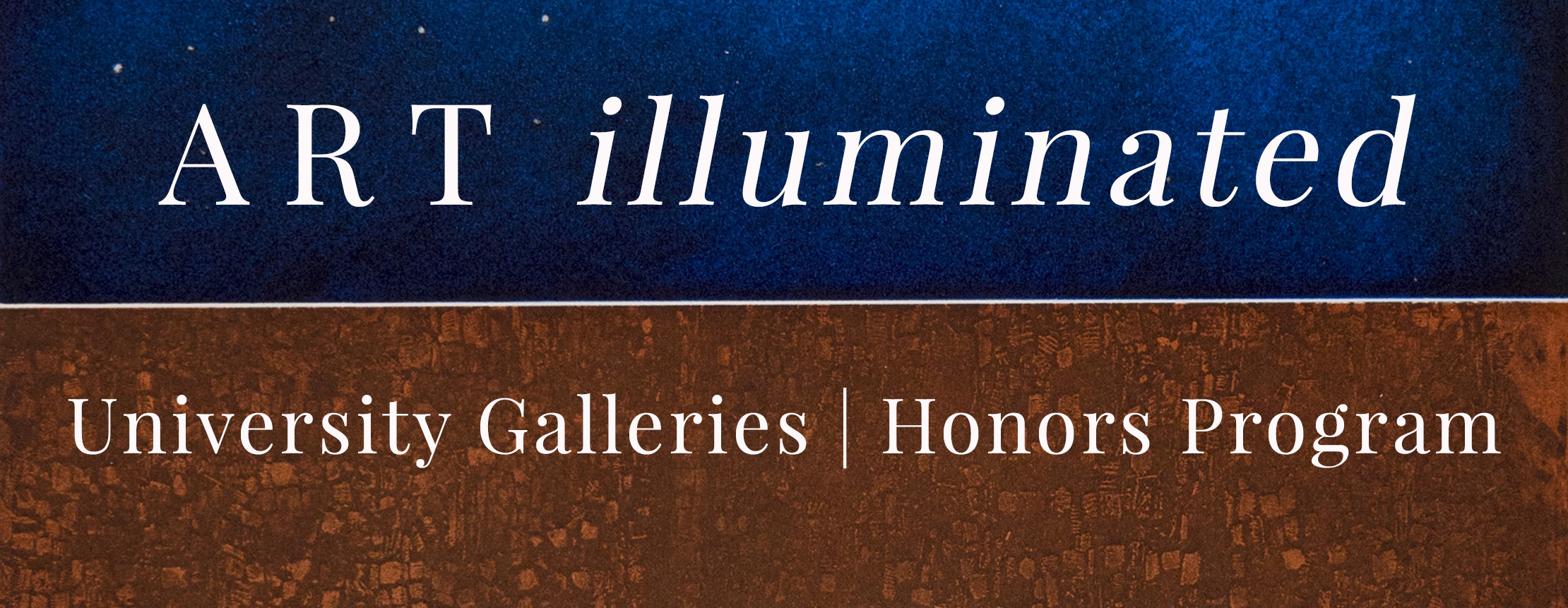
Brooklyn-based sculptor and printmaker Leonardo Drew possesses an ingenious ability to derive beauty from materials in decay. Growing up in an apartment overlooking the city dump of Bridgeport, Connecticut, the eyesore outside his home became an unlikely source of inspiration. Repurposing junk and debris sparked Drew’s interest in evolution, decay and regeneration, which all figure prominently in his body of work. Such themes are evident in CPP3, part of a series of seven color aquatints created in collaboration with Crown Point Press. Employing a symmetrical composition, the print is vertically divided into two distinct halves. The top half is inked in an ethereal, deep teal, speckled with white throughout. The subtle variations in the ink produce regions of dark and light reminiscent of the night sky. In contrast, the bottom half of the print uses a copper-colored ink. This section appears to have a gritty, rough texture, evocative of rusty metal. The juxtaposition of the soft and vaporous and the raw texture suggests that dilapidation and rebirth are inexorably intertwined. As evidenced by this print, Drew is a master at creating the illusion of decay and patina in his work. With its raw, minimalist beauty, CPP3 stands in stark contrast to the hyper-perfected, Photo-shopped images that dominate our social media feeds. Drew’s work gives us permission to abandon our need for perfection and instead, embrace the fact that we as humans, like he says, “are all lived in and weathered.”
Brushstroke, 2019
Jibade-Khalil Huffman (American, b. 1981)
Three-color screenprint
12 ½ x 20 in.
Anonymous Gift, PC2020.18.04
Jibade-Khalil Huffman is an artist and poet, whose enigmatic work integrates themes of visibility, race and memory. His screenprint, Brushstroke, was created in honor of the 2019 LA Art Book Fair. Huffman collaborated with New York’s Printed Matter to produce and sell this print and donated all proceeds to charities that support Black communities. In this cacophonous print, geometric patterns are layered in a patchwork fashion. In the lower right-hand corner, Huffman includes a gloved hand, hinting at a human presence. The hand seems to be polishing a surface with a rag. At the bottom, there appears to be a bucket and some bottles, perhaps containing cleaning supplies. Finally, it looks like the artist took a paint roller to finish his print, creating zig-zagged lines that overlay the composition. Despite its title, the print lacks an expressive, painterly quality. Instead, Huffman favors mechanical, geometric and repetitive patterns, which directly undermine our conception of a brushstroke. This begs the question: what is a brushstroke? How is it created, and by whom? By incorporating images that are associated with cleaning, such as the gloved hand and the plastic bucket, Huffman’s disorienting print suggests a relationship between art and domestic work, both as forms of manual labor. The composition positions the viewer as if the hand inside the print is their own, challenging them to engage with the work in an unexpected way. The viewer embodies the janitor, or the handyman, or the painter whom the print evokes. Huffman’s print directly contradicts the notion that this labor is menial and showcases the dignity of individuals engaged in this type of work.
Juliana Guerra, Class of 2022, Finance
Juliana Guerra is an Honors student majoring in Finance with minors in Art History and French. She worked as an intern in the Print Room in Spring 2021. Beginning in Fall 2021, visit Art Illuminated in the Honors Suite at the USD Learning Commons.