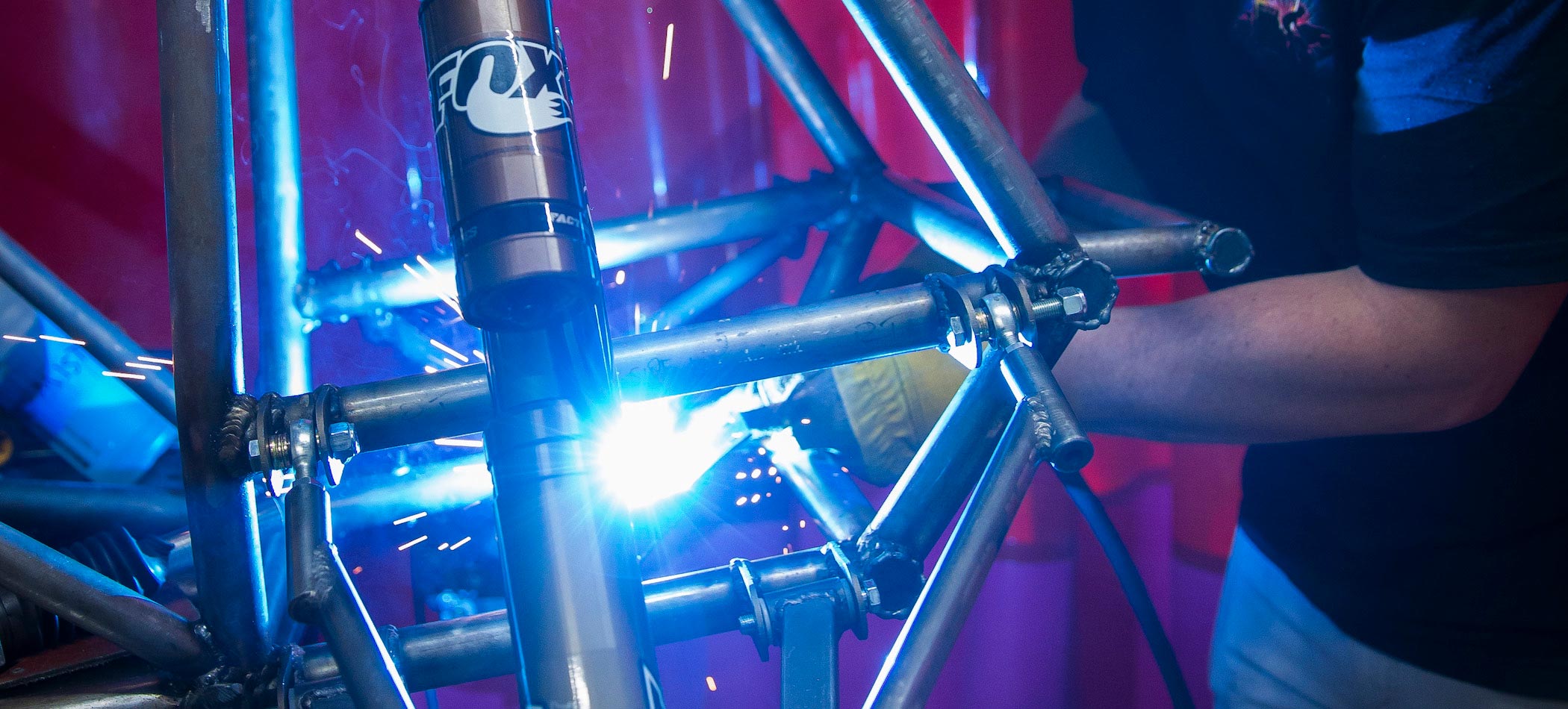
Students building their Baja vehicle

Mechanical Engineering Curriculum

Navigating a path to your academic success.

Explore mechanical engineering courses currently offered

MENG 210

Statics

Units: 3

Equilibrium analysis of particles and rigid bodies using vector analysis of forces and moments in two and three dimensions; free body diagrams; friction; analysis of trusses; distributed forces; basics of shear and moment diagrams; centroids; and moments of inertia. Three hours lecture weekly. Fall and spring semesters. Prerequisites: PHYS 270 and MATH 150.


MENG 260

Introduction to Thermal Sciences

Units: 3

Introduction to basic engineering thermodynamics, fluid mechanics, and heat transfer. Applications to engineering systems. Three hours lecture weekly. Fall and spring semesters. Prerequisites: MATH 151 and PHYS 270.


MENG 294

Special Topics in Mechanical Engineering

Units: 1 TO 4

Special topics seminar in areas of special interest to mechanical engineering. May be repeated for credit with a different topic.


MENG 299

Independent Study

Units: 1 TO 3

Individual project in creative design and synthesis under the general supervision of a participating professor. Project proposal must be submitted and approved prior to enrollment. May be repeated for credit.


MENG 300

Applied Thermodynamics

Units: 3 TO 4

Further developments of concepts from classical thermodynamics. Application of laws of thermodynamics to gas and vapor power cycles, mixtures of gases and vapors, and refrigeration cycles. Moist air analysis and chemically reacting systems. Three hours lecture weekly. Fall semester. Prerequisites: MENG 260.


MENG 311

Materials Science and Engineering

Units: 3

Basic concepts of material structure and its relation to properties; atomic structure; mechanical properties; engineering applications; introduction to semiconductor materials. Prerequisites: CHEM 151, CHEM 151L and MATH 151.


MENG 321

MATLAB Programming and Problem Solving

Units: 1

Computer programming in Matlab with elementary numerical analysis of engineering problems. Arithmetic and logical operations, arrays, graphical representation of computations, symbolic mathematics, solution of equations, and introduction to data structures. Prerequisites: COMP 110; MENG 210.


MENG 350

Manufacturing Processes

Units: 3

Description, classification and analysis of manufacturing processes used in the transformation of different raw materials (e.g. metal, polymers, and ceramics) into consumer or capital goods. Topics include analysis of variables that affect process operations, performance, quality, cost, sustainability and the design of process plans. Prerequisites: MENG 210, MENG 311 or ENGR 311.


MENG 350L

Manufacturing Processes Laboratory

Units: 1

A laboratory course to compliment the lecture material presented in ISYE 350. One three-hour laboratory weekly. Spring Semester.


MENG 351

Machine Shop Practices

Units: 1

Introduction to metal and wood working machines and practices, with emphasis on development of basic competence and safety. Three-hour laboratory weekly.Sophomore standing in Mechanical engineering. Fall semester


MENG 352

CAD Practices

Units: 1

Introduction to 3D computer-aided design of components and assemblies using modern solid modeling tools. Two-hour lecture-laboratory weekly. Sophomore standing in Mechanical engineering. Fall semester.


MENG 360

Fluid Mechanics

Units: 3

Basic laws of fluid mechanics with applications to engineering problems, including dimensional analysis and similitude, boundary layer analysis, internal and external flows, and turbomachinery analysis. Three hours lecture. Spring semester. Prerequisites: MENG 260 and MATH 250 and MATH 310.


MENG 365

Water in California and Israel: Challenges and Solution

Units: 3

Discussion of the hydrological cycle, distribution of water resources, water delivery and treatment infrastructure, as well as wastewater management. Focus on water challenges and solutions in California and Israel. Prerequisites: MENG 360 (Can be taken concurrently)


MENG 370

Mechanics of Materials

Units: 3

Analytical methods for determining stress and strain, torsion, bending of beams, shearing stress in beams, combined stresses, principal stresses, and deflection in beams. Three hours lecture weekly. Spring semester. Prerequisites: MENG 210.


MENG 370L

Mechanics of Materials Laboratory

Units: 1

Laboratory for MENG 370. Three-hour laboratory weekly. Spring semester. Prerequisites: MENG 370


MENG 375

Dynamics

Units: 3

Analysis of dynamics of particles and rigid bodies using vector methods in two and three dimensions. Topics include kinematics and kinetics of translational and rotational motion, energy and momentum methods. Three hours lecture weekly. Fall semester. Prerequisites: MENG 210.


MENG 380

Kinematics and Design of Machinery

Units: 3

Kinematics and dynamic analysis of machinery; mechanism synthesis techniques for function, motion, path generators; and design applications with linkages, cams, and gears. Three hours lecture weekly. Spring semester. Prerequisites: MENG 375.


MENG 381

Designing Your Life

Units: 1

Application of design thinking to personal decision making. Development of oral and written communication, teamwork, and leadership skills. Prerequisites: ENGR 103


MENG 400

Heat Transfer

Units: 3

Heat transfer by conduction, convection, radiation, and combinations thereof. Introduction to heat exchanger analysis and design, along with other applications. Three hours lecture. Fall semester. Prerequisites: MENG 360.


MENG 400L

Heat Transfer Laboratory

Units: 1

Laboratory for MENG 400. Three laboratory weekly. Fall semester. Prerequisites: MENG 400


MENG 410

Alternative Energy Systems

Units: 3

Thermodynamics of traditional fossil fuels and bio fuel combustion. Analysis of solar, wind, wave, and tidal power systems. Introduction to fuel cells and advanced battery technology. Discussion of the current technological limitation of each topic listed above. Three hours of lecture weekly. Prerequisite: MENG 300.


MENG 415

Solar Energy Conversion and Storage

Units: 3

This course introduces principles and technologies for converting sunlight into electricity and heat. This class will study the behavior of photovoltaic solar energy systems and solar thermal technologies. The design and sizing of residential photovoltaic systems will be covered, including estimation of costs, benefits and subsidies. Introduction to hardware elements, effect of renewables on the grid and available electrochemical, thermal and other energy storage devices will be included. Prerequisites: MENG 260


MENG 420

Computer Applications in Mechanical Engineering

Units: 3

Mechanical design and analysis using commercially available solid modeling, kinematics, and FEA computer software. Numerical methods and their applications using root solving, optimization, regression analysis, numerical differentiation and integration will be covered. An introduction to finite difference and finite element methods will also be presented. Two hours lecture and one three-hour laboratory weekly. Fall semester. Prerequisites: (COMP 110 or COMP 150 or ENGR 121), MATH 250 and 310, MENG 352 and 370.


MENG 430

Design of Machine Elements

Units: 3

Analysis and design of mechanical components against failures under steady and fatigue loads. Design applications of various machine elements, such as shafts, bearings, gears, springs, and fasteners. These are integrated into mini-design projects required of all students. Three hours lecture weekly. Fall semester. Prerequisites: MENG 370.


MENG 445

Introduction to Robotics

Units: 3

This course covers introductory materials related to the subject of robotics. The course is designed to encompass theories as well as practices, intended for both the user and the designer of a robotic system. Topics include modeling and analyses of the mechanics of robots, actuators, sensors, and vision systems. Prerequisites: MENG 375


MENG 460

System Dynamics and Vibrations

Units: 3

Analysis and design of dynamic systems in various engineering domains; modeling of mechanical and electrical systems, free and forced responses, time and frequency domain analysis, applications in isolation and control of mechanical vibrations, and vibration measuring instruments. Three hours lecture weekly. Spring semester. Prerequisites: MENG 375.


MENG 462

Topics in Fluid Mechanics

Units: 3

Additional topics in fluid mechanics, including the differential description of fluid flow, its application to channel flow, pipe flow, and boundary layers, scaling of the equations, methods in computational fluid dynamics, and an introduction to turbulence. Three hours lecture weekly. Prerequisite: MENG 360.


MENG 465

Introduction to Computational Fluid Dynamics

Units: 3

This course introduces students to finite volume methods as a means of solving differential equations that arise in fluid dynamics. The conservation of mass, momentum and energy equations will be solved using a software package. Fundamentals of numerical analysis related to fluid mechanics and heat transfer will be reviewed. Applications include modeling laminar and turbulent channel flow, pipe flow, boundary layers, heat exchangers, or flow past an airfoil. Prerequisites: MENG 360.


MENG 470

Finite Element Analysis

Units: 3

Finite element based solutions to engineering problems with an emphasis on elastostatic problems in structural mechanics. The power and pitfalls associated with the finite element method highlighted through practical modeling assignments. Modeling and practical applications using commercial finite element codes. Three hours lecture weekly. Prerequisites: MATH 310 and MENG 351 and MENG 370.


MENG 491

Senior Design Project I

Units: 3

Mechanical engineering capstone design experience in a simulated industrial environment. Students work in teams, in collaboration with an engineering faculty and/or an engineering professional from industry, on an open-ended design project. This involves designing, construction, testing, and evaluation as well as consideration of issues related to ethics, economics, safety and professional practice. Two-hour lecture and four-hour laboratory weekly. Prerequisites: (MENG 311 or ENGR 311) and (ENGL 304 or ISYE 305) and (COMM 103 or NAVS 201 or MILS 301) and MENG 351 (Can be taken concurrently) and MENG 352 (Can be taken concurrently) and MENG 400 (Can be taken concurrently) and MENG 430 (Can be taken concurrently)


MENG 492

Senior Design Project II

Units: 3

Mechanical engineering capstone design experience in a simulated industrial environment that applies and integrates engineering and nonengineering topics.. Students work in teams, in collaboration with an engineering faculty and/or an engineering professional from industry, on an open-ended design project. This involves designing, construction, testing and evaluation as well as consideration of issues related to ethics, economics, safety and professional practice. The course also includes documentation of design project including written reports and oral presentations to multiple audiences. Prerequisites: MENG 491.


MENG 494

Special Topics in Mechanical Engineering

Units: 1 TO 4

Special topics seminar in areas of special interest to current engineering practice in Mechanical Engineering. May be repeated for credit. Prerequisites: upper Division Standing and consent of instructor.


MENG 496

Undergraduate Research

Units: 0 TO 3

Faculty-directed undergraduate research in mechanical engineering. Problem proposal must be submitted and approved prior to enrollment. Written report required. Upper division standing in the MENG major. Prior approval by the department chair is required. May be repeated for credit.


MENG 498

Internship/Co-op Experience

Units: 1 TO 3

Directed upper division level internship/co-operative experience in engineering research, design, development, manufacturing, or the engineering activity. Written report required. Credit not applicable to minimum program graduation requirement. Placement contingent upon approval of participating organization. May be repeated for credit.


MENG 499

Independent Study

Units: 1 TO 3

Individual design or research project under the general supervision of participating professor. Project proposal must be submitted and approved prior to enrollment. May be repeated for credit. Prerequisites: Second semester junior standing in the ME major or consent of instructor.