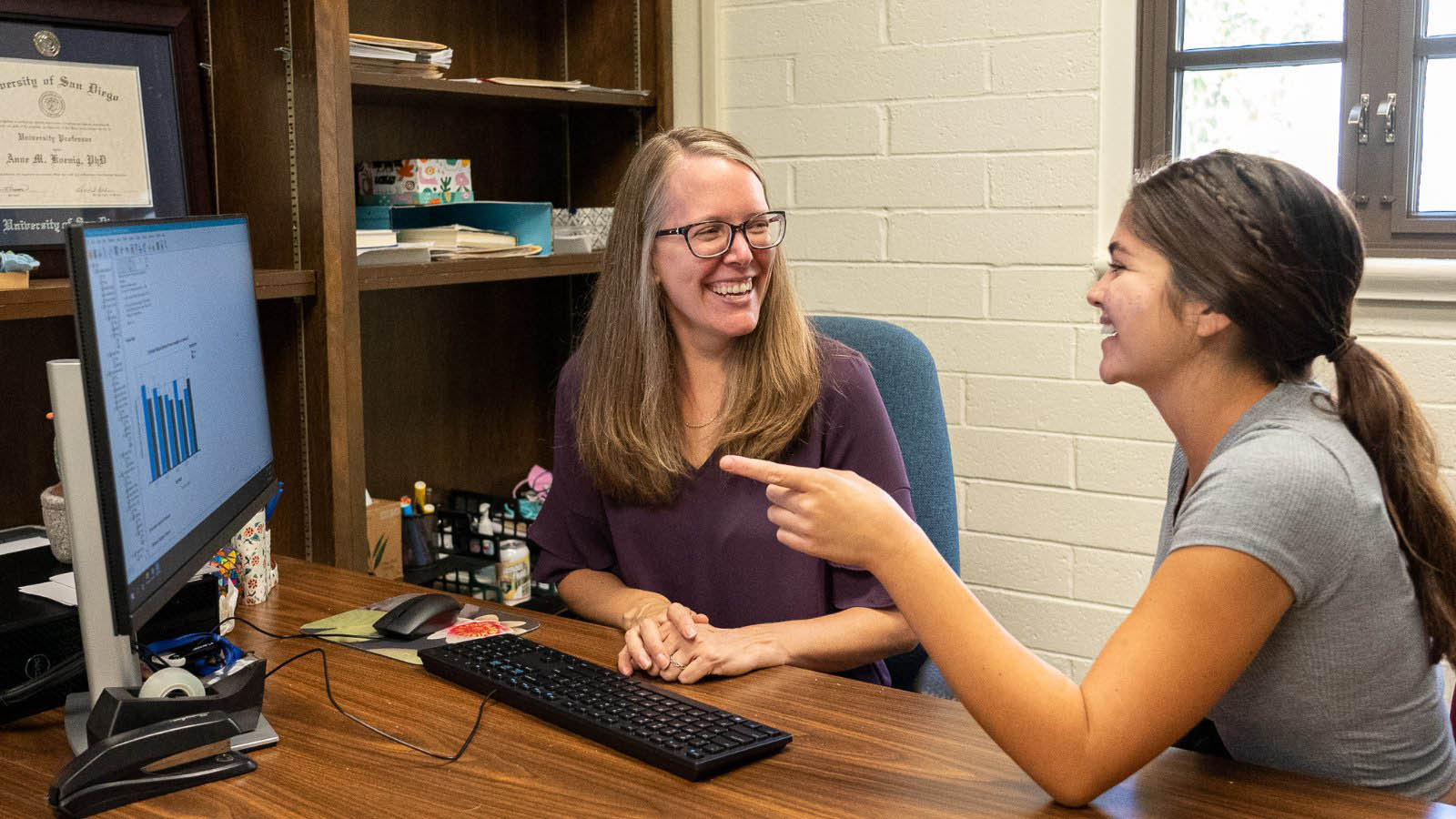
Professor of Psychological Sciences Anne Koenig, PhD, talking with a student in her office.

College of Arts and Sciences

Psychology Curriculum

Discover the Psychology Curriculum

Psychology at USD provides a strong foundation in the principles and practices of psychology within the framework of a liberal arts education. It is designed to give students both the theoretical bases of the discipline and extensive hands-on experience testing theories in practice.

Major

Our psychology major advances your understanding of psychology as a science, a profession and a means of promoting the welfare of people. The psychology major spans many psychology sub-disciplines, including clinical, developmental, social, cognitive and biological, preparing you for various careers. Our majors are offered the opportunity to study through the general major or a major with one of four emphases:

  1. Clinical Mental Health
  2. Child/Human Development
  3. Health and Well-being
  4. Social and Cultural Processes

Review the Major tab below to learn more about your options within the Psychology major.

Minor

The psychology minor provides foundational offerings in psychology concepts and a range of elective courses.

Explore Psychology Courses!

Read class descriptions for the Psychology program on our Psychology Courses page! Not all courses offered below will be available every semester. Make sure to check course offerings on the registration portal for each upcoming semester.

Program Requirements

Each student declares their major(s) and minor(s) under a single catalog of record that is identified on the student's degree audit (available on Degree Works).

The program requirements below are based on the current course catalog and may not be applicable if a student is declared in an earlier catalog.

Find all previous course catalogs on our Archived Catalogs of Record page.

36-37 units

Major

18 units

Minor

Major unit estimates include preparation for the major courses as well as major requirements.

Program Requirements


Psychology majors can choose a general major in Psychology that allows for a variety of psychology elective courses, or a Psychology major with one of four emphases:
Clinical Mental Health
Child/Human Development
Health and Wellness
Social and Cultural Processes

All Psychology majors fulfill the same set of learning outcomes by taking the same preparatory courses and at least one course in each of the five main areas of psychology (biological, clinical, cognitive, developmental, and social psychology) as well as a capstone in psychology. Students without an emphasis can fulfill their major elective requirements with psychology courses of their choosing. Students who select an emphasis within the major will take courses related to the area of emphasis, which also fulfill major requirements. Courses used in an emphasis may not double count toward another major or minor.

All majors are required to complete the following courses.

Preparation for the Major

Required Courses

PSYC 101

Introductory Psychology

3

PSYC 260

Statistics

3

Total Units

6

Major Requirements

A minimum of 30 units of upper division coursework in psychology is required and must be distributed as follows:

Research Methods

3

PSYC 300

Research Methods in Psychological Sciences

Biological

3

PSYC 342

Biological Psychology

Clinical

3

Select one of the following:

PSYC 354

Clinical Psychology: Childhood and Adolescence

PSYC 355

Clinical Psychology

PSYC 356

Psychological Assessment

PSYC 366

Methods of Evidence-Based Psychotherapy

Cognitive

3

Select one of the following:

PSYC 336

Cognitive Psychology

PSYC 339

Human Memory

Developmental

3

Select one of the following:

PSYC 314

Developmental Psychology: Childhood and Adolescence

PSYC 315

Developmental Psychology: Adolescence and Emerging Adulthood

PSYC 316

Developmental Psychology: Adulthood and Aging

PSYC 318

Child Development Across Cultures

Social

3

PSYC 322

Social Psychology

Capstone

3-4

Select one Capstone course from the following:

There are two capstone options for students - a Senior Seminar where students discuss research within an area of psychology and write a literature review and an Advanced Research Methods course where students design a research project. Students interested in graduate school are encouraged to enroll in the Advanced Research Methods capstone to gain more experience in developing research projects.

PSYC 495

Senior Seminar

or PSYC 497

Advanced Research Methods Capstone

Senior Psychology Assessment

PSYC 492

Major Field Test in Psychology

(As part of the department’s assessment program, each graduating senior is required to register for PSYC 492 during their last semester, which requires completion of a major field test in psychology and senior exit survey. A student who fails to do so may be restricted from graduating.)

0

Total Units

21-22

In addition to the above requirements, students must fulfill one set of the following courses.

Psychology Major

The general major in Psychology is suitable for any student interested in different areas of psychology. Students without an emphasis can fulfill their Psychology major elective requirements with psychology courses of their choosing. This allows for a wider variety of elective choices across multiple areas of psychology.

In order to obtain a general major in Psychology, students must satisfy the coursework described above plus an additional 9 units of upper-division courses from the list below.

Upper-Division Electives (9 units) selected from any course listed above, if not used to fulfill a requirement, or from the courses below. 9

Any upper-division PSYC course, if not used to fulfill a requirement above.

MFTS 365

Current Approaches to Peer Assistance

NCB 350

Sensation and Perception

NCB 352

Music Cognition

NCB 360

Stress Management

NCB 378

Human Sexuality

Students wishing to emphasize a defined area of psychology can declare one of four emphases within the Psychology major. In order to obtain a Psychology major with an emphasis, students must satisfy the coursework described above plus an additional 12 units of upper-division courses as listed below.

Psychology Major with an emphasis in Clinical Mental Health

Students choosing an emphasis in Clinical Mental Health are required to take courses from the following foundational and elective lists which concentrate on the application of psychological principles in the service of improving mental health.

The emphasis in Clinical Mental Health within the Psychology major focuses on empirically validated methods for the promotion of mental health as well as the prevention, assessment, and treatment of psychological disorders. The coursework will cover key topics in clinical psychology including assessment, biopsychosocial theories, diagnosis, and evidence-based treatments. This emphasis is particularly useful for students interested in pursuing advanced training in a variety of mental health fields including clinical and counseling psychology and/or psychiatry as well as related fields such as social work, medicine, health policy, and ministry. 

Upper-Division Electives (12 units) selected from the courses listed below, if not used to fulfill a requirement.

Only 1 course can be from outside of PSYC.

12

PSYC 354

Clinical Psychology: Childhood and Adolescence

PSYC 355

Clinical Psychology

PSYC 359

Topics in Clinical Mental Health

PSYC 356

Psychological Assessment

PSYC 366

Methods of Evidence-Based Psychotherapies

PSYC 377

Personality

MFTS 365

Current Approaches to Peer Counseling

MFTS 400

Introduction to Marital and Family Therapy

3 units of PSYC 496, 498, and/or 499 can be used as an elective in the emphasis if the topic of the research or internship focuses on clinical mental health, as approved by the department chair.

Psychology Major with an emphasis in Child/Human Development

Students choosing an emphasis in Child/Human Development are required to take courses from the following foundational and elective lists which concentrate on the developmental aspects of human behavior.

The emphasis in Child/Human Development within the Psychology major focuses on the issues, methods, and tools of developmental science. The coursework focuses on development in humans across the lifespan, with special emphasis on the concepts, frameworks, and empirical findings concerning development within physical, cognitive, and social-emotional domains. This emphasis is useful for students interested in careers desiring understanding of children, families, and adult development such as nursing/medicine, education, clinical/social work, public/health policy, nonprofit outreach, research careers, and more. 

Upper-Division Electives (12 units) selected from the courses listed below, if not used to fulfill a requirement.

Only 1 course can be from outside of PSYC.

12

PSYC 314

Developmental Psychology: Child and Adolescence

PSYC 315

Developmental Psychology: Adolescence & Emerging Adulthood

PSYC 316

Developmental Psychology: Adulthood & Aging

PSYC 318

Child Development Across Cultures

PSYC 319

Topics in Child/Human Development

PSYC 354

Clinical Psychology: Childhood and Adolescence

PSYC 362

Black Families

EDTE 310P

Educational Psychology

SOCI 311

Sociology of Families

3 units of PSYC 496, 498, and/or 499 can be used as an elective in the emphasis if the topic of the research or internship focuses on child/human development, as approved by the department chair.

Psychology Major with an emphasis in Health and Wellness

Students choosing an emphasis in Health and Wellness are required to take courses from the following foundational and elective lists which concentrate on the application of psychological principles in the service of improving health and wellness.

The emphasis in Health and Wellness within the Psychology major focuses on physical and mental health and wellness for the betterment of the individual, their community, and society. Course options include coursework that focus on physical health and wellness, such as courses on health psychology and sleep, and those that focus on mental health and wellness, such as courses on positive psychology and habits. This emphasis is useful for students interested in pursuing careers in health and wellness, such as physician’s assistant, occupational therapy, physical therapy, nursing, medicine, and health policy. In addition, students interested in teaching or working with clients would benefit from the training offered in the health and wellness emphasis.

Upper-Division Electives (12 units) selected from the courses listed below, if not used to fulfill a requirement.

Only 1 course can be from outside of PSYC.

12

PSYC 345

The Science of Sleep

PSYC 343

Latine Health Psychology

PSYC 349

Topics in Health and Wellness

PSYC 370

Social Psychology and Health

NCB 360

Stress Management

SOCI 315

Health and Society

3 units of PSYC 496, 498, and/or 499 can be used as an elective in the emphasis if the topic of the research or internship focuses on health and wellness, as approved by the department chair.

Psychology Major with an emphasis in Social and Cultural Processes

Students choosing an emphasis in Social and Cultural Processes are required to take courses from the following foundational and elective lists which concentrate on the influence of social and cultural influences on thoughts and behaviors.

The emphasis in Social and Cultural Processes within the Psychology major focuses on the basic science of social psychology and cultural influences on behavior as well as the application of social psychological principles to human cognition and behavior. Topics include interpersonal interactions, emotions, conformity, attitudes, stereotypes, and cooperation. This emphasis is useful for students interested in careers helped by an understanding of social and cultural influences on behavior, including careers in marketing, business, education, law, sport and social work as well as those interested in graduate programs in social psychology.

Upper-Division Electives (12 units) selected from the courses listed below, if not used to fulfill a requirement.

Only 1 course can be from outside of PSYC.

12

PSYC 318

Child Development Across Cultures

PSYC 324

Cross-Cultural Psychology

PSYC 326

Organizational/Industrial Psychology

PSYC 329

Topics in Social and Cultural Psychological Processes

PSYC 330

Psychology of Gender

PSYC 362

Black Families

PSYC 364

Sports Psychology

PSYC 370

Social Psychology and Health

PSYC 374

Psychology and Law

COMM 325

Interpersonal Communication

COMM 460

Persuasion and Influence

MGMT 309

International Comparative Management

POLS 315

Political Psychology

SOCI 303

Race and Ethnic Relations

SOCI 316

Social Psychology: Sociological Perspectives

3 units of PSYC 496, 498, and/or 499 can be used as an elective in the emphasis if the topic of the research or internship focuses on social and cultural processes, as approved by the department chair.

Students can take a maximum of 4 experiential units towards the Psychology major (e.g., PSYC 491, 496, 498), and a maximum of 6 are applicable to the 124 units required for graduation. 

For students interested in graduate work in psychology obtaining field and research experience is an important consideration. Those who anticipate completing a PSYC 499 Independent Study research project should begin that work in the first semester of their senior year.

Due to the number of shared courses, students with a major in Psychology are not eligible to double-major in Cognition and Behavior or in Neuroscience.

Recommended Program of Study, Psychology

The recommended program of study is intended as a guide to students in planning their college program. It is not expected that students will adhere rigidly to the sequence of suggested courses. For example, a student may take FYW 150 in the second semester of the freshman year equally as well as in the first semester.

Freshman Year

Semester I

Units

PSYC 101

Introductory Psychology

3

CC

12

Semester II

PSYC 260

Statistics

3

CC

12

Sophomore Year

Semester I

PSYC 300

Research Methods in Psychological Sciences

3

CC

12

Semester II

Upper-Division PSYC

3-6

CC or electives

9-12

Junior Year

Semester I

Upper-Division PSYC

6

CC or electives

9

Semester II

Upper-Division PSYC

6

CC or electives

9

Senior Year

Semester I

Upper-Division PSYC

3

Psychology Capstone Course

4

CC or electives

9

Semester II

Upper-Division PSYC

6

CC or electives

9