
Associate Director, Center for Food Systems Transformation
- PhD, University of Washington, Geography
- MA, University of Washington, Geography
- BA, Sarah Lawrence College, Creative Writing
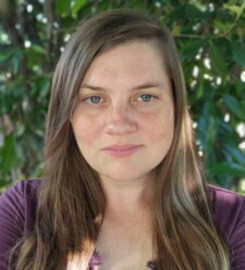
Kathryn (Katie) Gillespie, PhD, is a geographer whose research, writing and teaching focuses on food and agricultural systems, human-animal relations and the environment. Her work is dedicated to uncovering the harms experienced by animals in routine spaces of animal use and the possibilities for transforming our relationships with other species into ones of flourishing, mutual care, and respect. Prior to joining USD as associate director of the Center for Food Systems Transformation, Dr. Gillespie was a postdoctoral scholar in the Applied Environment and Sustainability Studies Online Master’s program at the University of Kentucky, an animal studies postdoctoral fellow at Wesleyan University, and a lecturer at the University of Washington.
Her first book The Cow with Ear Tag #1389 (University of Chicago Press, 2018) is a multispecies ethnography about the lives of cows in the Pacific Northwest dairy industry. She has also published on human-animal relations, food systems, feminist geographies, political economy and multispecies methods in numerous scholarly journals, such as Antipode, Annals of the American Association of Geographers, Environment & Planning E, Gender, Place & Culture, Animal Studies Journal, Politics & Animals, and Hypatia. She is co-editor for three books: Vulnerable Witness: The Politics of Grief in the Field (University of California Press, 2018); Critical Animal Geographies: Politics, Intersections and Hierarchies in a Multispecies World (Routledge, 2015) and Economies of Death: Economic Logics of Killable Life and Grievable Death (Routledge, 2015).
Her forthcoming book, The Sound of Feathers: Practicing Attentiveness in Multispecies Worlds (Duke University Press, 2026) takes a multispecies autoethnographic approach to understanding the foundational dynamics and histories of harm behind everyday human-animal encounters and offers a pathway to imagine futures of flourishing.