

Anonymously Report Hazing
 |

Campus Hazing Transparency Report
Last updated: June 23, 2026
Stop Campus Hazing Act (Public Law No: 118-173 (12/23/2024) requires institutions of higher education to develop a campus hazing transparency report that summarizes findings concerning any student organization found to be in violation of the institution of higher education’s standards of conduct relating to hazing. An institution of higher education is not required to develop or update this report unless the institution of higher education has a finding of a hazing violation.
State laws relating to hazing can be found here: Stop Campus Hazing Act, Cal. Educ. Code Sec. 66305-66309. There are no applicable local or tribal laws regarding hazing.
Reporting Period
December 24, 2025 - June 23, 2026
During this reporting period, no student organizations were found responsible for hazing.
USD's Hazing Policy Statement is currently published in our 2025 Annual Security and Fire Safety Report. While we have started collecting hazing-related statistics as defined by the Stop Campus Hazing Act in 2025, those statistics will be published in the 2026 Annual Security and Fire Safety Report.
For questions or additional information regarding this campus hazing transparency report, please contact us at studentaffairs@sandiego.edu.
Hazing Prevention and Education Statement
Hazing is prohibited by California state law, Federal law and University policy. The University of San Diego’s hazing prevention and education policy is grounded in the University's mission to create a more inclusive, sustainable, and hopeful community. Anchored in USD's mission and values is our commitment to uphold the dignity of every person through socially responsible practices and ethical conduct. Hazing rituals, ceremonies, initiations, behaviors and rites of assimilation exploit the inherent human need to belong to a community. Hazing practices, in addition to harming individuals, diminish the integrity of the Torero community we strive to cultivate. Failing to prevent, discourage, and/or report hazing may violate this policy.
What is Hazing?
As a part of the University of San Diego’s core values, “we affirm the dignity of every person and strive to create a culture of respect and inclusivity. This conviction grounds our efforts to ensure that all members of our community are able to thrive in every dimension of their lives”. As such, individuals or groups of individuals may not engage in any hazing activities whether on or off campus and whether planned or spontaneous. Hazing means any method of membership into or within an organization or student body, whether or not the organization or body is officially recognized by the institution, which is likely to cause physical, psychological, or social harm to any former, current, or prospective community member at USD, regardless of intent or an individual’s willingness to participate. Initiations and similar activities should be designed to instill group spirit and affinity, but not at the expense of the individuals involved or the values of USD.
The following is a list of examples from each of the three categories. The list is not all inclusive but it provides common examples of hazing that are prohibited by USD policy.
Subtle Hazing
Activities or behaviors that emphasize a power imbalance between new members and other members of the group or team or organization. "Subtle hazing” refers to types of hazing that are often not recognized as harmful behaviors, but happen far more frequently. Subtle hazing typically involves activities or attitudes that breach reasonable standards of mutual respect and place new members on the receiving end of ridicule, embarrassment, and/or humiliation tactics. New members often feel the need to endure subtle hazing to feel like part of the group or team. (Some types of subtle hazing may also be considered harassment hazing).
Some Examples:
- Deception (such as lies, tricks, or dishonesty)
- Assigning demerits
- Demeaning names
- Socially isolating new members
- Silence periods with implied threats for violation
- Line-ups, drills, or tests on meaningless information
- Expecting certain items to always be in one's possession
- Silence periods with implied threats for violation
- Deprivation of privileges granted to other members
- Socially isolating new members
- Name calling
- Requiring new members to perform duties not assigned to other members
Harm to Well-Being
Behaviors that cause emotional anguish or physical discomfort in order to feel like part of the group. Harassment hazing confuses, frustrates, and causes undue stress for new members/rookies. (Some types of harassment hazing can also be considered violent hazing).
Some Examples:
- Verbal abuse
- Threats or implied threats
- Asking new members to wear embarrassing or humiliating attire
- Stunt or skit nights with degrading, crude, or humiliating acts
- Expecting new members/rookies to perform personal service to other members such as carrying books, errands, cooking, cleaning etc
- Sleep deprivation
- Sexual simulations
- Expecting new members/rookies to be deprived of maintaining a normal schedule of bodily cleanliness.
- Be expected to harass others
Violent
Behaviors that have the potential to cause physical and/or emotional, or psychological harm.
Some Examples:
- Forced or coerced alcohol or other drug consumption
- Beating, paddling, or other forms of assault
- Branding
- Forced or coerced ingestion of vile substances or concoctions
- Burning
- Water intoxication
- Expecting abuse or mistreatment of animals
- Public nudity
- Expecting illegal activity
- Bondage
- Abductions/kidnaps
- Exposure to cold weather or extreme heat without appropriate protection
How Does The University Respond to Hazing?
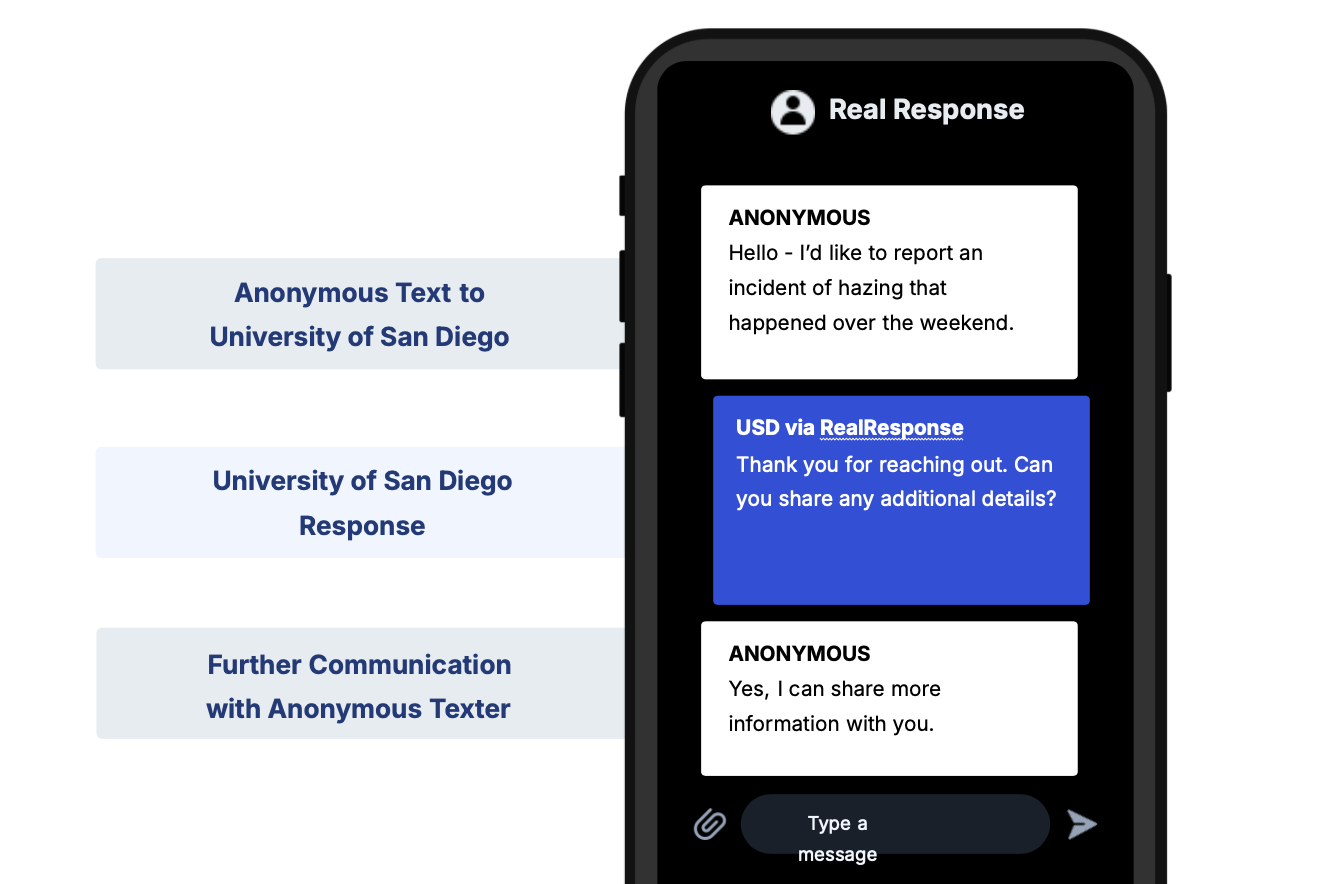
USD strongly encourages all members of the university community to report information about any incident of Hazing as soon as possible, whether the incident occurred on or off campus, to the Department of Public Safety, Title IX Office, or the Division of Student Affairs, and/or the appropriate local law enforcement agency. Anonymous reports may also be submitted.
In addition, those individuals who have been informed by the Department of Public Safety that they are “Campus Security Authorities” (CSAs) under the Jeanne Clery Campus Safety Act (“Clery Act”) are legally required to report such incidents to the Department of Public Safety.
Any current student, faculty, administrator, or staff member of the University of San Diego or non-USD affiliates/community members may file a complaint against any community member alleging a violation of campus policies regarding hazing.
RealResponse
(619) 260-4873
Department of Public Safety
(619) 260-7777
publicsafety@sandiego.edu
Title IX
(619) 260-4594
titleix@sandiego.edu
When a report of hazing is made, the University will initiate an investigation to assess the situation, gather relevant information, and determine whether any violations of the hazing policy have occurred. The investigation will typically involve the following steps:
- Receipt of Report: A hazing report will be documented and assigned to the appropriate investigator.
- Preliminary Review: A University representative, often from the Division of Student Affairs or the Department of Public Safety, will conduct an initial review of the claim.
- Investigation: A formal investigation will be conducted, gathering statements from witnesses, involved individuals, and any other relevant information.
Outcome Determination: Based on the findings, the case will be referred to the Office of Ethical Development and Restorative Practices for resolution, or Human Resources for staff/faculty.
Violation of these standards, policies and procedures may subject an individual or group to disciplinary action as determined by the Assistant Vice President for Student Affairs/Dean of Students or their designee, pursuant to the provisions of the Code.
California Anti-Hazing Law
Matt’s Law
PENAL CODE – PEN [240-248] 245.6.
(a) It shall be unlawful to engage in hazing, as defined in this section.
(b) “Hazing” means any method of initiation or preinitiation into a student organization or student body, whether or not the organization or body is officially recognized by an educational institution, which is likely to cause serious bodily injury to any former, current, or prospective student of any school, community college, college, university, or other educational institution in this state. The term “hazing” does not include customary athletic events or school-sanctioned events.
(c) A violation of this section that does not result in serious bodily injury is a misdemeanor, punishable by a fine of not less than one hundred dollars ($100), nor more than five thousand dollars ($5,000), or imprisonment in the county jail for not more than one year, or both.
(d) Any person who personally engages in hazing that results in death or serious bodily injury as defined in paragraph (4) of subdivision (f) of Section 243 of the Penal Code, is guilty of either a misdemeanor or a felony, and shall be punished by imprisonment in county jail not exceeding one year, or by imprisonment pursuant to subdivision (h) of Section 1170.
(e) The person against whom the hazing is directed may commence a civil action for injury or damages. The action may be brought against any participants in the hazing, or any organization to which the student is seeking membership whose agents, directors, trustees, managers, or officers authorized, requested, commanded, participated in, or ratified the hazing.
(f) Prosecution under this section shall not prohibit prosecution under any other provision of law.
California Assembly Bill 524 (Postsecondary education: Campus-Recognized Sorority and Fraternity Transparency Act)
Campus Hazing Policies
In addition to USD’s hazing prevention and education policy, several campus departments have developed additional language that pertain specifically to students engaged in activities sponsored by those departments.