
Campus Safety Tips and Resources
We encourage you to take time to become familiar with our campus and its safety procedures. Understanding campus safety resources and practicing preventative measures will help us work together to maintain a safe, welcoming, and enjoyable environment for all members of the USD community.
The information provided below include safety tips and resources, crime prevention strategies and support services available. We encourage you to review these resources carefully, as they are designed to enhance your personal safety and support your success during your time at USD.
The following safety tips have been provided by the Department of Public Safety in conjunction with the San Diego Police Department and the National Crime Prevention Council.
- Always be aware of your surroundings. Don't go out under the influence of alcohol or drugs. They will impair your judgment and reactions.
- Let someone know where you are going and when you expect to return.
- Walk with a friend or family member.
- Don't go out alone at night, venture into unfamiliar or dark places, take shortcuts, talk to or accept rides with strangers, or hitch rides. Don't walk in or near alleys, on deserted streets, near dark doorways or shrubbery.
- Don't approach vehicles even if the occupants say they need directions or assistance.
- Avoid verbal confrontations. They may lead to physical altercations.
- Carry a working cell phone. Otherwise know where phones are located along your route. 911 calls are free but carry change for other calls for assistance.
- Carry only necessities, i.e., identification (not a Social Security card), medical information, names and phone numbers of people to call in emergencies, some cash, and a credit card.
- Don’t display your cash or any other inviting targets such as pagers, cell phones, hand-held electronic games, or expensive jewelry and clothing.
- If you think someone is following you, switch directions or cross the street. If the person continues to follow you, move quickly toward an open store or restaurant or a lighted house. Don’t be afraid to yell for help.
- Try to park in well-lighted areas with good visibility and close to walkways, stores, and people.
- Make sure you have your key out as you approach your door.
- Always lock your car, even if it’s in your own driveway; never leave your motor running.
- Do everything you can to keep a stranger from getting into your car or to keep a stranger from forcing you into his or her car.
- If someone tries to rob you, give up your property—don’t give up your life.
- If you are robbed or assaulted, report the crime to the police. Try to describe the attacker accurately. Your actions can help prevent someone else from becoming a victim.
If you are out running, also:
- Vary your route.
- Don't run on deserted streets or trails.
- Don't run at dusk or at night.
- Run with a partner.
- Don't wear a headset. Not only won't you hear someone approaching but you may get so distracted by what you're listening to that you won't be aware of your surroundings.
Be AWARE of your surroundings and who or what is nearby:
- Listen to your intuition. If something doesn't seem right, it probably isn't.
- Watch your surroundings. Leave any places in which you are uncomfortable. Be especially alert for suspicious persons around banks, ATMs (Automated Teller Machines), stores, your home, etc.
- Be wary of strangers who seem overly friendly, ask a lot of questions, or ask for help.
- Never turn your back to a stranger.
- Be wary if a vehicle pulls up beside you.
- Be especially alert when alone in a dark parking lot or structure or any isolated area.
At Night Clubs and Social Functions:
- Go with and stay close to a friend.
- Use prearranged signals to indicate that you need help or want to leave.
- Don't allow alcohol or drugs impair your judgment.
- Watch your drinks and don’t give anyone an opportunity to spike them.
- State your personal social standards and limits. Stick to them and don't let anyone change your mind.
- Avoid people who make you nervous or uncomfortable.
- Provide your own transportation when you go out alone.
The Department of Public Safety encourages every student to record important information on their bicycle and/or their electric scooter. Please complete the registration form located below.
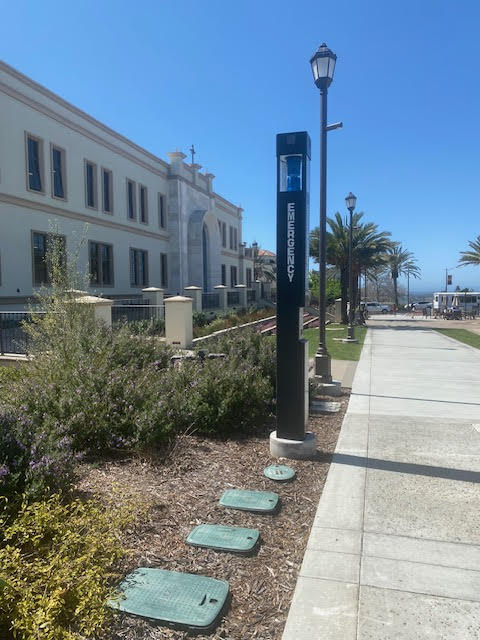
All Emergency phones connect directly to Public Safety and are to be used for emergencies only.
More than 2,000 resident students live on campus, for many it is the first time away from home. Each one brings various items of personal property and can be easy targets for a criminal. The residence halls will quickly feel like home -- but you have to remember to keep your property safe.
Most of the crimes that occur in the residence halls are theft of personal property.
The following are some tips to help you reduce the chances of becoming a victim of a crime.
- Do not prop open any exterior locked residence hall doors. Even though propping the doors makes it easier for you to get back into the residence halls, you also have made it easier for an unauthorized person to enter the building. For the safety of you and others in the residence halls, do not prop open any residence hall doors because you don't know whom you may be letting in.
- Lock your door when you leave and take your keys with you, no matter how short a time you may be gone - even when you go to the restroom.
- Lock your door when you and your roommate are sleeping.
- Do not leave notes on your door stating that no one is home or when you will return; it's an open invitation to theft.
- Keep personal valuables out of sight and locked up if possible.
- Keep a record of all your valuable items, noting descriptions, serial numbers, and approximate dollar values of all items. These records should be kept in a secure location.
- Do not allow strangers into your room.
- Do not open your door unless you know who is on the other side, especially at night.
- Do not allow door-to-door salespeople to enter the residence hall or your room. The University of San Diego's policy prohibits soliciting in any building without prior written consent from the University.
- Please contact your Resident Assistant or Community Director with advice and recommendations.
- Report any person behaving suspiciously to Public Safety immediately at (619) 260-7777 or in case of emergency (619) 260-2222.
Thefts from residence hall rooms, administrative buildings, classrooms, and campus apartments are one of the most common crimes on college campuses nationwide. Protect your property:
- Lock your door when leaving your room or office, even for a short period of time.
- Never hide your keys outside your room or apartment. Don't have your name or address on your keys.
- Inventory personal possessions, making a record of make, model, and serial number of the items. You may borrow an engraver from our Department of Public Safety to mark your possessions with your driver's license number.
- Reduce your chance of bicycle theft by always locking it with a high quality lock.
- Take valuables such as stereos, computers, and jewelry home with you at semester break times.
- In libraries, recreational facilities, classrooms, and dining halls, property such as textbooks, book bags, and purses should never be left unattended. You should mark the inside cover of all your textbooks with your name and address and mark one or more of the later pages with your initials or other markings.
- When using lockers in recreational facilities, always secure your property by locking the locker. Do not leave the locker unsecured while showering or exercising. If possible, avoid keeping money or valuables in lockers.
- If you work in an office, keep your purse locked in a cabinet or drawer. Never leave it unsecured in, on top of, or underneath a desk.
- Make certain your personal property at USD is covered by your own renter's insurance or your family's homeowner policy, otherwise, your losses are unrecoverable.
- Report all thefts to the Department of Public Safety immediately, this is critical to us, it helps us identify patterns, find solutions and craft crime prevention efforts.
The Department of Public Safety holds Campus Emergency Procedures Review and Guidance for Surviving an Active Shooter/Assailant Situation presentations for the USD community. All USD community members are welcome and encouraged to attend.
Please RSVP with Captain Quinton “Q” Kawahara at qkawahara@sandiego.edu if you are interested in attending.
The Department of Public Safety can also make special presentations to individual departments, student organizations, or any USD group that would like to receive the information.
Please contact Captain Quinton “Q” Kawahara at qkawahara@sandiego.edu if you would like to learn more about the group presentations.
A Public Safety escort is provided from dusk till dawn for the safety of anyone walking alone on campus at night. Simply call Public Safety at (619) 260-7777, and an escort will be sent to your location and will accompany you to your on-campus location. Public Safety provides escorts within a one mile radius of campus.
University of San Diego
The Department of Public Safety is proud to be part of the national network of R.A.D. instructors.
R.A.D. Coordinator: Inv. Sgt. Ryan Hansen (619) 260-4775
Instructors: Captain "Q" Kawahara, Inv. Sgt. Ryan Hansen, Sgt. Ron Daguia, and Sgt. Augie Garcia
- Only $10 for USD students and staff
- $25 for non USD community members
To register, please contact Inv. Sgt. Ryan Hansen:
- Email: rhansen@sandiego.edu
- Phone: (619) 260-4775
The Rape Aggression Defense Basic Physical Defense is a national program of realistic self-defense tactics and techniques taught for women only. USD offers this course to any female who is 16 years old or older. All courses are taught by nationally certified R.A.D. Instructors.
The goal of R.A.D. is to provide realistic self-defense options to women, regardless of their level of physical conditioning. Students at all levels of ability, age, experience, and strength will be provided with techniques and information that can be effectively used from the first day of class. R.A.D. is not a martial arts program, nor does it require students to be athletes in training to succeed. The R.A.D. system will provide students with the knowledge to make an educated decision about personal defense. We provide information on physical and non-physical options, as well as insight into the attacker mindset. Every student receives a manual for reference and practice. Once a student has completed a R.A.D. program, their signed manual becomes a ticket for free lifetime return and practice with any R.A.D. instructor in the US and Canada.The widespread acceptance of the R.A.D. system is due to the ease, simplicity, and effectiveness of our tactics, solid research, legal defensibility, and unique teaching methodology. R.A.D. is the only self-defense program endorsed by the International Association of Campus Law Enforcement Administrators (IACLEA).
Why R.A.D.?
- R.A.D. is the largest network of its kind with over 7,000 Instructors having received training in our systems to date. These Instructors teach at various colleges, universities, and municipal law enforcement agencies as well as various other community organizations internationally. R.A.D. has trained more than 300,000 women throughout the U.S. and Canada since the program began in 1989. R.A.D. is the only existing program with a free lifetime return and practice policy, honored throughout both the US and Canada. R.A.D. has developed specialized simulation techniques and equipment for use by certified R.A.D. instructors. R.A.D. is the only self defense program ever endorsed by the International Association of Campus Law Enforcement Administrators (IACLEA).
- Lawrence N. Nadeau, Director of Instructional Development and Founder.