
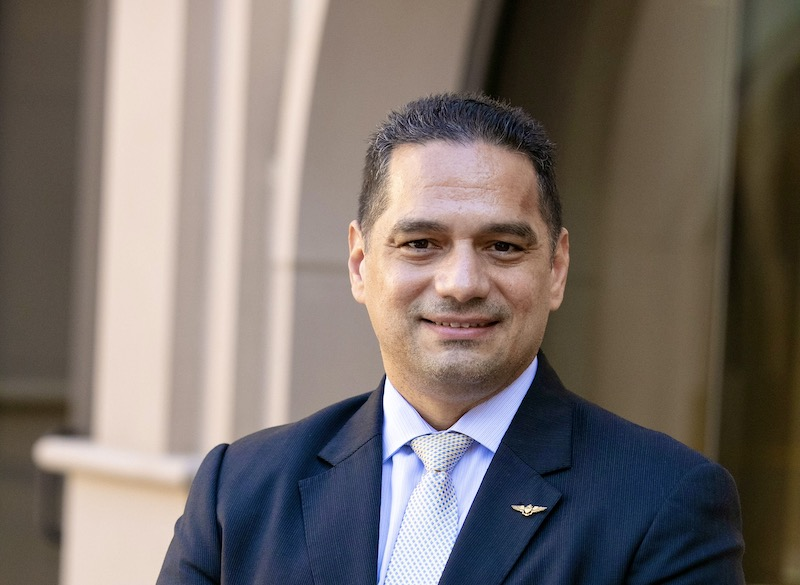
Jorge Muñiz ’23: A Veteran Cultivating Intrinsic Growth
Jorge Muñiz is a program manager at Northrop Grumman who oversees Global Hawk Enterprise Services. Before moving into the defense contracting industry, he had an established military career spanning 20 years. But even someone with his level of career success is susceptible to self doubt.
Once he left the military, Jorge wondered if he embodied the skills and knowledge to be an effective leader in the civilian world — something his fellow servicemen immediately understood by the badges and insignia displayed on his uniform. It was this self doubt — coupled with observing his wife, Michelle Muñiz going through the master’s in real estate program at USD — that motivated him to begin pursuing an MBA in 2020.
In this Q&A, find out more about Jorge’s military career, his experience in the Flex MBA program at the Knauss School of Business and the entrepreneurial spark that’s been brewing within.
Why did you first join the military?
In high school, I was #800 in the class. By contrast, the girl at my high school — Michelle, who I was dating at the time and later married in 2004 — was #8. I was enjoying life and less focused on academics. She got accepted into the best schools including Binghamton in New York. I didn’t get in anywhere. So I joined the U.S. Navy right after high school out of sheer necessity and ended up in its nuclear program. Specifically, I worked on the submarine USS Boise. And within a few months, I got picked up to join the U.S. Naval Academy.
How did you get involved in naval aviation, specifically?
Although I studied at the Naval Academy, I didn’t actually graduate. After leaving the Academy, I enrolled at the New York Institute of Technology to complete a degree in interdisciplinary studies. But you gotta know…since I attended the Naval Academy for three and a half years, I owed them service or would have to pay back my tuition. So after I finished my bachelor’s degree in 1998, I applied again to join the Navy and ended up in Officers Candidate School. From there, I worked as a pilot until I retired from the military in 2017.
What type of work do you do now in defense contracting?
I currently work as a program manager at Northrop Grumman and will soon be taking over foreign military sales of the unmanned aerial vehicle, Global Hawk Enterprise Services, to the Republic of Korea and Japan. It’s funny because in 2003, I was the recipient of information from the Global Hawk system. And now, almost 20 years later, I’m managing the sale of it to foreign militaries.
Prior to Northrop Grumman, I worked at L3Harris Technologies, the #8 company in defense contracting. I was also a program manager and led several multimillion-dollar programs and projects from initial concept to final qualification and testing.
What motivated you to pursue an MBA?
When I left the military, there had always been an educational gap. Some roles in the military, such as a supply officer, expose you to skills used in business such as financial projections, expenditures, profit and loss. However, as a pilot, I was never exposed to that. And that educational gap became more apparent once I got into program management in my civilian career.
My wife was also a big inspiration for me to go back to school. By seeing her get her MSRE degree at USD, I saw how she got smarter, how she was growing within her field. And I thought, I should go back. I should get smarter and close that educational gap.
My boss at the time actually told me that I didn’t need to go back to school because it wouldn’t benefit me at the company. But ultimately, it wasn’t about that. It was about expanding my knowledge base, expanding my horizons and opening up new opportunities that I never dreamed of.
As an MBA student, are there any skills or lessons you’ve learned that are valuable to your career right now?
Yes! The negotiations class that I’m taking with Professor Craig Barkacs should be a required class. Right now, I’m in the process of drafting a proposal and the negotiation aspect is very, very important. In defense contracting, the government sends a Request for Proposal (RFP) which describes the scope of work they want. The company then responds with a proposal, which is what I’m working on. Professor Barkacs would be so proud…I’ve already established my “BATNA,” best alternate to a negotiation agreement.
How did you uncover your passion for entrepreneurship?
I believe I’ve always had an entrepreneurial spirit, but I don’t think it had any focus. When I started the MBA program, we had a group project where we were tasked with “inventing” a product or technology that would address a need in emerging markets. Our team’s idea was a software product that could improve learning in online classrooms.
After the project, I was still really interested in our idea. So I teamed up with a software engineer I worked with at L3 Harris and explored the feasibility of software that could indicate online student engagement by changing colors as they become less engaged (detected by eye and body movements, participation in online chats, speaking to ask a question, etc.). When the Fowler Business Concept Challenge came up, I pitched the idea there. The following spring, I also participated in the tech competition hosted by the Shiley-Marcos School of Engineering where I came in second place and won $5,000.
My new venture is called Deck the Palms. Hanging palm tree lights is hard. I realized that while propped up on a 25-foot ladder last year hanging Christmas lights with my son. So I came up with a robotic device that decorates palm trees and am 3-D printing the prototype right now. My son, Ethan, is going to demo it when I pitch Deck the Palms at this year’s Fowler Business Concept Challenge. Because if a 14-year-old kid can do it, anyone can do it.
In what ways are you still involved with the military community?
When I first retired from the military, I joined the Institute for Veterans and Military Families at Syracuse University, specifically the Onward to Opportunity program. I’ve been with them for five years now and am pretty active within that organization. I teach courses that help veterans get certification and credentialing from the Project Management Institute. And most recently, I was a panelist at the USD Military Transition Conference.