
Profile
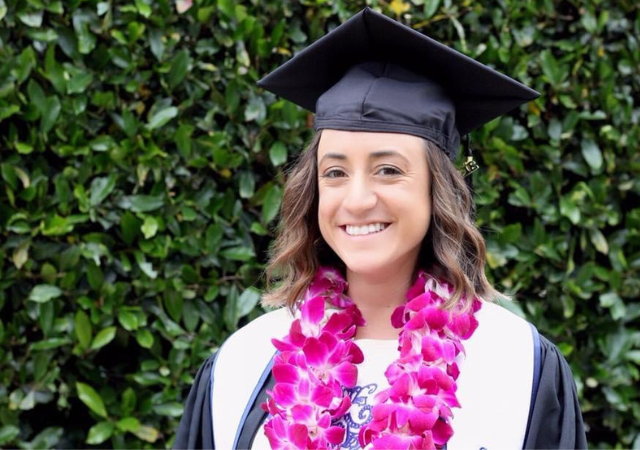
SOLES Alumna Spotlight: Carli Danaher '18 (MEd), TESOL
Tell us about your degree program and why you chose SOLES for that program.
I had originally planned on going to DePaul in Chicago to get my master's degree in English literature. When I talked to a representative at USD, they told me about the Master’s in TESOL, Literacy and Culture Program. I felt like that opened up a new door for me and that it would be a way for me to broaden my perspective. I would get to meet people from all over the world and work with people from different countries and cultures. I thought that that was so exciting, and it really was because half of my classmates were international students. That experience of meeting people from all over the world, going to school with them, and becoming friends with them is an experience that I would have never have gotten in Chicago. This program is so diverse, and I don’t know how diverse a program in English literature would have been.
What was your favorite class from the TESOL program?
My favorite class ties in with who my favorite professor was because I feel that the professor had a lot to do with why it was my favorite class. It was my first semester at SOLES when I was making friends and meeting my colleagues, and I think that's what made it even more special, too. This professor, Dr. Viviana Alexandrowicz, was full of energy and passion and was able to create a space for us to become such good friends. My cohort was incredibly close. The class Dr. Alexandrowicz taught was Language, Literacy, and Culture. I liked this class so much because we went on a Linda Vista immersion trip to the Bayside Community Center. It was eye-opening to see the difference between being on campus at USD, and being in the Linda Vista community just up the road; it's so diverse. That class sparked my interest in teaching English as a second language. Dr. Viviana Alexandrowicz inspired me about USD's changemaking initiative through this class and she really helped me find areas and opportunities to make a difference. She helped me create volunteer ESL teaching classes, so I could teach people from the Bayside Community Center. Not only that, but the class was really fun because of one of the projects we had to do. Dr. Alexandrowicz had us all choose a different country and interview someone who came from that country. I interviewed someone that came to America from Italy. Everyone had to interview someone and learn about their country, and then everyone had to present about it. That was so much fun because everyone chose a country that they're not from and it helped us to find out about another culture. We were learning about a lot of different cultures because everyone's presentations were about somewhere different. I truly liked that class and could honestly go on and on forever about that class.
Last summer I presented during the SOLES Leadership Showcase Series with Dr. Alexandrowicz. The topic was “Leading ESL/Changemaking Initiatives for Community Members”. That’s another reason why I feel that she's my favorite professor; she always provides opportunities to stay involved, even though I'm so far away and I graduated a few years ago. She was always one to push me to publish or present. She gave me the opportunity to present at that leadership showcase and it was nice to be able to share my experience there with everybody. I think that it was an important experience for people to know and to share.
Can you share a little bit about your Action Research project?
My research was unique because I was able to do a project on campus. It also fulfilled my international experience requirement; I didn't travel abroad. Another student in my program worked in La Paloma and was speaking to some of the Spanish-speaking workers on campus. She said that many of the facilities workers on campus had expressed the need and the want to learn English, so that’s where it started. My colleague and I partnered to find food and facility workers on campus. We spoke to their managers and to the facilities workers to create a curriculum based on why they wanted to learn English and, for the manager, what kind of English skills are you looking for your workers to get. Mostly they wanted to understand paperwork better, be able to communicate if there were any issues with pay or vacation time, and really just get some workplace English skills. Once a week, we would teach at the facilities management building in their lunchroom. I did my action research within that classroom and it was unique because we were working on campus with facilities workers that were also working on campus. It was pretty cool to find that need within our own campus and to help meet that need. I loved the facility workers – our students; we developed such a good relationship with them and we even had a mini graduation for them. We brought them cake and they made pozole, and it was a really good experience and a good time.
Were you involved on campus in other ways as a student?
I was part of the SOLES Graduate Student Association (SGSA) for two years, serving as the Learning and Teaching Representative my second year. I loved being on SGSA because my roommate was also a part of it. She was in the Higher Ed program and I was in TESOL, so I met so many people from her program and the students from her program were super fun, energetic, outgoing, and really involved on campus. Being in SGSA made me super involved with campus but it was good for my cohort, too, because everyone knew what was going on. We would have professional development events and also social events. We did a speed interviewing event where practiced interviewing skills. But we also hosted a Christmas brunch. That was one of my favorite memories from the university, having the SGSA brunch at Tom Ham’s Lighthouse. We also hosted an SGSA bonfire on Mission Beach, and that was a really good way to get to know people. We did a volunteer event where we partnered with the Travis Manion Foundation to paint the Bayside Community Center. If I could give one piece of advice to anyone who is entering the SOLES program, it would be to get involved and to maybe even try to be part of SGSA, because I wasn't that involved in my undergraduate years; I would just come to campus for class and then go home. I didn't feel like I had a place or that I was a part of the campus community, and I decided to make a completely different experience for myself at SOLES. SGSA is what made it an even better experience for me because of how involved we were.
Where was your favorite place on campus, and why?
This is so hard because it's such a beautiful campus. I literally have three.
The Garden of the Sea was a really good place for me to go to do reading. The view of the ocean was so peaceful and it didn't even feel like I was studying. So many times in San Diego I didn't feel like I was doing schoolwork because I was studying in a beautiful garden with a beautiful view. It’s surprisingly so quiet there, too; it’s very peaceful. That’s one of my favorite outdoor places on campus.
My favorite indoor space is a tie between The Immaculata and the library that we all call the Harry Potter Library (Copley Library). It looks like you're honestly in a different world. I spent so much time there. I don't want to say that the library is my favorite place, but for being in a library and having to study that much, it wasn't the worst place to be studying. The Immaculata brings a fond memory to me because my grandma (who passed away a few years ago) visited me in San Diego and I took her to the campus. This was one of the last times she even traveled somewhere; she wasn't able to make it to my graduation because she was sick, which was very sad and unfortunate, but she had visited campus. She was really religious, so I took her into the Immaculata and that was my first time being there, too, after months of going to USD. We walked in there together and that is a memory that I’ll have for the rest of my life. I remember going in and she said, “Every time you go into a new church or a chapel, you have to make a wish”. I thought it was cute that she said that so I made a wish and I have that fond memory of my grandma being in that place. She loved it and we took a picture outside of the Immaculata, so I have a picture of me and her and the whole building.
What is your favorite memory from your time at SOLES?
I hate to be cliché because I don't want to say that it was graduation – because that's the end of an era – but it was. Seeing one of our professors, Dr. Mark Manasse, in his doctoral gown and leading us out; having my SGSA sash on, representing a time in my life with an organization that I was very involved in, and seeing everyone with that sash; seeing everyone with their leis on; seeing everyone line up; seeing the look on all of my colleagues' faces, because we finally were at that moment after so much work with our research. It’s such a strenuous journey, but when you get there it's amazing. I would say that is a memory that I could never forget.
I have a memory of people from my cohort and me going to a concert on campus – I think it was MisterWives who played that year. But we got together for the concert and we all hung out at the graduate student housing first, and then we walked up the stairs to the concert. It was one of the first times some of the girls in the cohort got together. Having a campus that will have a concert like that for us was such an amazing memory and time.
Another big moment for me was when I presented my final research. You have so much anxiety before you're going to present your final research, but you know it so well that when you're up there you just do it. I felt like it came out flawlessly. To share what you've been working so hard on, with the panelists and everyone who comes to see you present your final research – it’s just so rewarding. Being there presenting my research, even though it was so nerve-wracking leading up to that point, was a huge success. I remember how I felt after – I was so proud. It was such a proud moment.
What have you been up to since graduating from SOLES?
Throughout my time as a student at SOLES, I worked at San Diego Mesa Community College and I continued to work for them as a graduate tutor after graduation. I was an embedded tutor in English 101 courses, so I worked closely with the professor almost like a teaching assistant (TA). I would help students with their writing, I would meet students for office hours, I would split up the students with the teacher for conferences, and we would work on their papers. I continued to do that while I was still a professor. When I graduated, I got a job at Palomar Community College in San Marcos where I taught ESL. This ESL class was pretty much the class before the students moved to English 101; it was an advanced writing course. Unfortunately, as an adjunct professor, the tricky thing sometimes is that classes can be cancelled because of low enrollment. You could have a class and then the next semester you may not have a class, and so that's what happened after Palomar.
I went to Grossmont Community College after Palomar, and I taught the first level of ESL there. It was the first literacy level beginner course, so I went from teaching advanced writing to teaching very beginner. I feel like I do have a broad perspective when it comes to teaching ESL because I taught complete opposite levels. I did online tutoring with Mesa, too, so I was an embedded tutor in online courses, as well. I had to make a pretty big online presence in order to help students with their writing.
After that, I wanted to get experience teaching English 101; that has been a dream of mine for a long time. I had experience teaching ESL, but I really want to get that experience teaching English 101 and so I applied for an opportunity in Phoenix, Arizona and I taught four sections of English 101 at Paradise Valley Community College. Some of the classes were not just with college students, but there were also high school students that came from a high school that is pretty much on the college campus, and they were taking a college credit course. That was pretty unique because I had never really planned to ever teach high school or high school students, but it became something else that I could put on my resume.
I taught out there for a semester and then I decided after that, as happy as I was about the opportunity in Phoenix, I wanted to go home to Chicago. I’m really family-oriented and close to my family, so after that semester I just decided not to take any more classes at Paradise Valley Community College and I moved back to Chicago. The difficult thing when I moved back to Chicago was when the pandemic hit. Everything was going online and it didn't seem like there were that many international people coming to America to do school. At that point, it was a really hard time to find a job. Luckily, I did find another teaching position in Chicago. It was a little bit different from what I’ve ever done, but I still was hired because I had the credentials. I taught for the City Colleges of Chicago on the east side at Olive-Harvey Community College. They were teaching a mandatory stress management course for the Chicago police officers, and I was a stress management instructor. There would be a lot of things for me to talk about with the police officers when it came to their job and managing stress and anxiety. Unfortunately, it was a trial program and they decided to stick with hiring from within the police department to teach the course.
I applied for a position at the University of Chicago which I am so, so, so happy at. I honestly love being back in the university environment. I’ve been here since August 2021 and I’m a Fellowship Coordinator. My position is more like education administrative. I feel like the University of Chicago is similar to the University of San Diego in the sense of diversity; most of the faculty that I work with are from different countries. I like working with people that are from all over the place, not just people from Chicago. I feel that I’m in a similar experience to that one I had at the University of San Diego, and that's why I enjoy it. I'm not teaching at the moment but I am actively looking for a night class to teach in the city at a community college. That would be ideal, to do one or two ESL classes at night.
Where do you see your career going long-term?
I want to continue doing well with where I’m at now, learning a lot of things within the university and administrative-wise. I want to stay at the university and I feel like when you work here and apply for a job within the university, it's a little bit easier than if you are coming from outside the university. I want to stay here because I’m super happy here and there is so much room for opportunities and climbing the ladder. It’s a hard question for me to answer because I think about it sometimes and I wonder if I want to eventually go back to school and get my PhD. I’m not at the point yet where I necessarily want to go back to school right now. But I think that would be something I would think about in the future…hopefully becoming full-time faculty somewhere, too.
How has your degree from SOLES impacted your career?
My degree from SOLES had everything to do with where I’m at. And not only my degree, but my whole experience at SOLES. The difference between the University of San Diego and my undergraduate school was how prepared I felt to enter the workforce after graduation. During my time at Xavier, I wasn't necessarily set up with an assistantship, an internship, or a job. SOLES had representatives and alumni come in from the community colleges explaining what an assistantship was, and then we would apply for these assistantships and we would work while going to school. So then when we graduated and received our degrees, we had already made so many connections and had made a name for ourselves within these community colleges, and gotten to know so many people who could help get us a job. That was the most helpful thing in the world. That set me up for success after graduation because by that time, people knew who I was and they wanted me and encouraged me to apply to teach there. Because I was working closely with professors at these community colleges in San Diego, I had all these points of contact and references that could speak up for me. That was super helpful in getting a job, especially because a lot of people know the TESOL program at SOLES.
I liked that during one of our last courses we were assigned to create a website for ourselves. It was a huge part of our grade. We had to create a website that included our teaching philosophy; pictures of us in real-time, maybe helping a student or tutoring a student; our research; a video of us teaching – an actual video of us teaching a lesson. Another one of our assignments was creating our CV. I think that creating a CV also really helped because I could put my website address on my CV and everyone who was looking at my application or my CV could see what I was doing at USD. That course was another way that I was set up for success and helped me get jobs.
What advice do you have for current or prospective TESOL students?
I've said this already, but I must emphasize getting involved. Find ways on campus that you can get involved, whether that's with intramural sports like the SOLES softball team or joining SGSA. I feel like being involved is a way for you to meet people and to feel more purposeful. When you go to campus just for class and then leave right after, you don't feel much like you're part of the campus community. I feel like you can be so much more successful when you feel like you're a part of something. Go to the events hosted by Graduate Student Life, like the bagel breakfast. Go to those because they're so fun and they’re so nice. And meet people from other programs. I became friends with people from all different programs within SOLES, and even the law school. When it’s possible, really just try to branch out.
Get used to pushing yourself out of your comfort zone. The classes challenge you to think differently than maybe you’re used to. SOLES is more diverse and there are people from all different cultures. Sometimes it can be uncomfortable for people, but I think pushing yourself out of your comfort zone is important. I did this many times. I hated my video presence so in one of our assignments I decided to use video for my platform. Challenge yourself.
Anything else you’d like to share?
I hope that everyone who goes to the University of San Diego receives the experience that I received because it's unforgettable and untradeable. There was nothing like it and it was the best two years of my life.