
The Roads Less Traveled
There's more than one path that leads students to the University of San Diego. In fact, many Toreros arrive after journeys that look nothing like the typical high school-to-college route. Some have led troops, raised children or built careers before ever setting foot on campus. Others are first-generation college students, transfers, former foster youth, students with disabilities or neurodivergent learners.
Together, they form a vital part of USD’s community — and these nontraditional students are an essential part of our intellectual life. USD supports every student with a holistic, wraparound approach — from academic advising and wellness services to identity-based resource centers and individualized coaching. Some nontraditional students need extra guidance to thrive, while others navigate campus independently, but every student benefits from the community and resources in place. The following students’ paths to USD are as varied as their ambitions. These stories capture their journeys to campus and reveal how they’re shaping their futures.
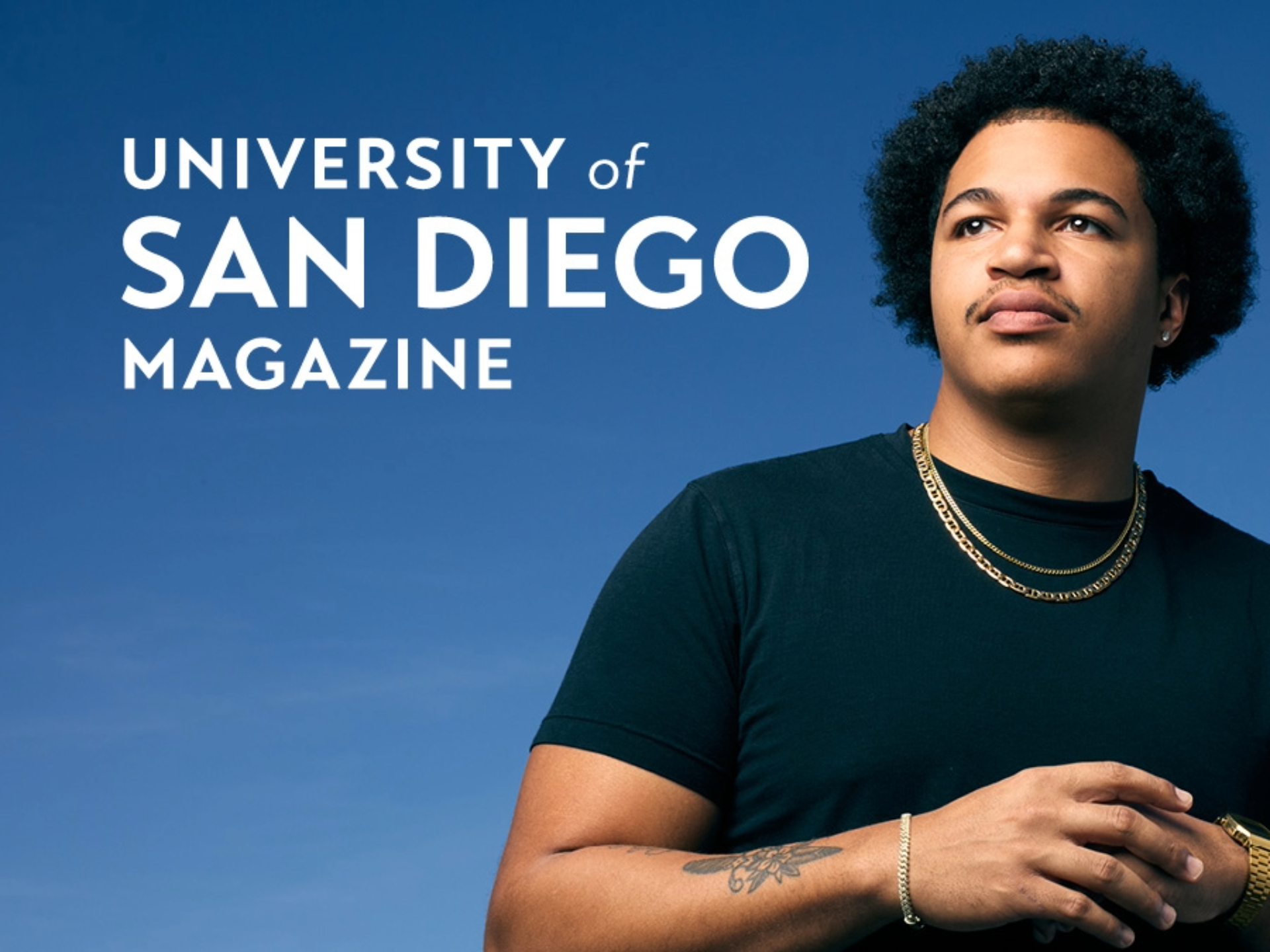
Winston Hendricks
Winston Hendricks ’27 (BA) is proof that sometimes a happenstance 10-minute conversation can redirect your life. On a lunch break from his job at Nordstrom, he was drawn to drive up the hill toward a beautiful campus he had only admired from a distance. In the parking lot, he struck up a conversation with the man getting out of the car next to him. That chance encounter — with a university administrator who encouraged him to apply when the time was right — planted a seed. Months later, Hendricks transferred from San Diego City College to USD and took the next step toward his psychology career.
Before college, Hendricks spent eight years in the U.S. Air Force, working in munitions systems — inspecting, warehousing and delivering bombs, missiles and ammunition in assignments that took him from Alaska to Turkey, Germany and Utah.
Military service was part of his family history — his father in the Marine Corps, uncles in the Army and Navy. By choosing the Air Force, he “finished the set.” But his choice wasn’t just tradition, it was necessity. The day after his college acceptance letter arrived, his family learned they were being evicted. College would have to wait. Rather than add to the financial strain, Hendricks enlisted, determined to support his family and forge his own path to stability.
After leaving the military and starting at San Diego City College, Hendricks initially pursued business before realizing his heart was elsewhere. “When I was a certified mental health trainer in the Air Force, I’d meet new airmen and airwomen adjusting to life in the military,” he said. “During our conversations, I could see them light up when I’d give them tools to work through their problems or emotions. It gave me a new sense of passion.” He’s now intent on becoming a clinical therapist for veterans and active-duty personnel. He also hopes to eventually contribute to research on psychedelic-assisted therapies for post-traumatic stress disorder.
Hendricks helps create a real sense of belonging for fellow veterans navigating campus life, both through his job at the Military and Veterans Program Center and by leading marketing efforts for the Student Veteran Organization. He also joined the local chapter of Kappa Alpha Psi Fraternity Inc., one of the Divine Nine historically Black fraternities and sororities. “I’ve had opportunities to work and volunteer in the community to give back. I’m the first brother at USD in the past five years, and it’s an amazing experience having older alumni call me up and help me reestablish our name here,” he said.
Being a 30-year-old college student has given him perspective. He finds he communicates easily with professors and connects what he’s learning in his classes to his previous experiences. “I’ve lived many lives,” he said. “Going back to school at this point in my life, I tie what I’m learning in class to what I’ve seen in life. Especially as a psychology student, there are so many things I wish I knew earlier.”
Emma Chheng
On any given day, you’ll find Emma Chheng ’27 (BA) weaving through the University of San Diego campus walkways, heading to class, greeting friends along the way. She is, in nearly every way, a typical undergraduate junior: enjoying her business analytics coursework, nurturing friendships with her Pi Beta Phi sorority sisters and classmates, and planning for her future. The only difference is the wheelchair she uses to maneuver through life.
Born in France to a Cambodian father and Thai mother, Chheng’s family came to the United States when she was in fourth grade with their sights set on an American education. During her high school years in Orange County, she was deeply involved in student government and community service. When it came time to find a college, she knew USD was the place for her after a visit to campus.
“At other schools, you can get lost as a number. Here, everyone has an opportunity to thrive in their own way and go at their own pace,” said Chheng, who was drawn to USD’s small size. “I love that I know a lot of people, who I’ve met in different ways, and we always have a reason to run into each other on campus.”
The resources available to support students, including the Disability and Learning Difference Resource Center (DLDRC), have exceeded her expectations. “I can basically do everything my classmates do, but I need different resources. The DLDRC made sure I had a really smooth transition to college,” said Chheng, who has used a wheelchair since a spinal cord injury and surgery when she was less than a year old.
She has long wanted to study abroad, but she wasn’t sure it was something she’d be able to do. With the support of the DLDRC and the USD Madrid Center, Chheng spent a “life-changing” semester abroad in Madrid this past fall.
“It’s hard to be in a wheelchair in Europe, but the USD Madrid Center and the DLDRC made it possible for me to have an above-and-beyond experience,” she said. They mapped out a plan and addressed concerns before they became barriers, especially making sure she could participate in every aspect of their weekend travel seminars. “I got to travel to so many places that I never thought I’d be able to see,” she said.
Back on campus and wrapping up her junior year, Chheng is now focusing on her future after graduation. She recently joined the Women in Business group and is exploring internships. “If I went to another school, I wouldn’t be as free to do all that I’ve been able to do,” she said.
Azad Kurdi
As the sun sets over Mission Bay, Azad Kurdi ’26 (MS) likes to visit a favorite bench on the western edge of campus, what he half jokingly calls the “secret spot.” From there, he can see the whole city, and it reminds him how different his view was just six years ago.
Kurdi was born in northern Iraq as part of the Kurdish minority, and he grew up watching U.S. service members in his city — with a vision for a different future. “Seeing the U.S. military in Iraq was my inspiration,” he said. “I told myself, I’m going to learn English, and I’m going to go to America one day.”
Kurdi taught himself English through music and movies, and got a scholarship to American University in Sulaymaniyah, Iraq. When the U.S. military returned to Iraq, he left college to work as a translator for U.S. forces fighting ISIS, using his Arabic, Kurdish and English language skills. That paved the way for him to immigrate to the U.S. in 2019. When he first arrived, the nonprofit No One Left Behind helped him settle into his new life. He soon enlisted in the United States Marine Corps, serving for four years as an infantryman, mostly at Camp Pendleton, with a tour in Japan. Today, he volunteers with No One Left Behind, supporting newly arrived Iraqi immigrants as they begin their own transitions.
After finishing his undergraduate degree online, he knew a master’s in cybersecurity engineering was next — and he didn’t want to leave San Diego. Now 30, Kurdi brings his perspectives shaped by war, immigration and military service to his grad program and the larger USD community.
“I think my life experience helps me a lot in grad school. I’ve worked in high-pressure environments, I’ve been in combat zones, I’ve had to adapt to new cultures and start over from scratch,” said Kurdi. “Because of that, in some situations I’m the mentor, but I’m always learning.”
On campus, Kurdi has embraced a range of opportunities. Through USD Outdoor Adventures, he has gone camping and rock climbing — experiences he’d never tried before despite his love for outdoor activities. And he’s also a regular at Graduate Life’s biweekly bagel breakfasts. “I’ve made so many friends there,” he said. “Law students, MBAs, people from all over the world. We sit down, have coffee and just talk.”
The veterans center plays a practical and personal role in his life — helping coordinate his VA education benefits and housing allowance, while also offering mentorship, networking lunches and a place to connect. “You can always knock on their door, and they’re there for you,” he said.
That welcoming feeling extends across Alcalá Park. “At USD, the professors genuinely care, and every conversation feels meaningful. Even on days I don’t have class, I still want to be on campus,” he said.
Kurdi hopes to convert a summer internship at American Express into a full-time cybersecurity role after he graduates in December. After that, he wants to earn advanced certifications and eventually pursue a PhD. His long-term goal is to launch his own cyber consulting firm.
“I don’t want to stop,” he said. “Even when I’m working full time, I want to keep learning.”
Holly Burton
After a decade of teaching dance and helping children discover their own creative voices, Holly Burton ’26 (MS) found herself at a crossroads. A mother of five now-grown children and a seasoned dance specialist in Utah public elementary schools and universities, she had enjoyed blending movement with learning, teaching dance units on everything from science to math to social justice. Yet Burton realized there were questions she wanted to explore — about peace, religion and social conflict — that went far beyond the dance studio.
“When my second-oldest son came out as gay, it changed my world, having grown up in a conservative religious community. It really opened my heart to all kinds of marginalized populations. I also realized there are still so many things I want to learn about,” she said. “I was drawn to studying how to build peace, how to bring about change in nonviolent ways.”
That curiosity led her to USD’s Joan B. Kroc School of Peace Studies, where she is now earning her master’s in conflict management and resolution. Burton immediately found a community that not only encourages her to pursue her unique vision but also provides support to make it come to life. As part of her thesis, she designed a curriculum examining religion’s role in both conflict and peacebuilding, and along with Assistant Professor May Farid, DPhil, she’s now co-teaching that class at USD — creating opportunities for students to engage directly with leaders from five diverse faiths across San Diego. “I would have never dreamed that would be possible,” she said. “I saw a need, devised a solution, and the USD faculty helped me make it happen.”
Burton’s life experience as a teacher and parent enriches her graduate studies. “It’s added depth to my learning and hopefully helped my classmates see things in new ways,” she said. “We each bring our own lens to our classes, and it’s a very supportive environment.”
She has also taken on the role of president of the Kroc Graduate Student Association this year. “I’ve been in leadership roles in other parts of my life, especially in my church, so I knew I could bring that experience into this position,” she said. “As president, I really wanted to help students feel more connected — to each other and to the faculty and deans, and there’s a genuine interest on all sides to do that. We started our informal Peace of Pizza on Wednesdays, and just sitting down to eat and talk without an agenda has made a difference. It’s social, but it opens the door to deeper conversations and real relationships.”
Looking ahead, Burton hopes to continue teaching. “I realized I’m an educator at heart,” she said. “I want to take what I’ve learned here and find ways to teach it, whether through workshops, classes or community programs. Life is learning, and I’m not stopping anytime soon.”
"People often focus on struggles and sacrifices, but these students arrive at USD accomplished and driven. I'm inspired by what they've already done, and energized by how the enrich this community. They're changing the game for all of us."
Ivan Chaban
A month after Russia invaded Ukraine, Ivan Chaban ’29 (BA) escaped death twice in one day.
He was on his way back from a long, cold and dangerous walk in search of food because his large family, who lived in a rural village in Ukraine, had none. When they encountered Russian soldiers, Chaban was gravely wounded. He made his own tourniquet with his mother’s purse strap, nearly bleeding out before help came an hour later. Then, on the operating table, in order to save his life, surgeons had no choice but to amputate his leg without adequate anesthesia. He was 15 years old.
“That day changed everything,” Chaban said. “I lost a lot. But I also gained something — the chance to come to America, to study here. I got to choose what kind of life I wanted.”
Chaban came to the United States because a prosthetician in San Diego offered to build him a prosthetic leg at no cost. That first act of generosity became a pathway to a new life with new opportunities.
He arrived speaking almost no English. Members of the local Ukrainian diaspora took him in and cared for him, while the rest of his family remained in Ukraine. Through a connection with Rotary International, he met a woman who became his guardian — someone he now calls “Mom.”
She enrolled Chaban in Torrey Pines High School’s Multilingual Learner Program, and in a short time, he was fluent in English. Through the Challenge Athletes Foundation, he received prosthetics that enabled him to join the track team and become an award-winning athlete. He learned to surf along the California coast and to rock climb. All the while, he managed high school classes, immigration paperwork and the ongoing physical realities of using a prosthetic limb.
When he was exploring colleges, a Rotary member who’s also a USD scholarship donor opened Ivan’s eyes to the possibilities of a private, four-year university. He chose the University of San Diego for its size and support services. “I wanted a place where people would know my name,” he said. “When I visited USD, it felt like home. Now that I’m here, I’m even happier than I expected.”
Thanks to the Torero Renaissance Scholars program, which supports students who have experienced foster care or housing instability, Chaban receives guidance navigating financial and university systems, connections to paid summer internships and year-round housing — including free winter and summer break housing. In addition, the DLDRC helps him with classroom accommodations, coordination around his medical needs and physical access across campus.
Chaban has thrown himself into campus life: competing in adaptive triathlons, working at the Student Health Center, participating in student organizations and exploring creative pursuits like theater.
His calendar is full, and his ambitions are endless.
He’s studying international relations, hoping to work in diplomacy or humanitarian policy. In the short term, he’s aiming for an internship with the International Rescue Committee. In the longer term, he wants to start an international school.
“As someone from a poor family, someone who had no food at home many times in my life, it’s incredible that I now have a happy life and I’m getting my education,” Chaban said. “I want to open doors for children who are capable of thriving and changing the world.”