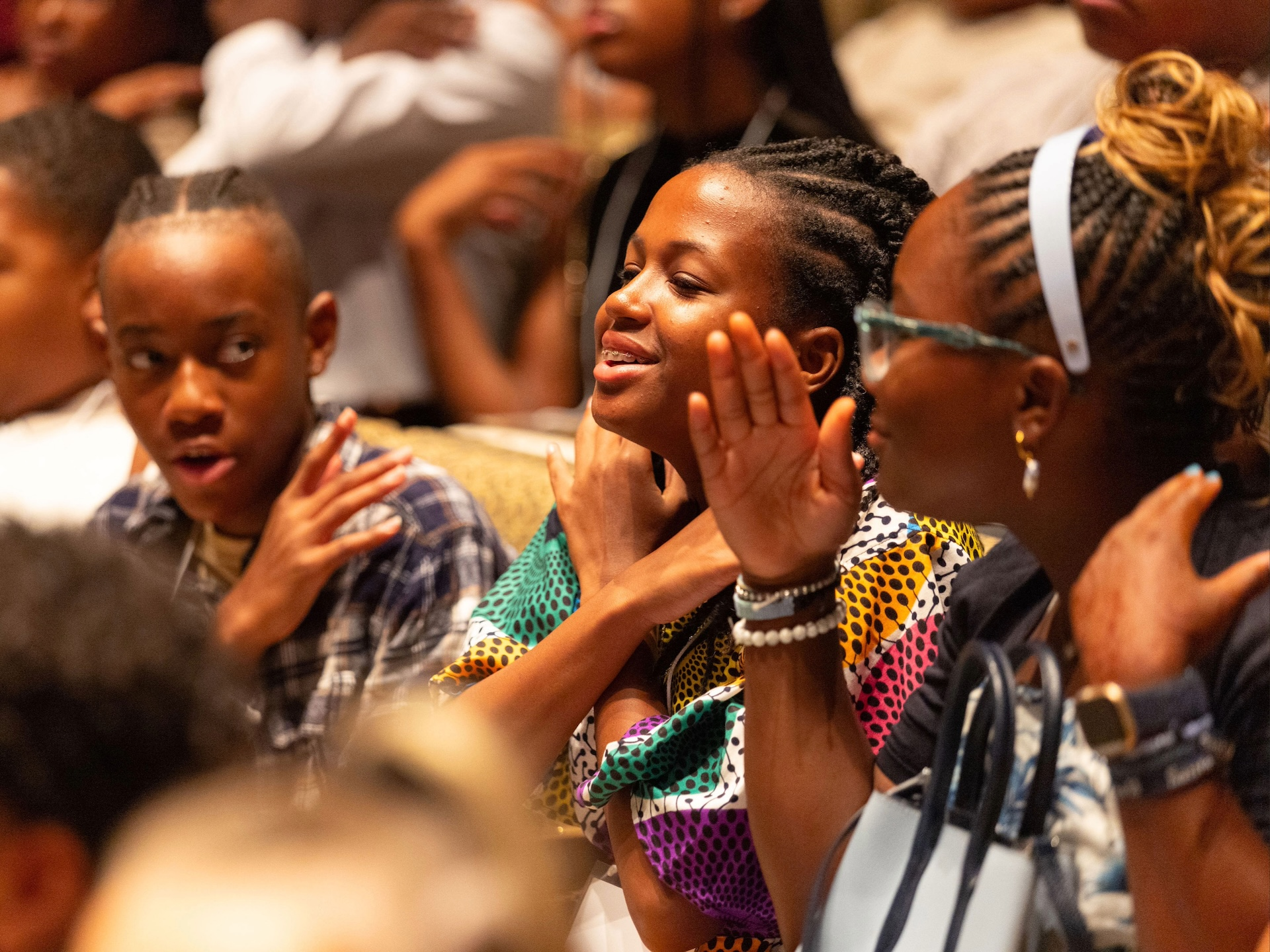
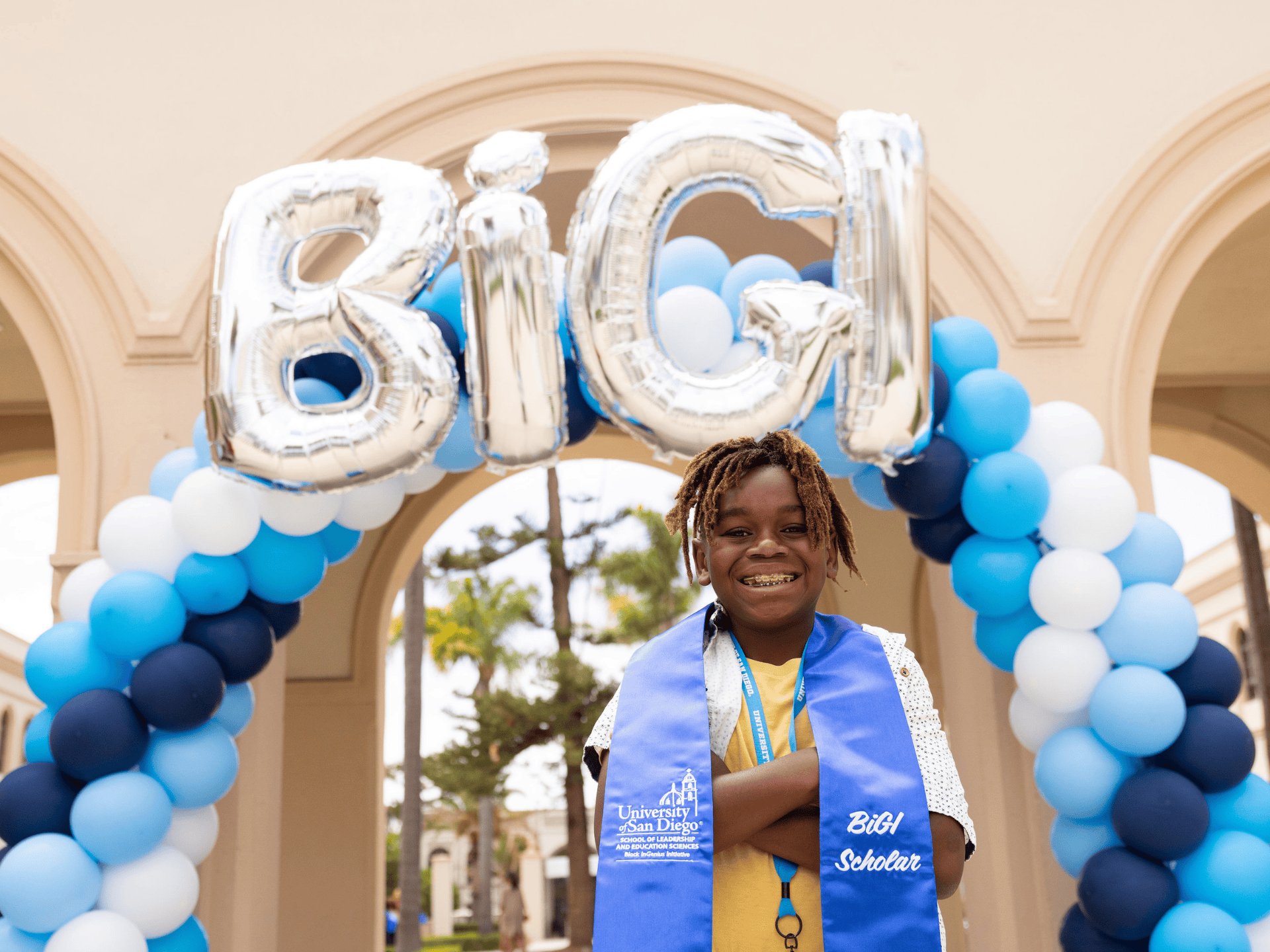
NewsPlanting Seeds for Tomorrow: Milestone Celebration for BiGI CohortMay 15, 2026USD and the community celebrated the first-ever BiGI cohort as they transition from middle school to high school.
NewsUSD SOLES Celebrates Third BiGI Induction Ceremony: Advancing College Access One Cohort at a TimeAugust 25, 2025
Planting Seeds for Tomorrow: Milestone Celebration for BiGI CohortMay 15, 2026USD and the community celebrated the first-ever BiGI cohort as they transition from middle school to high school.
Celebrating the Graduating Class of 2026: Lucia AlcantarMay 13, 2026Stories about USD's graduating students
2026 Undergraduate Honors ConvocationMay 7, 2026USD recognized outstanding students at the annual ceremony ahead of commencement.
Register Now for Franciscan School of Theology's Summer Continuing EducationApril 21, 2026Join us this summer for the Franciscan School of Theology’s Continuing Education program — an opportunity to engage deeply with Franciscan spirituality, theology, and history through affordable, high-quality instruction from world-renowned Franciscan scholars.
Melissa-Diaz CisnerosSOLES Alumna Spotlight: Melissa-Diaz Cisneros ‘06 (BA); ‘15 (MEd), Online MEdTell us about your degree program and why you chose SOLES to pursue that degree. I have done all of my education at USD: my undergrad, my credential program, and my MEd. When I started teaching, I wanted to further my experience with STEAM education, so I met with a few of my past professors. Nancy Hanssen was a big advocate for USD’s Online Master’s Program . I ended up following her advice, and I just loved the program. It really helped me, not only in my field of STEAM, but also in other areas of education. I got to meet some amazing educators like Dr. Suzanne Stolz , who's been a huge advocate for my work in equity and special education. It's opened so many incredible doors. I loved that I could balance my career, new family, and MEd with the help of my peers and professors. Were you planning on becoming a teacher when you first came to USD as an undergrad? No…I majored in political science and wanted to get into the legal field. I've always wanted to help others, especially in the field of special education. After graduation, I worked at a law firm, but something was always calling me to work with children. I did a total 180 after volunteering at Kit Carson Elementary. I was always too scared of my own teachers, so I decided I wanted to change that cycle of fear and shame, especially as a minority with a learning disability. What was your favorite class at SOLES? Oh, wow. They were all great because they were flexible and the materials that were given to us were great. I think it was our research class, because I love to conduct research. Being able to learn how to put my work together in a more structured way was helpful. I appreciate that the class was broken down into smaller chunks, and that each class I took supported my final research project. The feedback from professors was so helpful and it was done in such a positive manner. It never felt like they were talking down to me; it felt like they genuinely cared and wanted the best for me Have you used the results or findings from your Action Research in your work? Have you found it helpful? I have used the research. My research was on the barriers students face in low income communities, especially with access to STEAM. My research has fuelled my advocacy for changes in our education system. I am always finding ways to address these huge gaps in our education system. It has allowed me to bridge out of the classroom and into the community to introduce students to fields of STEAM they never knew existed. I love to see kiddos shine when they discover their connection to these fields. I work at the school I conducted my research at. We are a Title I school and as a school community, we really push for equity. Recently, I worked with my administration to help develop a maker space at my school. We literally built it from scratch. My mission is that by the time my kiddos reach 6th grade, they will be able to code and have foundational engineering skills. My goal is to also make this a place to introduce after school programs like robotics. This coming year is the first year teachers and students will come in and access the lab for science lessons. My goal this year is to support teachers with lessons that are cross curricular and relevant to students. Anytime students can relate to the issues at hand, the more engagement there is. Who was your favorite professor from your time in the program? Oh, my goodness, I loved all my professors! They were all so great. You know, I had Dr. Bobbi Hansen . Dr. Hansen was so amazing – Dr. Hansen and Nancy Hanssen were both great. Dr. Stolz was amazing, too. Gosh, they were all so helpful, even though it was online. I was hesitant to do an online program, but at that time I had just had my son so I needed a program that was flexible. I was hesitant because I had heard of other programs where you never hear from your professors, But the professors in the Online MEd program were very engaging. They were always available and they set us up in these great pods where we had communication with other people in our program. I still keep in touch with a lot of those people. One of my good friends that was in the program is actually up in Sacramento and she and I are always talking about what we do in our different school districts. It's nice that it's just like a USD community - that small-knit community that's developed. They managed to somehow do it online, as well. In what ways were you able to connect with your classmates? We had audio. I don't remember having Zoom back then – that was way before COVID. But we did find ways to contact each other, whether it was through FaceTime or just calling each other. That was kind of the nice thing about being with the same people throughout the whole program – you knew each other and you had that ability to say, "Hey, can we meet on Thursday or Friday and talk about what you wrote in that post? Or can we just talk about the project? I didn't understand what the project was". So we didn't have Zoom, but we had the ability to communicate. Since you live in San Diego, did you ever take advantage of being able to come to campus for support? I did. I live incredibly close to USD, so I was always there. Even though it was an online program, my professors always had their open door policy and I could come in and meet with them, especially towards the end of our research. I came in a lot and was able to ask questions like, "Is this good? What do you think of this? Is this good to support this?" It was nice that my professors were available because, again, a lot of online programs don't offer that ability to come in and see your professors. I also loved that I had access to the library on campus. As a new mom, sometimes I needed that quiet place to work on research. Where was your favorite place on campus? I love USD so much, anywhere you go is super peaceful, like the Joan B. Kroc Institute for Peace & Justice (KIPJ) . I love going to SOLES after hours. Watching the sunset on the West Plaza is pretty cool. I think one of my favorite places to sit and reflect is over by that little pond area at the KIPJ. Sometimes during the summer, I go on campus and get food because there’s a really good cafe. Anywhere you go on campus has a pretty cool view. What is your favorite memory from the Online MEd program? I have so many cool memories. I think one of my favorites was at graduation. My cohort had a little ceremony beforehand because we were the first group to go through the online program. I was three months pregnant with my second son and super pregnant; I felt horrible. But it was amazing and mind blowing to be recognized as one of the lead students in our program. That felt like a huge accomplishment because I was a mom, I was working, and I have always been a struggling student. To be recognized for my work was really awesome. To then share that with my three-year-old – that was the coolest moment ever. Can you share a little bit about what you've been doing since graduating? It's been a cool journey. This is my eighth year here in my school district, and I am now what's called an Impact Teacher. Our school has a high population of second language students and unfortunately, we have the lowest reading rate in the district because of that. I work with about 56 third through sixth-grade students on their reading and writing development. I meet with them every day; we work on phonics, sight words, and developing their reading level. In addition to working with my students, I am collecting data on their development. At the end of year, it's breathtaking to look at the data and see how far all my students have come. Over 98% of my students jumped two to three reading levels. I can also hear them as stronger, more confident readers. Oh, and their comprehension – wow! On top of that, I work with our administrators to help with our STEAM lab. I also work in our district to help with our NGSS curriculum. When I'm not here at school, I'm still working. At UCSD, I work with the San Diego Area Writing Project . I do a few of the youth camps there for writing. Right now we're working on climate change and equity. Additionally, I'm working on my admin credential. I'm also advocating for special education and low-income communities. I've got a lot on my plate, but it's amazing. I wouldn't have it any other way. This school is like my second home. The kids here are very important to me. Recently, we became what's called a Community School. Now our kids have access to paid afterschool programs from sports to arts, health care, dental, vision, and mental health, which is so important. Anything that I can do to improve the school is my mission. How would you say that your education from SOLES has impacted your career? My perspective of education was very different before I came to SOLES. I think, like a lot of people before becoming a teacher, you just think it's fun and you're gonna work with kids. And then I started the program and I started teaching. I love how our credential program is set up, because you get a lot more access to the classroom and you get that real-world teaching, versus some of the student teachers that I've worked with that say, "Oh, my gosh, I was in the program at another school and we didn't have access to the classroom until we actually became teachers". It was mind-boggling. SOLES prepared me and I think that the professors that are at USD in SOLES are truly passionate about education and the various things that pop up – not just how to teach reading and writing, but they're teaching us about special education, equity, and about what to do when you have children that are homeless. That prepared me and it pushed my passion even more. It's also made me think about what I want to do in the future. Eventually, I do want to get my doctorate. And someday I would love to teach at USD, as well. How do you remain involved with USD as an alumna? I participated in the Johnson Fellows for Education Program a few years ago, and I still work with Dr. Stolz. I'm always in contact with Dr. Stolz doing small projects. Unfortunately, I haven't done much post-COVID with our alumni community. I did some work during COVID with Dr. Perla Myers . I taught with Project VisMO , which was super fun. I also participated as a featured alum at a networking event with SOLES students earlier this semester. Outside of that, I haven't done too much. I'm always attending as many events as I can as an alumna. I do want to be more involved – especially with SOLES – because it's an amazing program. It's done so much for me in my field. Can you share a bit more about the Johnson Fellows Program? I participated in the two-year program. During the summers, we met as teachers and we talked about different issues in special education. After those two years ended, I was still involved in the program. You come back and you present to the new group of people, teachers, parents, and whoever is in the program. Unfortunately, I only did it for about a week last year because my son got sick. This year I presented in person on experience, bias, and myths of dyslexia and provided insight into California laws that will ensure all school districts provide yearly dyslexia screening. As a person with dyslexia, I like to share my personal experiences and how it is vital to support all students who struggle. What advice would you give to a current student in the Online MEd program? My advice would be to take advantage of the cohort and the people that are in the program with you. They're a great resource. Also, reach out to your professors! I feel like going from undergrad to grad school is such a different world. Professors in the grad program are a lot more open to your questions. At the beginning of the program, I wasn't doing it as much. But as people in my cohort were telling me they had reached out to the professors, I decided I should do it, too. Take advantage of the fact that you can send out a message or ask questions for clarification. I know, especially towards the end of your action research, that there are so many components. I was lucky in the fact that I live in San Diego so I could go in and ask questions in person. Definitely take advantage of your cohort and reach out to your professors. Any final thoughts? One thing I’d give kudos to USD for is that I noticed when I was an undergrad, I didn't see a lot of diversity in my programs. I completed my undergraduate degree in 2006, and during that time I encountered people who questioned my place at USD. Over the years, I applaud that USD has made some changes and provides more diversity on campus. I love walking into SOLES and seeing people that look like me.
Jennifer Reiter-CookSOLES Alumna Spotlight: Jennifer Reiter-Cook ‘97 (MEd), Special Education; ‘10 (EdD), Leadership StudiesPlease tell us about your degree programs and why you chose to pursue those programs at SOLES. I had just moved out here from Pennsylvania, and I knew I had to clear my credential, so I was looking at a few different universities. I wanted to combine my clear with a master’s, but I didn't know what I wanted to do. I was interested in counseling, special education, or curriculum and instruction, and through touring and talking to different university professors at the University of San Diego, I met Dr. Katie Bishop. Dr. Bishop was the lead for the moderate severe program under special education at the time. I met her and immediately connected and knew that that's what I wanted to do. It was definitely that one-on-one connection with her that ended up influencing me to get into special education. For my doctorate, I knew I wanted to get my doctorate, but I just wasn't sure where. The SOLES EdD program allowed me to research any area that I wanted. I emphasized my research on charter schools, which isn't necessarily something that is a specific program anywhere. I was able to tailor my research, and I just loved the diversity of the program. People had been in the military, in business, and education. So there were a lot of different perspectives in the program, which I thought was great. Who was your favorite professor from your programs? For my master’s program, it's definitely Dr. Katie Bishop. For my EdD program, I think Dr. Fred Galloway and Dr. Bob Donmoyer were my favorites. Dr. Donmoyer was my chair, but those two had an influence on me and took an interest in my success in the program. What were your favorite classes from both programs? For the master’s program, I had no experience in special education. I think my favorite class was the very first class I took, which was just kind of an introductory class. It's actually where I had to go out and do field observations. That's when I knew I wanted to work with kids with more significant disabilities, because of my field experience. That impacted the trajectory of my future – getting the double credential, working with particular students, and such. For the EdD program, the qualitative and quantitative research classes were probably my favorites. Being able to formulate my dissertation and figure out ways to demonstrate data has carried through to support me in different ways in my career, too. At the time, I don't know if I would say the research classes were my favorites, but now I know they had a positive impact, both then and now. Can you share a little bit more about your fieldwork? In the master's program, I initially just did observations. And a lot of times when you go into special education classrooms, the teachers are shorthanded. Instead of doing an observation, you're actually kind of jumping in and helping support the teachers. That's where I got my first sense of what it was like to work with students with disabilities. Even in my student teaching on the East Coast, I didn't have any kids in my student-teacher classrooms who had disabilities. I only had one student who was a second language learner, so moving out here to California, it was all sort of new to me. I got a job after completing nine units of my master’s program as a special education teacher in the Chula Vista Elementary School District. I was working with my own students instead of doing the actual fieldwork for the program. Dr. Bishop would come into my classroom, observe me, and work with me. I didn't have a formal student-teaching experience, because I had my own classroom at the time. How were you able to balance having your own classroom, while still having classes to attend? Sometimes I took back-to-back classes at night. I didn't have kids at the time and I wasn't married, so that was probably helpful. Having my own classroom helped because I could take what I was learning in class and apply it the next day with my students. I feel like it helped me because I only had nine units of courses, so I was still brand new to special education. The ability to go to class at night while I was teaching during the day was helpful. And then with the doctorate program – I got my doctorate in 2010 when my son was seven years old and my daughter was two. I had some experience having a family and trying to balance everything else. But it helped to be able to talk to my professors about that. As you get into the doctorate program, people usually have some life experience, and they're working, and they typically have families, so connecting with other students was helpful, as well as working with the professors who were pretty understanding of that as a student in the doctoral program. Dr. Donmoyer, especially, kept a fire under me, kept me going, and helped me stay motivated to finish the program, which was important to me. Were you involved on campus as a student? I was a grad assistant while in the doctoral program, and I taught some undergraduate classes in leadership studies . That was great because I already had some experience teaching at the college level, but it was all graduate students or students in teacher credential programs, so that was my first time teaching undergrads. It was a great experience to be able to take what I was learning in the leadership studies doctoral program and be able to connect it back to the undergraduate students. Where is your favorite place on campus? The Immaculata is my favorite place because my husband and I got married there, and both of our kids were baptized there. It was also a place I'd love to stop by while I was on campus. A lot of my classes were at night, but if I was on campus during the day, it was a special place to be able to stop in and take a minute to reflect or meditate. The Immaculata is definitely special. Can you share a bit about your dissertation? My dissertation was on charter school closures in California. I looked at nine different charter schools across the state that had closed, and I compared the differences between the legal reasons that the authorizers closed the schools or revoked the charter petitions, and the reasons why the leaders that were there at the time felt that their school had been closed. I initially sent out some surveys to all of the leader contacts I could find that had been the leaders of charter schools that had closed, and then set up qualitative interviews with the nine schools. The schools were as far north as Sacramento or a little further to Palm Desert, to down here in San Diego. I was able to compare and contrast what the on-the-ground reasoning was for why the school closed, and what the experiences were of that leader, and then recommend any sort of support for either current charter school leaders or authorizers to use that information to help the sustainability of charter schools Did you do any work with charter schools once you completed your doctorate? For the past 10 years, I’ve worked for the California Charter Schools Association (CCSA) . It's a nonprofit and statewide organization that supports advocacy and policy surrounding California charter schools. I'm the Managing Director of School Development, which means I help people across the state start new charter schools. There’s a definite direct line between my research and my doctorate, and what I do even today What are your favorite memories from your time at USD? For my master’s, I feel like I made a lot of connections with my peers, and just being able to to support each other in the classroom. Particularly, taking classes with Dr. Bishop and having her come into my classroom gave me a sense of her investment in what I was doing, and she gave me the support that I needed - above and beyond. Especially because I was a brand new teacher and there weren't any resources at the time like there are now for brand new teachers; I feel like she really helped me with that. With my doctorate, again, it was the personal connections I made with professors, and especially my dissertation committee. They just had a genuine interest in what I was doing, understood my passions, and were always willing to meet and talk with me. My favorite memory wasn’t one class or one particular moment, but the sense that I always felt like I was an individual, that I was being supported, and that my professors really did know what I was passionate about and what I wanted to do. That was true for both programs. Can you share what your journey has been like since graduating? When I got my doctorate in 2010, I continued to be a part-time professor at Point Loma Nazarene University in their Teacher Credential Program and their Master’s in Education Program. In 2013, I started working for the California Charter Schools Association. Three years after I got my doctorate, I was thinking about being a full-time professor. I spent some more time at PLNU, and then the opportunity came up with CCSA, and I've been there ever since. I had my 10th anniversary on July 1st. I've always been on the school development team at CCSA, supporting people who are starting new charters. I started as a manager and just worked with schools south of Los Angeles, and since then I've progressed and been promoted. Last July, I was promoted to Managing Director of School Development, and I'm the only person who supports our organization’s school development now. I work with schools across the state and I also run a cohort program for people who are interested in starting charter schools. We do a virtual cohort that lasts two years where we support and connect new people that are interested in starting a charter school with professionals and experts in the field. I also run several programs for our conference surrounding school development. How long and rigorous is the process of trying to create a charter school? At a minimum, it takes two years. And that's if you have a solid team and a lot of time to dedicate to the process. Typically, it takes about three years because once you submit a petition, it can take over six months to get authorized by a district or county. It's a long process. During the first year of the cohort, we offer modules online twice a month, and we have them do deliverables and demonstrate how they’re making progress with their petition. Then the second year is really about getting them to submit their petition and helping them through that authorization process. We assume it's going to take two years based on the length of our program, but sometimes they have to delay another year. This will be our fourth cohort. I'm actually in the middle of doing a dissection of our analysis of all of our schools that have participated and who's open and who has been successful and viable. I would say it's a mix of people that open and people that delay. People who tend to realize it's too much for them to do at this point sometimes come back to us after a couple of years and say, “We're ready to start the process again!” But it can be a pretty intimidating process, for sure. So I hope, with my role, I can help alleviate some of that and get them connected with the right people to create high-quality school choice within their communities. How has your education from SOLES impacted your career and career goals? I still rely on and utilize my Master's in Special Education, even while working with charter schools, because a lot of people who want to start charter schools don't have experience in special education. For my doctorate, even though the coursework wasn't about charter schools (although I'm using my research), I do use the leadership pieces that were part of that program in my work. I've been mentoring other people in a program called “ Women Unlimited ”. I mentor people who are coming into the work world and talk about their brand, how to present themselves, and all those kinds of things. I recently became a court-appointed special advocate for foster youth. I see a lot of my learning coming back to that in terms of leadership, as well as my knowledge in special education and my knowledge of the education worlds or landscape in general, which impacts all of those different areas. I feel that I can offer something unique from my education in all of those different areas. I do feel like I fall back on both of those programs, even though I'm not teaching, but while I’m still working in the broader education world, it's been really, really helpful. It’s helped me move forward in my career, and also take up other opportunities, whether they are volunteer opportunities or other opportunities where I can lend my expertise. In terms of your connection to USD and SOLES, what are the ways that you are still involved and connected – as a parent, as an alumna, etc.? My son is currently a junior at USD. He loves it. When he started as an undergrad at USD, I enjoyed Homecoming and doing the pinning ceremony with him, which was very special. Now, I enjoy being able to go grab lunch with my son on campus and stay connected in that way. I think his going to school at USD has rejuvenated, or reignited, my connection to the university on a more personal level. I still supervise student teachers, which I’ve been doing for a long time with Dr. Amanda Roth in the SOLES program. Staying connected with Dr. Roth and Dr. Reyes Quezada has been helpful to know what's happening in the program. I've taught courses on and off in SOLES, as well, for the Teacher Credential Program. What advice would you give to current students in either program? Take advantage of the fact that the professors are willing to spend a lot of time with you and work with you to make sure you are successful. Don't be shy about meeting with them and taking some time outside of class to talk with them, because anyone that I've had as a professor at USD has been willing to take that time. And I don't think it's always that way in every program at every university. It's the same advice I give my son: take advantage of going to office hours, make meetings with your professors, and help them get to know you on a personal level and what your interests are. Maybe they have some networking opportunities for you or some ways for you to get involved that might help you with your area of interest. That would be my biggest piece of advice.
Juliana AbercrombieSOLES Alumna Spotlight: Juliana Abercrombie ‘16 (MA), Clinical Mental Health CounselingPlease share about your degree program and why you chose SOLES to pursue that degree. Earning my Master’s in Clinical Mental Health Counseling was kind of a journey. I started with my Bachelor’s in Psychology and Spanish, and I loved it. But, I specifically did not want to do counseling – that’s what I told all of my advisors when I was graduating from undergrad. Pretty frequently, I got these nudges: “But you know, you should consider it. You like people, you like psychology. Those things really come together.” I did some more exploring post-undergrad, and that's when I got to know more about what it means to be a mental health counselor and a therapist, and I kind of took myself out of that stereotype of what a therapist is. Once I actually understood more of what it meant - it was beautiful. I reached out to my undergraduate professors and learned more about what their experiences had been, kind of the practical applications of psychology, and decided that I did want to be a licensed professional clinical counselor at some point. As I was looking into programs from there, USD immediately jumped to the top of my list. One, because San Diego is gorgeous, and being from Texas, I knew I wanted to move somewhere that had better weather. Looking into USD, the focus on social justice and the international experiences and I for a very long time had a strong connection and passion for serving and working within the Latinx community. That’s how I identify, as well, so that work has always been really important to me. USD has such a strong foundation and collaboration within the Linda Vista community, which is very diverse and has a lot of immigrant and Spanish-speaking populations, which was everything I wanted to do. I applied to USD and didn’t hear back for a long time, so I committed to a different graduate program with a slightly different focus area. I was able to connect with Dr. Ana Estrada and talk to her more about the program, getting a firsthand account of what it’s like to be a student and a Torero. Talking with her made me realize what it could mean for my professional and personal development to be in San Diego and at USD, and have the opportunities this program offers. That is ultimately what got me here. I love people, I love service and especially serving those who are traditionally under-resourced or traditionally, maybe not considered for some programs, especially in the world of mental health. USD offered me every opportunity to learn how to meet that need and to do it in the best way I possibly could. So it was kind of a match made in heaven, and it worked out really nicely at the time. So I was very, very happy that I got to ultimately switch my decision and come to USD for my graduate program. Who would you say was your favorite professor during your time in the program? I have to start with Dr. Estrada – she was amazing and the reason why I came to USD, as well as the reason I survived the experience. She was such a wonderful mentor and colleague. I loved her Positive Psychology class and that kind of fed that interest area for me. Her mentorship was huge; she was there for me professionally and personally, in navigating what it’s like to be an out-of-state student coming to USD, and what it’s like to sit and wrestle with my own identity and how that was impacting my professional development and my personal experiences. I identify as white Latina – I am bicultural, and biethnic. Dr. Estrada helped me to explore that and what it means as a counselor. How is that serving me in my personal life and in my self-care, as well as does it show up professionally? What does that mean for me in the passions I serve and the populations I want to work with? Huge shoutout to Dr. Estrada. She was also really great with advice and mentoring after graduation as I moved into the professional roles there. What was your favorite class in the program? I have to say my favorite class was Positive Psychology because I just loved it. It was something I had already had a personal interest in, and I was already involved in research with Dr. Estrada and positive psychology at that point. Being in the class allowed me to get information and perspective on parts of positive psychology that we hadn’t touched on in our research group since we were very focused on interventions and experiences of immigrant youth, in particular. The class was more wide-reaching – we got to go over a lot of different topics. We got to select and deep dive into areas that particularly appealed to us. I even got to create my own intervention plan – my own positive psychology program that was informed by the research I was doing with the group, but was uniquely my own, so it was great. Through that because of the topicality, themes, and pillars of positive psych, it’s also really informative for personal growth. It became a space to hone in and strengthen myself, and that’s something I’ve definitely carried with me and still use within my professional focus on positive psychology. Can you explain briefly what Positive Psychology is? Positive psychology, in the simplest terms I can think of, is the study of thriving. How do we move from being someone who is surviving in life to being someone who is thriving? That includes making space for negative and positive experiences. How do I recognize that when bad things happen, maybe I can learn from it and my strengths – like resiliency – can support me in overcoming whatever the negative experience might be? On top of that, how do I savor it? How do I find ways to practice gratitude or practice savoring and being mindful of the present moment? In my experience, positive psychology is all about taking what's working and reinforcing it – having it work even better, and expanding it so it works in different areas of our life. Can you talk a little bit about your position as a Research Assistant? I was a part-time research assistant, first for Dr. Mae Gonzales, and then later officially for Dr. Ana Estrada. The research was specifically focused on the experiences of immigrant communities. What does it mean to be a Spanish-speaking immigrant coming to the US and San Diego? How do you access resources? How do you foster internal strength for yourself and for your community? During the three years I worked with Dr. Estrada, we created an intervention plan and got to work with local Linda Vista schools to implement programs. We did a couple of two-week programs and a couple of every other week programs working with local middle schoolers, and older elementary students, as well. It was really neat; we did it in English and Spanish. Did you have any other involvement on campus as a student? In addition to Dr. Estrada’s work, I worked with Dr. Gonzales and we did a lot of research presentations, as well. We went to several local conferences, and the national AMHCA conference, and we presented on the actual research we were doing but also the actual practical application of the research knowledge. I was a SOLES Student Ambassador, and we went to a lot of the different events on campus for incoming and current students. I had an official Graduate Assistant (GA) position through undergraduate admissions. I did that for 2.5 years, and that was about 25 hours a week. That was in addition to working a part-time job off campus, too. I definitely kept busy during graduate school! Can you talk about your international experience? We were a relatively small cohort, but I want to say that almost half of us ended up going on a trip to Madrid. We got to be in the USD Madrid Center for the program in Central Spain for a summer international experience traveling with Dr. Ana Estrada and Dr. Moisés Barón. While there, we took Group Counseling and Multicultural Counseling, and we lived with a local family. I rode the metro to class every day and we had longer weekends so we could explore the city or other parts of Spain. We were doing our own independent research into different multicultural topics. I was focusing on the experience of immigrants in Spain, and how they may have similar or different experiences to those who are immigrating to the United States. It was amazing! We got to explore the culture – as much as you can in three weeks in a different country. We got to get close to our host family…our host parents taught me local recipes, gave me pointers on my Spanish, and gave us recommendations for where to go on the weekends so we could get to know more about the country. One of my absolute favorite experiences was when a group of us took a long weekend and went down to Southern Spain so we could explore Granada and Sevilla to understand more of what it’s like to be in the southern portion of the country. Central Spain, the capital is beautiful and amazing. It has so many incredible people and areas to explore. Southern Spain feels very different. Seeing what it’s like for immigrants in that part of the country and for us to be able to explore a different side of the culture and history of Spain was amazing. That became a big part of the culmination of our international experience, too. As for the living situation, we all got paired up. My housing situation in particular was me and two of my classmates. We each had our own room, so we were staying in a house that had 3 spare bedrooms so the 3 of us had our own space. We had dinner every night with our Spanish family, and oh, they were just wonderful! We were there over the Fourth of July and we came home from classes that day and our family had sparklers out on the patio for us, she made hamburgers and said they wanted to celebrate with us as well. So we had a fun Spanish celebration of American Independence Day, and it was so cool to have that exchange of cultures. Can you talk a little bit about your experience as a student during your practicum/fieldwork? My practicum year was the third year of my program, and it was probably the hardest year of my program because it was a chance to take everything I’d learned for two years and go do those things. For my practicum year, I was an intern at the Alvarado Parkway Institute (API), which is an inpatient psychiatric hospital in La Mesa. I was there as part of the psychological services team. I did individual therapy, I did group therapy, and I did rounds checking in on clients or patients in varying states of need. It was something I specifically chose because I wanted to challenge myself. I wanted to put myself in what felt like the most intensive experience I could find during my practicum year because I had so much support. During my practicum placement, I had individual and group supervision at the psychiatric hospital with their team, and I had individual and group supervision on campus with the faculty and professors. So doubling supervision everywhere, I felt ready. It was really hard serving folks who voluntarily, and a lot of the time involuntarily, were in the hospital for an assortment of needs. It was hard and I’m so glad I did it. I got to try out all the skills I had been learning, adjust, and find more of my style as a counselor. I loved the clients I got to work with, and my team there; it was great. Were you the only student doing your practicum there? There were a bunch of us. API keeps a pretty big psychological services office because they serve so many folx in the hospital. From SOLES, there were probably five or six of us who were all interning there at the same time, in addition to master’s and doctoral level interns from a whole bunch of other programs across San Diego. We would come in, and everybody would be comparing notes from classes and comparing notes from the clinical perspective of their faculty members. It became a cool growth opportunity and it expanded my perspectives professionally. It was also a really great networking opportunity; I’m still connected with a lot of those interns, either as friends or colleagues. Where would you say your favorite place on campus is? It’s different now than when I was a student. As a student, it was absolutely Bert’s Bistro . The outside patio has to be my favorite, whether it’s for studying or just catching my breath and staring off at the bay in the distance. Everything about Bert’s somehow always matched whatever energy or vibe I needed. Every time I walk in there – even now – I instantly just get a flash of the memories of meeting with my groups, working on projects, or even coaching myself to make sure I eat before I go to class. I would say Bert’s was my favorite spot. Now as an employee, I've shifted to across the street, and I love Garden of the Sea – the garden behind the Joan B. Kroc Institute for Peace and Justice building with the reflection pool and benches. It is always calm. Without even saying anything, people seem to know and respect that it is a quiet space to restore. Whenever I can, I will take a little stroll down to the reflection pool to just have a sit and breathe to recenter. I didn’t spend enough time there as a student. What would you say is your favorite memory from your time in the program? Oh, gosh! Favorite memory? That is really hard because I have a lot of them. I’ll name this: one of my absolute favorite memories is through the research assistantship. We were doing an outreach program with a local middle school. All of us who were involved were preparing to do day three of our program. Dr. Estrada was there running command, making sure everything was coming together, and each of us students was in charge of different interventions for each of these students. That day nothing was going according to plan. It became an exercise in flexibility for us. How do we adjust to being able to carry out the interventions, the programs, and activities that we had planned for these middle school students today in a way that respects the heart of what we're doing, which is to be there and present and nurture strength and positive psychology themes in our community? We ended up pivoting and having to do emotion charades with the students to teach them how to effectively identify their own emotions and recognize emotions in other folx. Our team put our heads together and adapted. Dr. Estrada was behind us, making sure the school administration was on board. We had such a flow. It was so clear to me at that moment how much we all cared. How engaged and invested we were in the research, in the work, and in the community. It was a really strong reminder for me why I chose USD, and why I wanted to be a mental health counselor. Can you talk about ways you’ve remained involved with USD as a SOLES alumna? I did teach one course, Positive Psychology, during an intersession term. It was during the tele-learning experience, which was interesting and unique. It was a quicker course because the intersession courses are only about three weeks long. It’s such an important topic and I was able to co-facilitate that with another SOLES alum, my colleague and cohort mate, Colene Lippman. It was a great experience, I’ve also come back to campus several times to do panels for current CMHC students. I’ve done alumni panels on finding jobs after graduation and panels on how we’ve used positive psychology in our work with individuals who have really severe and persistent mental health conditions. I've come back and done some things around conferences on campus and been an alumni rep at some of those, as well. For the most part, my involvement was coming back and participating in the panels to give an alumna perspective, and teaching the course. I currently work on campus in the Counseling Center , but previously when I worked in the community mental health clinic, I also had the opportunity to supervise some of our clinical mental health interns during their practicum year. That became a great way to foster and carry forward some of my experiences and share them with new interns. Can you share a little bit about what's happened since graduating from SOLES? Not long after graduation, I accepted a position at the Maria Sardiñas Wellness and Recovery Center, which is an outpatient mental health clinic in South Bay San Diego that serves around 600 clients who are all experiencing severe, persistent mental health conditions and typically have challenges accessing housing or food resources. A lot of folks who are uninsured or may have Medi-Cal insurance. I did that for five years; starting as a clinical case manager, stepping into bilingual roles, and working my way up into management, which is where I had the opportunity to supervise some of our CMHC interns who came to the site for their practicum. I loved that work. The research, the classes, and even my practicum while a student at USD prepared me to be able to do community mental health during that time. I absolutely loved it and learned so much. About a year and a half ago I made the transition and came back to USD, now as a mental health counselor with our Wellness team and the Counseling Center on campus. This is kind of coming back to the heart of what I originally wanted for counseling. When I first applied to USD, I talked about the passion I had for serving my Latinx community, the passion I had for serving Spanish-speaking individuals, and the passion I had for serving young adults, which was something I just hadn't had the opportunity to do as much. Being back on campus, getting to continue serving those passion populations, and coming home to my Torero family – to my USD community – has felt very full circle. Giving back to it and getting to serve all those populations, especially on a campus where sometimes, looking around, we don't realize how much diversity there really is here. Being able to intentionally create a space for students to be. Whether you're an undergraduate or graduate student, a professional continuing education student, anyone coming into our Wellness office is a human first and foremost. How can we support you in whatever state you may be in? It's been like coming home, and a cool opportunity to bring it all back together and come back to campus. How did you find your way back to campus? It was through the professional network. When I was leaving my position in community mental health, I was kind of looking out to see where I wanted to go next. I knew it was time for a change. I wanted to come back to something that served my passions. I reached out to Dr. Ana Estrada and said, “I'm considering this. Can we meet up for coffee? Let's talk more about this”. Through my conversation with her, I got reconnected with Dr. Christopher Burden . I started talking with the team here and some opportunities were coming up, so I applied and rejoined USD as a temporary counselor to help fill the need for a lot of folks coming out of the pandemic quarantine seeking services. Around the same time, one of my cohort mates also came on as a temp counselor to help out. It was through that network, the USD family. Within the mental health realm, but especially in the USD Counseling realms, folx keep in touch. We know and recognize the heart of what drives us, and it's been a really good community to stay connected with. It's very helpful and very supportive, professionally, and really warm and nurturing, too. It's a much closer connection than I expected to have with any of my professors. There are a number of them that I've kept in touch with since graduation. Dr. Estrada and Dr. Burden are the primary ones that I have the most contact with, but definitely not the only ones. How would you say that your education from SOLES has impacted your career and helped you set career goals for the future? I mean, it's all of it. I came in with a lot of raw material. I knew I had an interest in people. I had some background in psychology. I knew vaguely where I wanted to go, and the kind of work that I wanted to do. SOLES gave me clarity and it gave me direction. Not in the sense of someone else deciding “This is the path that you're on”, but really empowering me and encouraging me to find the path that felt right for me. Through the CMHC program and my graduate education, I learned the practical skills I needed to be a therapist. But I think the larger impact was the personal growth in figuring out who I am as a therapist. That includes where I wanted to go with it. The people that I want to serve, the work that I want to do, the advocacy, and expanding my own experiences that I wanted to keep exploring. SOLES planted a lot of seeds and then helped those grow in a direction that felt true and authentic to me. I like mental health. I like being a therapist. I'm so glad I found my way back to counseling after my undergrad. What do you do for your own self-care, mental health, and wellbeing? It changes depending on what's going on for me. That was something I thought was big during my graduate education. We always talked about self-care. We talk about it, and you need to do it, and you need to learn it, and you need to get something that works for you. But no one ever actually tells you what yours is supposed to be. It is intentional because it is unique to the person. But for me, something I found my way back to during graduate school was running. I had always found running to be an escape when I was younger, but not something I had intentionally done outside of organized sports. Running is a big self-care for me now – and walking my dog. Through my master's program, but especially during my practicum year, I realized how restorative it was for me to be outside. There is absolutely nothing better to me than sitting under a big leafy tree when the wind is blowing. That is my happy space. So I will gladly take a run, take my dog for a walk, drive, row, whatever it takes to get to a spot where I can spend some time outside. It's very calming for me. What advice would you give to a current Clinical Mental Health Counseling student? I would say to take it all in and breathe. The graduate experience is incredibly busy and challenging regardless of your program. I can say from the CMHC side that it was really hard. It was something I was passionate about and something I knew I wanted to do, but it was really hard. Having the chance to catch my breath to pause, really look around at what I was doing, what I was learning, and where I was starting to figure out to go next. Taking that time to catch my breath, I can remember the things that I'm grateful for, the things that I'm driven for, and that I don't have to do it alone. Professors and classmates, and grabbing a snack at Bert’s after class. Remember to catch your breath and take care of yourself. It's just as important as ever to eat, sleep, and drink water – things that are pretty quickly shoved to the bottom of the to-do list when you're a busy graduate student. Just remembering to pause and breathe, and check-in with each other, is the biggest advice I would give to somebody.
Tinesia ConwrighSOLES Alumna Spotlight: Tinesia Conwright '13 (MA), Nonprofit Leadership and ManagementPlease tell us about your degree program and why you chose SOLES for the program. I originally wanted to pursue an MBA. I was looking into different MBA programs, and was really on this professional development journey. A colleague of mine suggested that I apply for LEAD San Diego . I applied for LEAD San Diego and I ended up getting accepted. One of the seminars focused on nonprofits and how they impact the region. Pat Libby did a great presentation, and it made me think that’s what I want to do . I wanted to do something that impacted my community, not something that would have me working 40 to 60 hours a week with no impact. I didn't know I'd be working the same amount of hours with less money, but here I am. I knew that that was where I was supposed to be after seeing Pat Libby’s presentation. I started going to all of the SOLES open house events, developing a relationship with Pat, and doing what I had to do to apply to get into the Nonprofit Leadership and Management Master’s Program at SOLES. Were you working while you were in the program? Yes, I was working full-time at the San Diego Housing Commission. I guess that was the introductory period of my learning more about nonprofit work. Everyone knows about charity, but you don't think about nonprofits as businesses. The San Diego Housing Commission administers the Section 8 Rental Assistance Program. I was a manager and I had a team of 12 people. They were calculating rent portions, and so I would get all the complaints about people who didn't like their rent portions. I was thinking, “If they just had someone to give them a chance to increase their income and get a better job, then this wouldn't be a thing”. There ended up being an opening in our Workforce and Economic Development Department. I applied for that role because that was my belief: people are not on the system and receiving assistance because they want to; it's because they have to. If they had the tools and the resources they needed, they would be able to do better for themselves. I went to the Workforce and Economic Development Department, and that's when I started to learn about grants, community resources, community partnerships, and all the things that go on behind programming to provide financial literacy and workforce development. Those types of skills and tools- help people move up and out of poverty. I fell in love with the work that was going on in that department, and that was the premise of why I changed from pursuing my MBA to getting a nonprofit degree – because I knew I wanted to do more of that work. I was also starting something in my own neighborhood, working with girls. I knew that I wanted to pursue a career that would allow me to do more of that because I was passionate about it, versus going into something that I didn't really care too much about. What would you say was your favorite class in the program? The program evaluation class taught by Dr. Laura Deitrick was really hard. That's where we learned how to create an evidence-based program and to focus on the outcomes of the work that we're doing. Essentially, it taught us the mechanics of programming. Which, oftentimes in the nonprofit field or charity work, people do things because they have a love for it and they just want to do it. When in Dr. Deitrick's class, we were asked to think, “But is this really a need? And is it working?” That was a great class because the project we did for the class was about founders of grassroots organizations that end up burning out because they don't scale and build the organization to a level in which it can survive beyond them. That's what I was seeing in southeastern San Diego. You can still see it today: you have this great idea, you go out and you start a nonprofit, and it's doing well. Now, everybody wants your time. You're doing all the things instead of getting help to do all the things, and then you end up burning out after a couple of years because it's too much to do. The need is so great. In the class, we put together a mock program that would help those folks grow the organization and have some type of succession plan, so they're not the only ones doing everything, so they don't burn out, and the organizations can continue. Did you have a favorite professor from your time in the program? I liked Deirdre Maloney , who taught the marketing class. She had a lot of great marketing insights that we were able to learn. Because as a nonprofit organization, it is definitely hard to have marketing that's of high quality and affordable. That was a great class, too. Some people stick out, like Dr. Laura Deitrick and Pat Libby, because I still see them. Liz Shear, who taught the board governance class, was also great. I enjoyed her because she had a very casual way of teaching that was still impactful. Can you share a bit about some of the consulting projects you worked on? My favorite nonprofit that we worked with was The Tony Hawk Foundation …because it was The Tony Hawk Foundation. They had a big ramp as a part of their office space in a warehouse in Poway. That was probably my favorite project because I not only got to go there, but the board member I was interviewing had this awesome house in Del Mar that overlooked the ocean. I wondered to myself, How do I get here? It was great to be able to have that experience talking to that board member about the work that the foundation does and how they got involved. That was a great project. Then we also did Second Chance , which is an organization in southeastern San Diego, and we helped them do a board manual. That was good because I felt like they appreciated it and would use it moving forward. Knowing that Second Chance was a part of the community that I work in and that I'm passionate about, it was good to feel like we actually did something for the community. Second Chance was one of those places where you drive by all the time and you wonder what they do, or you kind of have an idea but you don't really know. It allowed us to learn more about the organization, what they do, and the impact that they make. Was the international requirement in place when you were a student? Yes. I got the opportunity to go to Mondragon, Spain, and we went one week early to explore Barcelona and Madrid. That was a cool experience. It was my first international trip outside of Tijuana, Mexico. It was my first official international trip. When I joined SOLES and I was taking my first class, it felt really intimidating because I got my undergrad degree in 2004 from San Diego State University. All these years had passed, and now we're in 2011 and I'm pursuing a graduate degree. I felt intimidated and I doubted my ability to succeed in the space. During the class, we talked about international philanthropy. Other folks in the class had experience and the knowledge of how things worked in other countries, and I didn't have any of that. I felt insecure about it. So to go from that space to ”yes, I've been to Spain and I know how they do things over there” – it’s a full circle. It was a great class and a great experience. It was a jam-packed schedule like 8 a.m. to 8 p.m. We did a lot of exploration, and the country is gorgeous. We learned about their economy, their nonprofit sector, and how it's different from ours. Can you talk a bit about the process of putting your portfolio together? That was crazy and it was a lot of paper. It was almost like writing a book. Even though a lot of the projects were done, I was redoing papers and collecting my best work. It was a great reflective period because I got to select the projects that were most impactful to me. It was something that I really had to focus on to complete. It was one of those go to Starbucks and plan to stay there for a couple of hours kind of thing. And don't bring anything else so that you can get this done. I think I still have my portfolio around here somewhere, believe it or not. What would you say is your favorite memory from your time in the program? I met a lot of great folks in the cohort and we are still connected today. That is my favorite memory – being able to connect with people and form lifelong friendships, support each other in our career growth, and clap for each other. A lot of my cohort have kids now, so I’m watching their kids on Facebook and stuff like that. The people were definitely the best part, starting from the interview process. Because it was a panel, when we all got let out we shared in expressing things like “That was so stressful! How do you think we did?” So the camaraderie started from that point all the way to graduation and through every class in between. We all have big hearts, we are in the nonprofit space, and we all care a lot about our community. It was a blessing to be able to have that experience with others who you care about, who care a lot about you, and folks you’re able to grow with even beyond the program. Can you share what you've been doing since completing the program? I launched my nonprofit DETOUR in 2009, so I was essentially at the beginning of the nonprofit when I was accepted into SOLES in 2011. I started the program because my mom is a foster parent; she had a bunch of foster kids, and I grew up with an understanding of the foster care system and wanting the kids to have a better life than the cards they were dealt. I started DETOUR casually and I realized I wanted to commit to it, which is the whole reason why I went to school and earned my master’s degree. I wanted to do that and be good at it, and I’m still doing that today. It’s a great organization. I was able to grow it from just a volunteer organization to now our budget is half a million dollars. We have staff and we are serving 140 girls every month during the school year. We have a leadership academy that consists of an after-school program at 11 different school sites, a community-based program, a paid internship program, and a scholarship program. Being able to give girls additional opportunities is what I love to do, and that’s what I’ve been doing continuously since I graduated from the program. I’m running DETOUR and also All About Girls of Color , and that is creating an ecosystem of supporters who are advocates for girls of color across all systems working towards systemic change. We do professional development training and also launched the podcast in January 2023, which highlights different women in our field who are doing great work pertaining to seeing girls of color thrive. I wrote a book that came out this year. Find Your Flair in essence is my message to girls to find that thing that makes them stand out and makes them comfortable with who they are. Oftentimes we feel like we have to fit into someone else’s picture of who we are, who we’re supposed to be, and we don’t feel comfortable operating in our own strengths and excellence. Find Your Flair is exactly that. You have a flair inside of you; find it and share it with the world, and be okay with that. Be your best authentic self according to the things you like to do and things that you love, and those things will impact the world. Also, I was a Kellogg Fellow. I was part of the W.K. Kellogg Leadership Community Action Network in 2019. It was an opportunity for 80 people around the country to come together to strengthen and develop our leadership skills. That was a great opportunity because I met people from all over the country doing great work across various nonprofit sectors, government sectors, and traditional businesses. I also did RISE San Diego in 2018. RISE is an urban leadership development program right here in San Diego. I got the opportunity to do some technical training with them for small and emerging nonprofits. I want to see more organizations like DETOUR out there doing their thing, so anytime I can coach, advise, or just help folks build up their skillset in order to build organizations that thrive, those are things that I enjoy doing. How would you say your education from SOLES has impacted your career and the career goals that you've set for yourself? For me, it was the foundation. Having somewhere to go to learn more about improving the nonprofit sector was very important to me because it nourished the seed I already had inside of me. I’m grateful for that because I didn’t have to shift what I wanted to do; I didn’t have to fit into a business program or a youth development program. I didn’t have to shift to any other degree to accomplish my goals. It was a foundation where I got to learn all the things that I needed to learn in order to build a strong and thriving nonprofit, and then also have that support system to support me emotionally along the way because I was going through it with other students and professors that also have a love for the work we do. The fact that a lot of the professors were practitioners was important, as well, because they were able to give first-hand insight into real-life situations. They weren’t just talking about theories they had no idea of, but they were able to portray the practicality of the theory, as well. Since then, it’s been like a secret society to come across other people who have gone through the program. I still have people calling me who plan to apply, asking me how it was and what advice I have for them. I run across colleagues all the time that are either enrolled or have recently finished. It’s a joy to see and be able to celebrate their experience in the program and compare notes and how the program has changed over the years. Being able to go back to events on campus , like the Nonprofit Governance Symposium and the State of Nonprofits, and seeing good work being done by the university and SOLES, and running into old classmates and colleagues in those environments is really nice, as well. Do you have any advice that you would give to a current student in the Nonprofit Leadership and Management program? Stay authentically yourself. There is a market for whatever it is you want to bring into the sector. That was something I was grateful to have the experience of, as I am from southeastern San Diego and I wanted to start an organization to empower teen girls. I had already started the nonprofit, but I wanted to grow my work, specifically in southeastern San Diego. I had no one challenging the vision I had, which allowed me to stick to it and really get it off the ground and grow it into what it is today. Whatever it is that you want to do, stay authentic in that and ride that thing until the wheels fall off. People have so many great ideas and, in essence, there is a tribe for that idea you have, but it's up to you to bring it to fruition. You have to believe in yourself and your ability to be able to see it through. That would be my advice – keep going, don’t stop. Any final thoughts? I’d like to see more people of color take advantage of these opportunities, and more black people specifically because I feel like we are out here and doing the work. Having the education and the structure behind it would make it more successful in the long run. I’m an advocate for black people joining the program. I loved my cohort and the mix because we had folks from every race. It allowed us to get different opinions for the different scenarios that we are faced with. It created a rich environment when it came to learning, growing, and being able to connect with different types of people while you’re early in your career. I loved that part about it.
Nathan SwettSOLES Alumnus Spotlight: Nathan Swett '12 (MEd), Special EducationPlease tell us about your degree program, and why you chose to pursue that degree at SOLES. I received my AA and transfer degree from Grossmont College. I then transferred to San Diego State University (SDSU) and received my BA in Theatre Arts. While I was at SDSU, I was also working at the Joan B. Kroc Institute for Peace and Justice (KIPJ) on campus at USD as an AV technician. As a USD employee, I was able to get a degree from the university. I looked through all the degrees that they offered for a Master’s in Technology. I’ve always been technology driven and focused, but I was also interested in going into special education because of my own learning experiences growing up with an IEP (Individualized Education Program) and not getting access to assistive technology (AT) until my years at Grossmont College. Thus, I didn’t get introduced to AT until my years in college, e.g. text-to-speech and reading my textbooks aloud. I felt like I could do something that would help kids at a younger age get exposed to technology to help them in school and feel more confident - that’s where I was thinking that degree in special education would take me. I enrolled in the Master’s in Special Education program at SOLES so I could go into education and help those students with learning challenges and give them resources so that they could succeed and not have the struggles that I had. I wanted to make a difference and impact them earlier in their lives, instead of waiting until higher ed, or not even making it that far. What was your favorite class during your time in the program? I enjoyed the Assistive Technology class, not just because I was interested in it, but because of our professor Jamie Tate-Symons . She was an adjunct professor and she was very connected. I always said, “if there’s anything that comes up, let me know because I’d be interested in working in this field”. That semester, she contacted an app company, and really got me connected in doing some side work in the field and changed the trajectory of where I headed in the field, as well. That was my favorite class because of that connection, and I think that’s what USD provides: smaller class sizes with adjuncts who are still active in the field and have connections. Who was your favorite professor? Dr. Anne Donnellan is probably my favorite professor because of the field I was going into. She became a mentor and helped me with a lot of things for my recommendations, encouraged me toward a more advanced approach like my doctorate degree, helped me with my research, guided me a little bit after I graduated from USD, and was a mentor for me in my field. Can you tell us about your Action Research? I did my action research in the field of assistive technology. I got a job through working with the assistive technology app company called AssistiveWare. I did some research on implementing augmentative alternative communication (AAC). AAC helps people with autism who are non-verbal to be able to communicate using technology. For example, using an iPad to touch on words displayed in a grid allows them to speak and communicate. I did my actual research around implementing that process and when I went into the field as an expert, I did that. I was still fresh and new, and the technology was just coming on, too. After I graduated, I did a lot of in-service teacher training around my action research on AAC. Were you a student teacher while in the program? I was a student teacher at a Julian Charter School. It was great because they were using a lot of technology. I worked with students from all around San Diego and those students came in using different models of learning, using all kinds of technology, and I was helping them learn with the technology. This was a great opportunity for me. That experience of student teaching in special education and working with all types of students really helped me develop some ideas of what's out there and some of the software that schools were using. I took all that knowledge and implemented it into my first teaching job right after I graduated. How did you navigate working at the KIPJ while also student teaching? That was challenging. Luckily, the KIPJ was very flexible and there were two of us working there. I would do a lot of the nighttime and weekend events. That's how I was able to balance that. I did work a lot during my student teaching and it was very challenging at times. But I did it. I even continued working after I was teaching and continued with that schedule of nights and weekends. Where was your favorite place on campus? It was probably the reflection pool at the Kroc School because of the views. I would go there and have lunch, sit at the picnic benches, and often have lunch with colleagues or whoever was on campus. What would you say is your favorite memory from your time at SOLES? The fact that I was able to work and go to school across the street, which was convenient for a lot of reasons. I knew many people on campus so I felt very comfortable there. It kind of felt like home. It was great to be able to work at USD, and have everyone know who I was. I could almost go to work, take a break so I could go to class, and then come back to work to close up. They're very flexible and it was convenient that I could do that. That creative schedule is what allowed me to get my degree while student teaching, working, and going to class. Can you share what you've been up to since graduating from SOLES? I've been up to a lot. I started teaching in special education as an assistive technology specialist. I was conducting assessments and providing services for AT & AAC. I continued working at the KIPJ as an AV Tech, and I was working for AssistiveWare (the AAC app company). I was working a lot and I stayed extremely busy, but it was really fun. I like to be busy as it keeps me motivated and driven. I kept on getting more and more job opportunities, teaching experiences, and networking opportunities. Eventually, what it all led up to was me being so busy and overworked that I decided to go back for my doctorate at SDSU. Right before I started that program, I became an adjunct professor at SOLES - full circle. I was teaching special education and assistive/educational technology courses. SOLES started developing more courses in technology, and I had that background and skill set. I also was developing courses for SOLES for educational technology programs. I started developing and shifting from assistive technology into more of the educational technology, and then started implementing more about UDL (Universal Design for Learning) and blending how all those three work together: educational technology, assistive technology, and UDL. Then COVID hit. I went into more of a consulting role, did some consulting work, and helped with developing curriculum online, and helping organizations implement digital lesson plans for science and math. My hope was to become a full-time professor at SOLES. But since COVID, getting full-time work has been challenging. This year, I started a new job and now I do wheelchair assessments for individuals with mobility needs. I build custom power and manual wheelchairs from pediatrics to adults. I am still teaching courses at USD, and have been teaching at CSU Northridge. The CSUN course is an introduction to assistive technology. That CSUN course is a certificate course for teachers in California who want to become assistive technology assessors or AT specialists. They take this course as a requirement. We usually have about 60 students in that course, which is year-round. I just finished developing some new courses for USD within the Online MEd program to get a specialization in EdTech. How would you say your education from SOLES has impacted your career? It gave me confidence. USD’s rigor and the levels of knowledge I gained from them really helped me in my field. I felt I was very prepared to go into the field, especially since I focused on technology and that is what I wanted to do. Having all those adjunct teachers who were still active in the field was great because they brought a lot of day-to-day classroom practical knowledge. The connections you develop by having smaller class sizes, having teachers who are connected, who refer you, who write recommendation letters for jobs or advance degrees, etc. I think because of that personalization that I got the most out of it, and it helped prepare me. That is what set me apart in my field. I know when your resume has University of San Diego on it, it carries a lot of clout in the educational world - and it has always helped my career. What advice would you give to a student that's currently in the MEd program? I would say that USD an experience. You walk away with more than just a degree. You meet classmates who will be in your field working together, especially in SOLES. The teaching field is very small. I’ve remained connected to colleagues and other alumni over the years, and we've done many achievements and are on the SDCUE (San Diego Computer Using Educators) board together. It's lifetime friendships you create and build at USD. It's overall an experience more than just a degree: being part of a family is the best way of putting it. It's just an experience, especially if you can also work on campus. It’s so beautiful and it's such a great place to work. It can be an immersive experience for someone. For students who are considering working there or current employees who want to go back to school, I would highly recommend it. That’s what I did, and it was definitely worth it (especially if you have benefits and you can get tuition remission). It's more than a degree, and that I can attest to. Any final thoughts to share? Always believe in yourself. I came from a very poor family, not really educated, and I didn’t have a lot of confidence in myself. I would probably say USD was one of those times where I developed myself, I learned a lot, and I got exposed to a lot of different things. I tell my students all the time, “it’s a small world out there, and everything you do is building upon your future”. So I feel like I’m still doing it, and I’m trying to live that, as well. I’ve come a long way, and I don’t take it for granted. I keep taking challenges that come to me and learning. You never stop learning. That’s my motto, “keep learning, and keep busy.”
Matt DahlmanSOLES Alumnus Spotlight: Matt Dahlman '20 (MA), School CounselingPlease tell us about your degree program, and why you chose SOLES for that program. I wanted to get my Master’s in School Counseling because I love working with young people. I'd been working with kids since high school, whether it was coaching or working as a camp counselor. I got my bachelor’s degree in psychology, and I was working in a psych hospital for kids. I loved doing that, but it made me realize that I wanted to have more of an impact on a larger number of kids and have a more consistent relationship in their lives. In the hospital, I saw them for only a couple of days and then, hopefully, I never saw them again because that means they weren't being hospitalized for any kind of mental health problems. I looked into school counseling. My now wife was moving to California, and we had just started dating so I wanted to move to California, as well. I was looking at programs in southern California, and I was pretty set on going to Los Angeles because that's where she was going to grad school. I applied to USD because it looked like a good program and it was close enough to where I could make it work to drive back and forth on weekends. I went to USD for the interviews, met the professors, saw the campus, and thought that there was nowhere else I could possibly go. It was kind of like the perfect fit once I met people and saw the program and was on campus. That’s why I chose USD and SOLES. Who was your favorite professor at SOLES? I got to go to SOLES at a really special time, and I was so lucky to be there with Dr. Ian Martin and Dr. Erika Cameron when they were the two heads of the department. Those two had a great impact on who I am as a counselor and made my time at SOLES really special. In what ways were you involved on campus as a student? I tried to get as involved as I could right away because I felt like it was the best way for me to fully dive into the program. I helped out with the interviews for the incoming classes at the end of my first year and the end of my second year, so that was cool to be able to give my perspective and meet other incoming students. I participated in Chi Sigma Iota (CSI) , the professional counseling organization. I went to a lot of the events my first year, and couldn’t participate as much my second year. But I found it really helpful to get to know people and to have some opportunities to practice things with CSI. I was able to go to a play therapy workshop, which was very cool, and an art therapy workshop through CSI. Some of the social events and other things like that were helpful, especially in my first year. My research project was tied in with research that I was doing with Dr. Cameron. One of my classmates and I had our Capstone Project where we explored the expertise of school counselors in response to trauma or trauma education in elementary schools. That was pretty cool. We interviewed a bunch of school counselors all over San Diego county, and we even presented it the following year at a conference for California educational research. I was a graduate assistant for the Pontem Path program with Dr. Sean Green . Everything I ended up getting involved with really helped me grow as a student, but hugely helped with my professional growth and feeling comfortable, getting a job, and other things after school, as well. I also participated in intramurals with my classmates, but I wouldn’t say that helped me professionally. We had a soccer and football team, and both were so fun. Since you brought up your Capstone, do you want to expand on that a little bit? I was looking into the expertise and comfortability of elementary school counselors in trauma-informed care. We searched the entire county for every single school counselor in every district, and we tried to email every single one of them to offer them a chance to do the interviews. I think we sent out around 50 invitations, and we got about 12 responses and we interviewed all of them. We interviewed school counselors in Oceanside, East County, and Chula Vista - all over the place. We did a qualitative study by looking at their answers and rating their comfortability, trying to find some themes in what they were saying in order to see where the gap is and find out how can we continue to have that support. How can we make sure that we help elementary school students right away, and don’t wait to react until they’re having a really hard time in middle and high school? Counselors are often seen as the mental health professional at a school, so if they don't know what to do, then who does? We found that there was a gap, that a lot of counselors felt like they could use some more support and education, and that there's work to do. It was cool to get to meet all those school counselors, learn from them, and hear what their experiences were. Working with Dr. Cameron was amazing. What was your favorite class in the program? My favorite class was the Multicultural Counseling class. I took the class with Dr. Kristopher Hall and we went to Jamaica as part of the international experience requirement. We visited a former plantation and discussed that and how ownership of land in Jamaica is largely by people that aren't Jamaicans, and how do you approach visiting a place like that? How do you do it without crushing the economy of the country, while still supporting them and supporting the local people? We asked ourselves if there was any hypocrisy around the visit. That was very intense and thought-provoking and difficult but a great learning experience. I really appreciated having Multicultural Counseling with Dr. Hall because he pushes you to think and to expand where your comfort zone is, and he pushes you into the learning, which I really appreciated. I loved that class, and it was cool to experience it while we were all there, as well. That was my favorite class, but I loved all my classes. Do you have any other thoughts on your international experience? We did three classes during that one trip to Jamaica; we had a condensed, but intense, 20 days. It was just such an incredible and invaluable learning experience. The other two classes were Quantitative Research with Dr. Wendell Callahan and Career Counseling with Dr. Martin. In Career Counseling with Dr. Martin, it was cool because we actually got to do some practical career counseling with local residents where we were staying for a day. I was able to form a relationship with this younger guy that was looking to try to get into college in America. I helped him with the process of doing that and figuring out what he wanted to do. We didn't talk for a super long time after I left, but I did chat with him a few times to make sure he was doing okay. He was trying to go to a community college in Pittsburgh, of all places. It was really interesting to get to meet people and actually apply what we were learning with real people in a community that were trying to get real jobs and real opportunities somewhere else, or wherever they were. That was really cool. And then, of course, we did really fun things like snorkeling and we went to see the bioluminescent water. Whenever you go somewhere with Dr. Martin, you get to do very cool things. I went to Chile with Dr. Martin, as well. This class was Applied Theories and Techniques for Counseling and School Settings, and a lot of it was learning about school systems. We visited an international school in Santiago, and we were there for a week. We went to Patagonia first, and then Santiago, and we were with the school counselors there, talking with them and seeing what they do, interviewing them, and seeing how they work with kids. We visited a public school, as well, to see the massive gap and disparity between what they can access at a wealthy private school versus what they can access at a public school. We did a project at the public school; we led some games and did activities with the kids there, which was a lot of fun. We had planned our activity the day before and then went there and did it. I remember just being blown away by the international school and how much counseling support they have. They have a counselor in each grade level - which is unheard of, especially in the States. It was cool to see what they could do, and how they could invest in the families and help them adjust to international life. It’s something that I would really like to implement in my school now. We talked a lot about MTSS and PBIS - Positive Behavioral Intervention Support, multi-tiered systems of support, and the tiers of counseling support. I still use that information all the time, in how I plan out my counseling program and how I advocate for the counseling program's needs and expanding and getting data. Not only was it amazing to be in Chile, see Patagonia, go river rafting, and see this amazing school, but I actually learned a lot and I use it all the time. It’s a class that I would normally think wouldn't be as exciting, but it was very impactful. Seeing Dr. Martin do a front flip off of a cliff was also pretty cool. The rest of us are holding onto our life jackets and just jumping off closing our eyes and he just gets up there and does a front flip. Can you share about your practicum and fieldwork experiences? My practicum was at a charter high school. There was a SOLES alumna working as a counselor there, and she was incredibly helpful. It was cool getting to work individually with students because that's basically what we did. We had a caseload, and we would see them every week. Practicing our counseling technique and skills, one-to-one in that small setting was so cool and fun; we had almost a therapy role and relationship with kids. I don't get to work with teenagers very often because I've been in elementary schools for the last four years. It was also really fun to have those kinds of conversations with them. I used that experience to write my cover letters which helped me get my last two jobs. I talked about how when I went there, I wanted to get to know all the kids, not just the 10 students that were on my caseload. I brought a basketball and every week I would go play basketball at lunch with kids that I didn't know. They knew who I was and they would be familiar with me, and it wouldn’t be weird for me to be walking around. One of my classmates and I would go play basketball with them every Thursday during lunch and we got to know a bunch of kids. It made us being around campus a lot more normal and not just these random adults walking around with one or two kids. I think it also helps the kids that we were seeing feel more comfortable going into counseling because then it wasn't like they were being pulled out randomly by a stranger. I had fieldwork at St. Catherine Drexel Academy through the Pontem Path. I was exceptionally lucky that I got to have my fieldwork at a place I was working for my graduate assistantship, as well. I was there five days a week, but for part of those hours I was getting paid, so that was nice. It was a small private K-8, but it was a lower SES school; it was a mix of a private school but without the wealth of a lot of other private schools. It was cool because it was pretty much just me, and then Dr. Green would obviously oversee what I was doing. I was the first counselor they had full-time, even though I was still a student. I got to build up my own counseling program. It helped me a lot when I became a professional school counselor because I had already practiced building my own program. I didn’t feel like a baby deer when I got my first job because I’ve already done this before, so I can do it here, too. There were 120 kids in the school and I loved it. I think Dr. Green still has students doing fieldwork there, and I think they hired one of the Pontem Path fieldwork students to be their full-time counselor. It ended up working out for everyone that they were able to have a school counselor there full-time. What is your favorite memory from your time at SOLES? That is tough. I’d say either one of the international trips…they were amazing in their own right. Chile was really cool and it was with a smaller group, so it felt more intimate and close. We got to do a lot of things together. Also just being able to be with your professors in a different environment is always pretty special, so those two stand out a lot. I’m sure that most people would say that going somewhere was special and fun, but my time with the intramural teams were really fun memories, too. Even though we lost every game, just being able to do things together as a cohort was so fun. I leaned on my cohort so much, as friends, as classmates, and everything to get through grad school and do well. Can you share a bit about your journey since graduating from SOLES? I got really lucky because right before I even graduated, I had a job lined up in the Bay Area - in San Mateo. I worked at a public elementary school for two years there and I loved it so much. It was amazing and I got to work with an amazing staff and principal. I was dating my wife at that point and we had talked about trying to go abroad…maybe trying it out for a couple of years. I started looking at jobs internationally and I applied to tons of places. The only two schools that got back to me were both in Denmark. I ended up in Copenhagen and we moved here in July. I work at Copenhagen International School , which has been cool. Living here has been amazing and I don’t have any plans of leaving anytime soon. I think we made the right decision coming here. That’s pretty much it, this is my third school year after graduating from SOLES and there are always new challenges, but it’s been pretty fun. Are there any differences in how you do your work internationally as a school counselor versus in the states? I would say a lot of my work is the same. Similar kinds of problems happen in pretty much every elementary school. Kids are kids. I guess the big difference is because of the international school and the lifestyle for the families, kids come and go a lot faster. The school is always changing it feels like, and kids are getting used to a new place or transitioning. People talk about third culture kids, or kids that were born somewhere, but their families are from somewhere else, and now they’re living in a different country, so they don’t feel like they belong anywhere. That is a big part of my role now. They don’t feel like they have a place to call home. But I also say that kids are kids anywhere you go, they need similar things. My job is a lot more similar than I thought it would be, which is good in a lot of ways because I know how to do that. The biggest difference is the constant changing of the school environment. How would you say your education from SOLES impacted your career and career goals? Now that I’ve worked with a lot of school counselors, I am continually grateful that I got to go to SOLES and pursue my master’s degree there. I feel like I was very well equipped to do this job; I think something that SOLES does well is equipping you to be a leader and advocate for counseling and mental health needs. I feel comfortable talking about what I think our school needs, why it is beneficial to have a counselor, and showing data on how our students are benefiting and how we could get there. That alone has not only gotten me several jobs now (which is nice), but also made me feel confident in my skills and being able to advocate for myself and what I think our program should look like. I think in school, I got easily excited about the possibilities of being above and beyond, like I want to be a leader of a counseling program for a district or a professor someday. Now that I’m doing my job, I love it and I have thought about what it would be like to be a district administrator or teaching something. I always come back to that. I love my job and I don’t know if I would be as happy as I am now if I did something that was maybe more aspirational. I feel like because of my education, it could be in my future someday but I love being a school counselor, and I think I’m good for a while now. What advice would you give to a current student in the School Counseling program? I would say to do as much as you can and get involved. Any opportunity you have is valuable if you have the time or energy to be able to do it. I’m so happy I took advantage of doing so many things I did at SOLES and spending as much time as I did with my professors and classmates. I never regretted trying to do something that would help my education or spending time with my classmates. Do as much as you are capable of while you have the time and energy there because when you leave, it’s hard to get those opportunities back.