
Profile
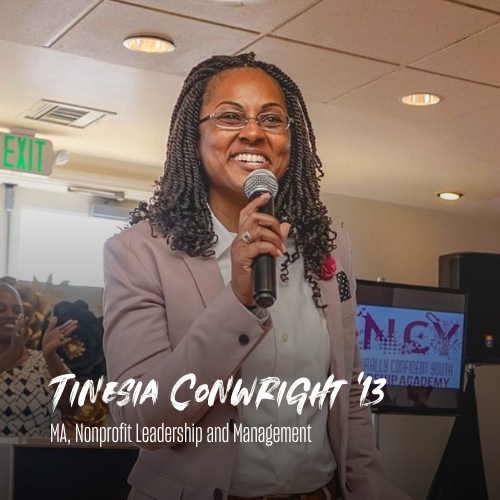
SOLES Alumna Spotlight: Tinesia Conwright '13 (MA), Nonprofit Leadership and Management
Please tell us about your degree program and why you chose SOLES for the program.
I originally wanted to pursue an MBA. I was looking into different MBA programs, and was really on this professional development journey. A colleague of mine suggested that I apply for LEAD San Diego. I applied for LEAD San Diego and I ended up getting accepted. One of the seminars focused on nonprofits and how they impact the region. Pat Libby did a great presentation, and it made me think that’s what I want to do. I wanted to do something that impacted my community, not something that would have me working 40 to 60 hours a week with no impact. I didn't know I'd be working the same amount of hours with less money, but here I am. I knew that that was where I was supposed to be after seeing Pat Libby’s presentation. I started going to all of the SOLES open house events, developing a relationship with Pat, and doing what I had to do to apply to get into the Nonprofit Leadership and Management Master’s Program at SOLES.
Were you working while you were in the program?
Yes, I was working full-time at the San Diego Housing Commission. I guess that was the introductory period of my learning more about nonprofit work. Everyone knows about charity, but you don't think about nonprofits as businesses. The San Diego Housing Commission administers the Section 8 Rental Assistance Program. I was a manager and I had a team of 12 people. They were calculating rent portions, and so I would get all the complaints about people who didn't like their rent portions. I was thinking, “If they just had someone to give them a chance to increase their income and get a better job, then this wouldn't be a thing”. There ended up being an opening in our Workforce and Economic Development Department. I applied for that role because that was my belief: people are not on the system and receiving assistance because they want to; it's because they have to. If they had the tools and the resources they needed, they would be able to do better for themselves. I went to the Workforce and Economic Development Department, and that's when I started to learn about grants, community resources, community partnerships, and all the things that go on behind programming to provide financial literacy and workforce development. Those types of skills and tools- help people move up and out of poverty. I fell in love with the work that was going on in that department, and that was the premise of why I changed from pursuing my MBA to getting a nonprofit degree – because I knew I wanted to do more of that work. I was also starting something in my own neighborhood, working with girls. I knew that I wanted to pursue a career that would allow me to do more of that because I was passionate about it, versus going into something that I didn't really care too much about.
What would you say was your favorite class in the program?
The program evaluation class taught by Dr. Laura Deitrick was really hard. That's where we learned how to create an evidence-based program and to focus on the outcomes of the work that we're doing. Essentially, it taught us the mechanics of programming. Which, oftentimes in the nonprofit field or charity work, people do things because they have a love for it and they just want to do it. When in Dr. Deitrick's class, we were asked to think, “But is this really a need? And is it working?” That was a great class because the project we did for the class was about founders of grassroots organizations that end up burning out because they don't scale and build the organization to a level in which it can survive beyond them. That's what I was seeing in southeastern San Diego. You can still see it today: you have this great idea, you go out and you start a nonprofit, and it's doing well. Now, everybody wants your time. You're doing all the things instead of getting help to do all the things, and then you end up burning out after a couple of years because it's too much to do. The need is so great. In the class, we put together a mock program that would help those folks grow the organization and have some type of succession plan, so they're not the only ones doing everything, so they don't burn out, and the organizations can continue.
Did you have a favorite professor from your time in the program?
I liked Deirdre Maloney, who taught the marketing class. She had a lot of great marketing insights that we were able to learn. Because as a nonprofit organization, it is definitely hard to have marketing that's of high quality and affordable. That was a great class, too. Some people stick out, like Dr. Laura Deitrick and Pat Libby, because I still see them. Liz Shear, who taught the board governance class, was also great. I enjoyed her because she had a very casual way of teaching that was still impactful.
Can you share a bit about some of the consulting projects you worked on?
My favorite nonprofit that we worked with was The Tony Hawk Foundation…because it was The Tony Hawk Foundation. They had a big ramp as a part of their office space in a warehouse in Poway. That was probably my favorite project because I not only got to go there, but the board member I was interviewing had this awesome house in Del Mar that overlooked the ocean. I wondered to myself, How do I get here? It was great to be able to have that experience talking to that board member about the work that the foundation does and how they got involved. That was a great project. Then we also did Second Chance, which is an organization in southeastern San Diego, and we helped them do a board manual. That was good because I felt like they appreciated it and would use it moving forward. Knowing that Second Chance was a part of the community that I work in and that I'm passionate about, it was good to feel like we actually did something for the community. Second Chance was one of those places where you drive by all the time and you wonder what they do, or you kind of have an idea but you don't really know. It allowed us to learn more about the organization, what they do, and the impact that they make.
Was the international requirement in place when you were a student?
Yes. I got the opportunity to go to Mondragon, Spain, and we went one week early to explore Barcelona and Madrid. That was a cool experience. It was my first international trip outside of Tijuana, Mexico. It was my first official international trip. When I joined SOLES and I was taking my first class, it felt really intimidating because I got my undergrad degree in 2004 from San Diego State University. All these years had passed, and now we're in 2011 and I'm pursuing a graduate degree. I felt intimidated and I doubted my ability to succeed in the space. During the class, we talked about international philanthropy. Other folks in the class had experience and the knowledge of how things worked in other countries, and I didn't have any of that. I felt insecure about it. So to go from that space to ”yes, I've been to Spain and I know how they do things over there” – it’s a full circle. It was a great class and a great experience. It was a jam-packed schedule like 8 a.m. to 8 p.m. We did a lot of exploration, and the country is gorgeous. We learned about their economy, their nonprofit sector, and how it's different from ours.
Can you talk a bit about the process of putting your portfolio together?
That was crazy and it was a lot of paper. It was almost like writing a book. Even though a lot of the projects were done, I was redoing papers and collecting my best work. It was a great reflective period because I got to select the projects that were most impactful to me. It was something that I really had to focus on to complete. It was one of those go to Starbucks and plan to stay there for a couple of hours kind of thing. And don't bring anything else so that you can get this done. I think I still have my portfolio around here somewhere, believe it or not.
What would you say is your favorite memory from your time in the program?
I met a lot of great folks in the cohort and we are still connected today. That is my favorite memory – being able to connect with people and form lifelong friendships, support each other in our career growth, and clap for each other. A lot of my cohort have kids now, so I’m watching their kids on Facebook and stuff like that. The people were definitely the best part, starting from the interview process. Because it was a panel, when we all got let out we shared in expressing things like “That was so stressful! How do you think we did?” So the camaraderie started from that point all the way to graduation and through every class in between.
We all have big hearts, we are in the nonprofit space, and we all care a lot about our community. It was a blessing to be able to have that experience with others who you care about, who care a lot about you, and folks you’re able to grow with even beyond the program.
Can you share what you've been doing since completing the program?
I launched my nonprofit DETOUR in 2009, so I was essentially at the beginning of the nonprofit when I was accepted into SOLES in 2011. I started the program because my mom is a foster parent; she had a bunch of foster kids, and I grew up with an understanding of the foster care system and wanting the kids to have a better life than the cards they were dealt. I started DETOUR casually and I realized I wanted to commit to it, which is the whole reason why I went to school and earned my master’s degree. I wanted to do that and be good at it, and I’m still doing that today. It’s a great organization. I was able to grow it from just a volunteer organization to now our budget is half a million dollars. We have staff and we are serving 140 girls every month during the school year. We have a leadership academy that consists of an after-school program at 11 different school sites, a community-based program, a paid internship program, and a scholarship program. Being able to give girls additional opportunities is what I love to do, and that’s what I’ve been doing continuously since I graduated from the program.
I’m running DETOUR and also All About Girls of Color, and that is creating an ecosystem of supporters who are advocates for girls of color across all systems working towards systemic change. We do professional development training and also launched the podcast in January 2023, which highlights different women in our field who are doing great work pertaining to seeing girls of color thrive.
I wrote a book that came out this year. Find Your Flair in essence is my message to girls to find that thing that makes them stand out and makes them comfortable with who they are. Oftentimes we feel like we have to fit into someone else’s picture of who we are, who we’re supposed to be, and we don’t feel comfortable operating in our own strengths and excellence. Find Your Flair is exactly that. You have a flair inside of you; find it and share it with the world, and be okay with that. Be your best authentic self according to the things you like to do and things that you love, and those things will impact the world.
Also, I was a Kellogg Fellow. I was part of the W.K. Kellogg Leadership Community Action Network in 2019. It was an opportunity for 80 people around the country to come together to strengthen and develop our leadership skills. That was a great opportunity because I met people from all over the country doing great work across various nonprofit sectors, government sectors, and traditional businesses. I also did RISE San Diego in 2018. RISE is an urban leadership development program right here in San Diego. I got the opportunity to do some technical training with them for small and emerging nonprofits. I want to see more organizations like DETOUR out there doing their thing, so anytime I can coach, advise, or just help folks build up their skillset in order to build organizations that thrive, those are things that I enjoy doing.
How would you say your education from SOLES has impacted your career and the career goals that you've set for yourself?
For me, it was the foundation. Having somewhere to go to learn more about improving the nonprofit sector was very important to me because it nourished the seed I already had inside of me. I’m grateful for that because I didn’t have to shift what I wanted to do; I didn’t have to fit into a business program or a youth development program. I didn’t have to shift to any other degree to accomplish my goals. It was a foundation where I got to learn all the things that I needed to learn in order to build a strong and thriving nonprofit, and then also have that support system to support me emotionally along the way because I was going through it with other students and professors that also have a love for the work we do. The fact that a lot of the professors were practitioners was important, as well, because they were able to give first-hand insight into real-life situations. They weren’t just talking about theories they had no idea of, but they were able to portray the practicality of the theory, as well. Since then, it’s been like a secret society to come across other people who have gone through the program. I still have people calling me who plan to apply, asking me how it was and what advice I have for them. I run across colleagues all the time that are either enrolled or have recently finished. It’s a joy to see and be able to celebrate their experience in the program and compare notes and how the program has changed over the years. Being able to go back to events on campus, like the Nonprofit Governance Symposium and the State of Nonprofits, and seeing good work being done by the university and SOLES, and running into old classmates and colleagues in those environments is really nice, as well.
Do you have any advice that you would give to a current student in the Nonprofit Leadership and Management program?
Stay authentically yourself. There is a market for whatever it is you want to bring into the sector. That was something I was grateful to have the experience of, as I am from southeastern San Diego and I wanted to start an organization to empower teen girls. I had already started the nonprofit, but I wanted to grow my work, specifically in southeastern San Diego. I had no one challenging the vision I had, which allowed me to stick to it and really get it off the ground and grow it into what it is today. Whatever it is that you want to do, stay authentic in that and ride that thing until the wheels fall off. People have so many great ideas and, in essence, there is a tribe for that idea you have, but it's up to you to bring it to fruition. You have to believe in yourself and your ability to be able to see it through. That would be my advice – keep going, don’t stop.
Any final thoughts?
I’d like to see more people of color take advantage of these opportunities, and more black people specifically because I feel like we are out here and doing the work. Having the education and the structure behind it would make it more successful in the long run. I’m an advocate for black people joining the program.
I loved my cohort and the mix because we had folks from every race. It allowed us to get different opinions for the different scenarios that we are faced with. It created a rich environment when it came to learning, growing, and being able to connect with different types of people while you’re early in your career. I loved that part about it.