
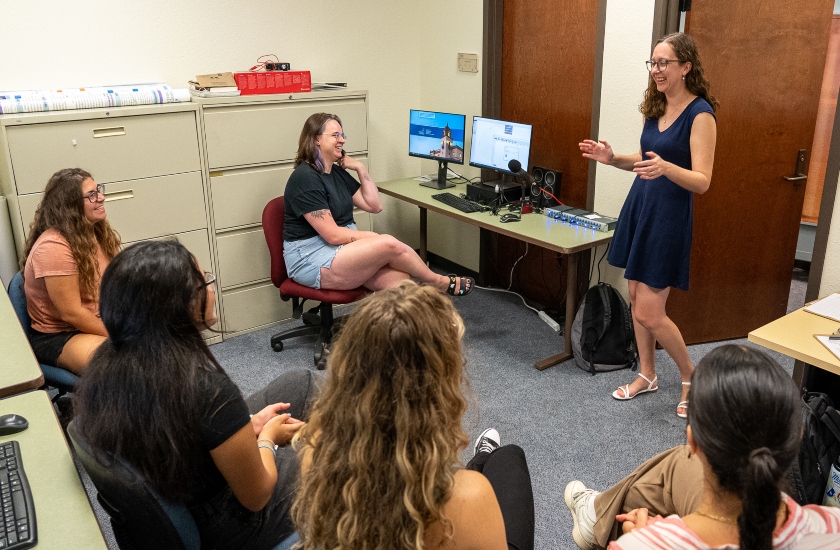
Discover the Cognitive Science minor
The Cognitive Science program at USD engages in the scientific study of minds and brains, encompassing human and animal cognition as well as artificial intelligence. Through interdisciplinary research, students explore questions regarding the nature of cognition, consciousness, the mind-brain relationship and the design of systems and tools to enhance cognitive abilities. For the most updated curriculum and course information, go to the catalog of record.
18.5 units
Minor
Cognitive Science at USD fosters an inherently interdisciplinary environment that brings together methodologies and discoveries from philosophy, psychology, computer science, neuroscience, linguistics and anthropology, providing students with a comprehensive understanding to navigate the realms of technology, minds, brains and behavior.
The Cognitive Science Minor
The minor requires one course each from Computer Science, Philosophy, and Psychological Sciences/Neuroscience, Cognition and Behavior, an advanced cognitive science course (COGS 490) and two elective courses from the following departments: Anthropology; Communication; Computer Science; Industrial and Systems Engineering; Marketing; Neuroscience, Cognition and Behavior; Philosophy; Psychological Sciences; Sociology.
Students are required to take the following: | ||
COMP 110 | Computational Problem Solving | 3.5 |
NCB 150 | Introduction to Cognition and Behavior | 3 |
or PSYC 336 | Cognitive Psychology | |
COGS 490 | Advances in Cognitive Science | 3 |
Select one course from the following list. Note that this course cannot be double counted with your 6 elective units below. | 3 | |
PHIL 114 | Philosophy and Technology | |
PHIL 347 | Neuroethics | |
PHIL 348 | Ethics of AI and Robotics | |
PHIL 405 | Games & Choices: The Tools of Philosophy, Politics, & Economics | |
PHIL 413 | Philosophy of Mind | |
PHIL 414 | Philosophy of Language | |
PHIL 416 | Philosophy of Archaeology | |
Select at least 6 units from the following list. Courses must be taken from two different departments. Note that no more than 3 units combined may be taken from Neuroscience, Cognition and Behavior and Psychological Sciences. | 6 | |
Anthropology | ||
ANTH 413 | Planet of the Great Apes 2: Ethics of Humanity's Relationships to Other Apes | |
Communication | ||
COMM 460 | Persuasion and Influence | |
Computer Science | ||
COMP 331 | User-Centered Design and Prototyping | |
COMP 332 | Human-Centered Systems | |
COMP 351 | Introduction to Artificial Intelligence | |
COMP 380 | Neural Networks | |
Industrial and Systems Engineering | ||
ISYE 410 | Human Factors | |
Marketing | ||
MKTG 420 | Consumer Behavior | |
Neuroscience, Cognition and Behavior | ||
NCB 330* | Topics in Cognition and Behavior | |
NCB 332 | Learning and Behavior | |
NCB 344 | Animal Behavior: Comparative Psychology and Ethology | |
NCB 346 | Evolution of Brains and Behavior | |
NCB 350 | Sensation and Perception | |
NCB 352 | Music Cognition | |
Philosophy | ||
PHIL 347 | Neuroethics | |
PHIL 348 | Ethics of AI and Robotics | |
PHIL 405 | Games & Choices: The Tools of Philosophy, Politics, & Economics | |
PHIL 413 | Philosophy of Mind | |
PHIL 414 | Philosophy of Language | |
PHIL 416 | Philosophy of Archaeology | |
Psychological Sciences | ||
PSYC 339 | Human Memory | |
Sociology | ||
SOCI 301 | Sociological Theories | |
Total Units | 18.5 | |
*Students may not receive credit for taking NCB 330 if the topic of the class is the same as another class they have taken. Consult with the Instructor for necessary permissions.
Additional courses may be used to satisfy the elective requirement in the Cognitive Science minor, if the topic is appropriate. Examples include: NCB 380, NCB 495, PHIL 334, PHIL 494, PSYC 494. Consult the Program Director for information about these courses.