
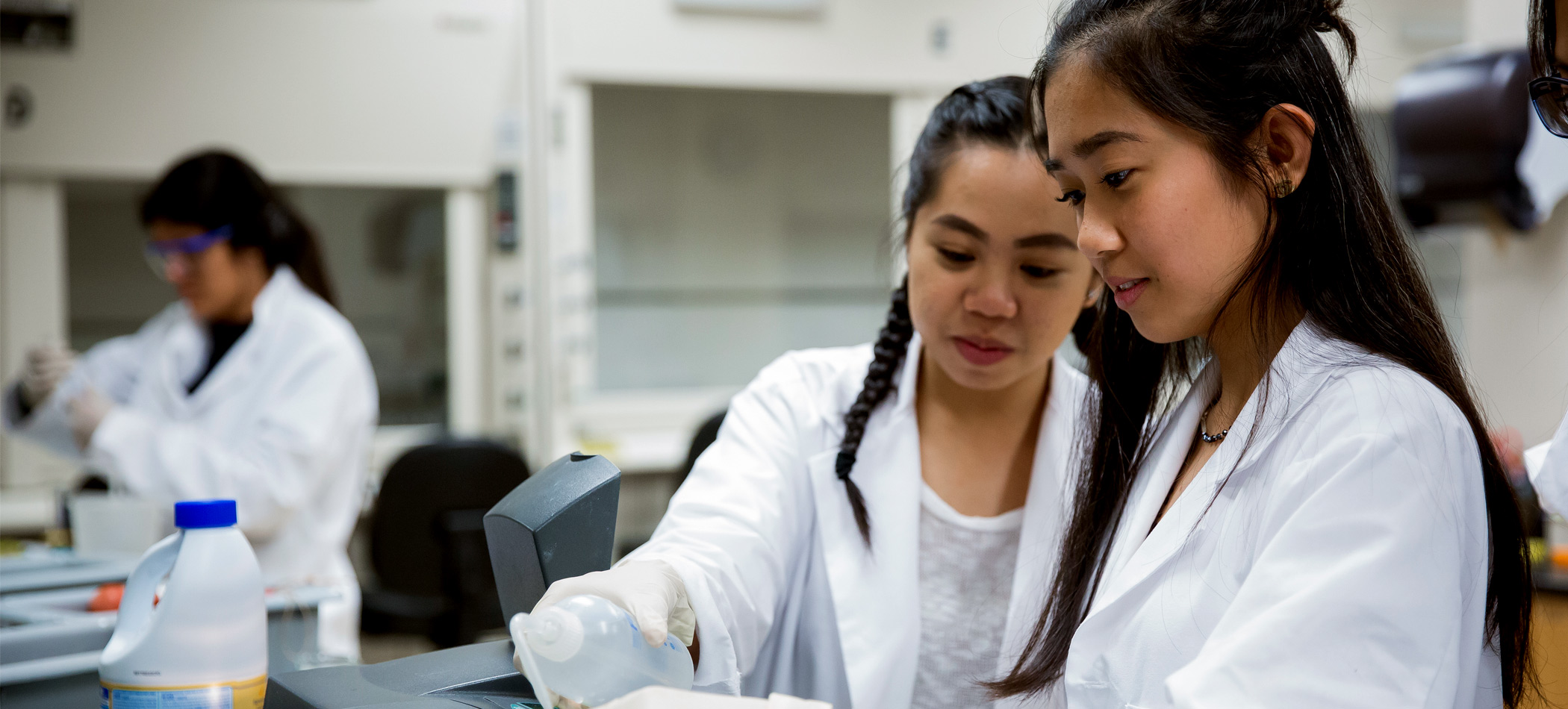
Are you looking for a research opportunity to fulfill your major requirement, but you're not sure where to start?
Below, you will find a complete list of active research groups in the chemistry department, along with brief descriptions of their work. When you find a group you are interested in, please contact the faculty member who leads the group for details about current projects, available positions and how you can apply.
J.K. Bell Lab
In the JK & JE Bell labs, we explore proteins involved in metabolism and cell signaling to provide detailed understanding of key biological processes and set the stage for therapeutic advances. We use cellular and molecular biology, biochemistry and biophysics-based techniques to relate structure and dynamics to function.
T. Bell Lab
One research aim of the T. Bell lab is to develop nucleic acid ligands against the DNA-binding cytokine, HMGB1 (HMGB1). HMGB1 is a suspected biomarker and therapeutic target in a variety of immune disorders including lupus and rheumatoid arthritis. Other research projects focus on defining the role of extracurricular DNA (eDNA) in bacterial biofilm formation, propagation and infection.
Benz Lab
Research in the Benz lab focuses on uncovering the surface chemistry of solid materials, with a current emphasis on metal-organic frameworks (MOFs). MOFs are an emerging class of solid materials which hold exciting promise in proposed solutions to current climate-related challenges, such as gas capture and storage. Due to their exceptionally high porosity, surface area and chemical tailorability, MOFs are being explored for numerous applications in addition to gas capture/storage, including sensors, catalysis and biomedical applications. The Benz lab is working to understand and control MOF surface chemistry, which is critical to MOF performance in modern applications.
Bolender Lab
Dr. Bolender has two distinct research priorities in his laboratory. The first project is the study of novel, lanthanide ion-containing, water-dispersive nanoparticles. These nanoparticles have potential uses that include efficient light-emitting materials for various uses (fluorescent lights, LED screens, etc.), and as potential MRI contrast agents. This project involves more fundamental chemistry.
Dr. Bolender's second project is a long-term water project in the southwestern region of Uganda. In this region, we work with Ugandan and other international partners to assess the impact of poor water quality on childhood and community health. Our work includes the assessment of water issues, and we were the first to find uranium at high concentrations in local groundwater sources. We also work with colleagues in Engineering to develop water filtration devices that are designed to use locally sourced materials.
Clark Lab
The Clark research group focuses on using metals to catalyze reactions that incorporate boron into organic compounds. Boron is now being used in pharmaceuticals that treat cancer and bacterial infections with more applications under development. We aim to simplify access to a variety of boron-containing molecules with a distant goal of biological applications, new types of catalysts, and as intermediates in organic synthesis.
Daley Lab
The Daley research group is a synthesis group that has two broad research interests: stereoselective catalysis and bioinorganic chemistry. In catalysis, the group is interested in controlling the molecular architectural outcomes of chemical reactions through the use of chiral ligand-based metal catalysts. Specific focus is on the development of catalysts for stereocontrolled polymerization and small molecule synthesis with the latter being focused on enantioselectivity (chiral compounds). The target products would have potential application in materials (polymers), drug compounds or perfume components (small molecule), and in other industries where stereospecific compounds are critical. The Daley group is developing the chiral ligand moiety for potential catalysts.
In bioinorganic chemistry, the group is interested in the structure-function relationship of the nitrile hydratase metalloenzymes. These mononuclear Fe- or Co-peptide bound systems hydrolyze nitriles to their corresponding amides that have found application in the kiloton-scale synthesis of nicotinamide as well as in wastewater remediation systems. The Daley group is developing a synthetic analog (model) of the active site with the hopes of learning how the structure and function of the systems work with the goal of developing small molecule analog systems that would be as effective but cheaper to use and easier to obtain.
De Haan Lab
Brown particles contribute to climate change by absorbing sunlight. The brown color of a wildfire smoke plume fades in the sun – unless it encounters a cloud. Cloud processing “locks in” smoke’s brown color, making it resistant to further fading in sunlight, but the chemical transformations responsible for this effect are unknown. The De Haan group is NSF-funded to simulate the chemistry of smoke-cloud interactions in the lab. We use optical, physical, and mass spectrometry measurements of the gas and aerosol components of smoke to unravel the chemistry of how smoke ages under wet and dry conditions.
Gillette Lab
The Gillette group is interested in understanding the mechanisms that make it possible to convert between chemical energy (stored in bonds) and electrical energy (useful for real world devices like batteries, fuel cells and sensors). We design and build nanomaterials which can efficiently carry out these electrochemical reactions, and use analytical tools like infrared spectroscopy to better understand how those reactions take place.
Iovine Lab
Dr. Iovine is on a leave of absence for academic year 2026-2027 and is not accepting lab group members at this time.
Research in the Iovine group spans a wide range of organic polymer chemistry. We utilize modern methods of organic synthesis to create new polymer constructs, to enhance naturally occurring polymers, and to investigate emergent properties of purely synthetic materials.
Kua Lab
The Kua lab is interested in how small molecules self-assemble into larger molecules and more complex mixtures, particularly in the area of protometabolism and origins-of-life chemistry. We use computational methods to generate free energy maps of chemical pathways, and we hope to discover how and why the specific molecules and polymers underpinning extant life could arise from simpler substances to generate complex self-sustaining systems.
Provost Lab Team MDH
The Provost Lab Team MDH focuses on a central but underappreciated metabolic enzyme called malate dehydrogenase (MDH). MDH exists in two forms within human cells: a cytosolic form (MDH1) and a mitochondrial form (MDH2). Together, these enzymes regulate energy production, redox balance and the flow of carbon between metabolic pathways that are disrupted in diabetes, obesity and cancer. Although MDH has been studied for decades, emerging evidence shows that it plays far broader roles in metabolic disease than previously recognized.
Understanding Metabolic Vulnerabilities in Diabetes, Cancer and Related Diseases
Metabolism lies at the heart of human health and disease. Disorders such as diabetes, metabolic syndrome, obesity and cancer arise when cells lose the ability to properly balance how nutrients are used to generate energy, maintain redox homeostasis and support normal growth and repair. Diabetes alone affects tens of millions of Americans and dramatically increases the risk of cardiovascular disease, neuropathy, kidney failure and cancer. Despite major advances in treatment, these diseases remain difficult to manage because affected cells often exploit normal metabolic pathways in abnormal ways.
More than two million Americans will be diagnosed with cancer this year, and metabolic diseases such as diabetes and obesity continue to rise at alarming rates. A unifying feature of these conditions is metabolic reprogramming. Rather than relying on entirely new genes, diseased cells repurpose essential enzymes and signaling systems that healthy cells depend on every day. In diabetes and metabolic syndrome, this rewiring disrupts redox balance and nutrient sensing. In cancer, similar changes support uncontrolled growth and survival. Understanding how these metabolic shifts occur is one of the most important challenges in modern biomedical research.
Our research demonstrates that MDH is not a passive “housekeeping” enzyme. Instead, it responds dynamically to cellular signals, nutrient availability and metabolic stress. In diseases such as diabetes, metabolic syndrome, obesity and cancer, MDH activity, regulation and protein partnerships are altered in ways that help cells adapt to chronic nutrient excess, insulin resistance, hypoxia or rapid proliferation. These findings suggest that MDH represents a shared metabolic vulnerability across multiple diseases.
By studying how MDH is regulated and repurposed in disease states, we aim to uncover fundamental mechanisms of metabolic control and identify new strategies that may ultimately inform therapies for both metabolic disease and cancer.
Why Malate Dehydrogenase Matters in Diabetes and Cancer
Both cytosolic and mitochondrial MDH sit at critical crossroads of metabolism. They connect glucose utilization, amino acid metabolism and redox balance, all of which are disrupted in diabetes and metabolic syndrome and further exploited in cancer. Changes in MDH regulation can influence how cells respond to insulin, nutrient overload, oxidative stress and growth signals.
Our work has revealed several key principles:
MDH is highly regulated by phosphorylation, a reversible chemical modification that acts as a molecular switch. In diabetes and obesity, altered signaling pathways change phosphorylation patterns that affect how MDH responds to glucose availability and redox stress. In cancer, similar signaling changes allow cells to remain metabolically flexible under extreme conditions.
MDH functions as part of larger protein networks, forming interactions with other metabolic enzymes that support efficient nutrient use. These partnerships are particularly important in insulin-resistant cells and rapidly dividing tumor cells, where metabolic coordination becomes essential for survival.
Under certain disease-associated conditions, MDH can be redirected toward non-canonical metabolic outputs, linking abnormal signaling to the accumulation of metabolites that promote disease progression. This metabolic flexibility makes MDH a powerful integrator of signals common to diabetes, obesity and cancer.
Because these regulatory features are shared across multiple diseases, MDH provides a unique opportunity to study how common metabolic mechanisms contribute to diverse pathological outcomes.
Undergraduate and Graduate Research Opportunities
Example Student Projects in the Provost Laboratory
Students in the laboratory work on independent but interconnected projects that combine biochemistry, molecular biology, cell biology and computational analysis. Projects are designed to address fundamental questions relevant to diabetes, metabolic disease and cancer, while providing strong training for future careers.
Project 1: Phosphorylation-Based Regulation of MDH in Metabolic Disease
Students investigate how phosphorylation alters the activity and regulation of cytosolic MDH1 and mitochondrial MDH2 in conditions relevant to diabetes, obesity and cancer. This project explores how insulin signaling, stress pathways and disease-associated signaling cues reshape MDH function and metabolic responsiveness.
Project 2: MDH Protein–Protein Interactions in Diabetes and Cancer
MDH operates within larger metabolic networks. Students identify and characterize MDH interaction partners that are altered in insulin-resistant and cancerous cells. Using biochemical assays and computational modeling, students explore how these interactions support metabolic adaptation in chronic disease.
Project 3: Metabolic Rewiring and Redox Balance in Disease
This project examines how altered MDH regulation contributes to changes in redox balance and carbon flow in diabetes and cancer. Students analyze how cytosolic and mitochondrial MDH coordinate metabolic responses to nutrient excess, oxidative stress and proliferative signals.
Project 4: Structural and Computational Studies of Disease-Associated MDH Regulation
Students integrate experimental data with structural modeling to visualize how phosphorylation and protein interactions reshape MDH structure and function. This work provides molecular-level insight into how a single enzyme supports metabolic adaptation across diabetes, obesity and cancer.
Why join the Provost lab?
We study how metabolism is altered in diabetes, obesity, metabolic syndrome and cancer, focusing on how cells reprogram energy use to survive and grow. Students work on meaningful, disease-relevant research while gaining hands-on experience with modern biochemical and molecular tools. Close mentorship and independent projects prepare students for medical school, graduate programs and careers in biomedical science.
Schellinger Lab
The Schellinger group has peptide-based research focus on developing biologically relevant molecules with potential applications in therapeutics, biomaterials and origins of life. In our lab, we focus on the synthesis, characterization and property investigation of a wide variety of compounds from small molecules, peptides to polymers.