
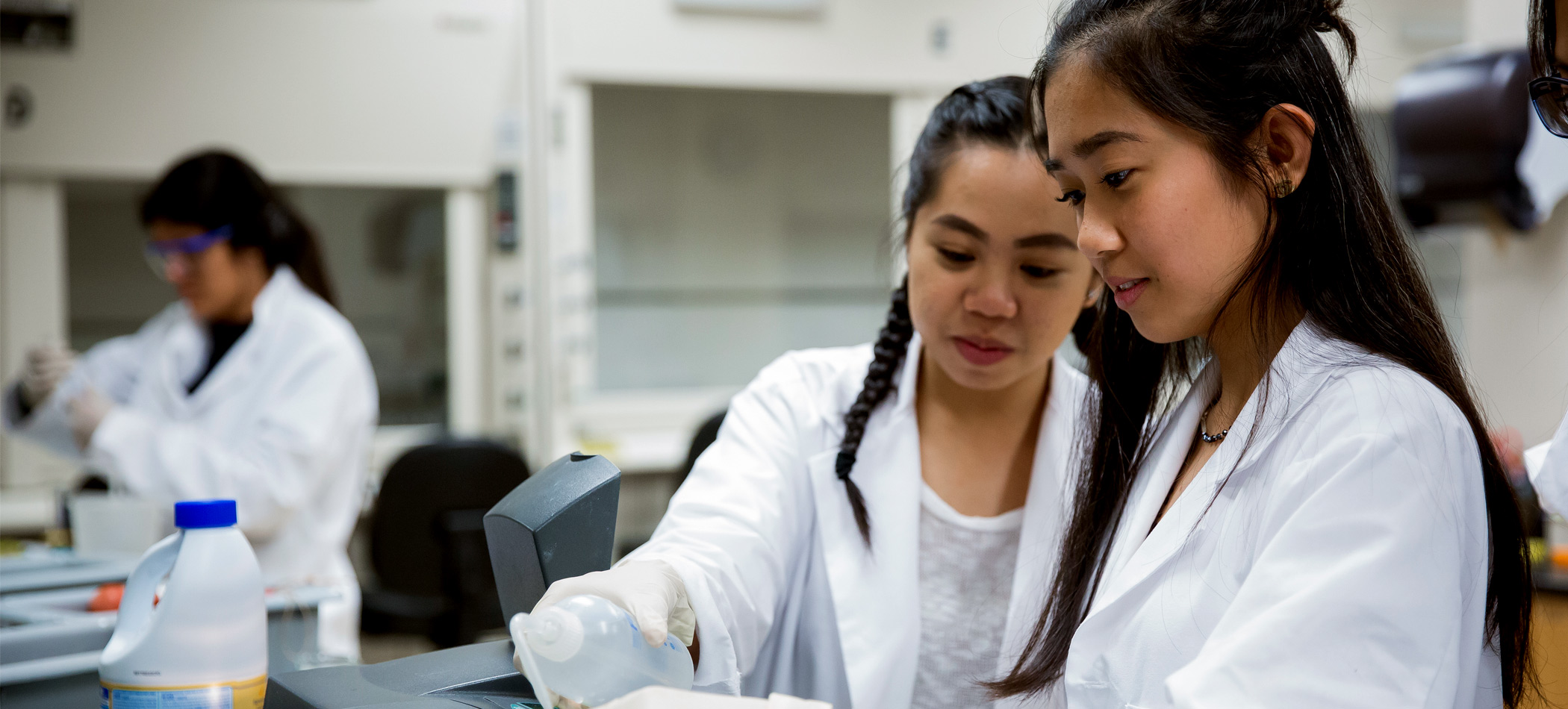
Undergraduate chemistry and biochemistry students are the main users of our more than 35 scientific instruments, which combined value surpasses $3 million.
The Department of Chemistry and Biochemistry is one of only a few undergraduate scientific departments holding state-of-the-art instruments, such as 500 MHz NMR spectrometer and dual-source X-Ray diffractometer. It acquires roughly two new instruments per year.
Students' curriculum includes early (during the first semester of their lower-division classes) and extensive hands-on experience with these instruments — the same equipment used by the scientific community-at-large in academic and private institutions around the world.
Students develop a fundamental expertise on a wide breadth of analytical techniques through their upper division mandatory labs and research projects, where they spend a significant amount of time collecting data independently. These skills are invaluable for future professional careers.
The instruments in USD's Department of Chemistry and Biochemistry are managed and maintained by a full-time instrument specialist, who is currently a USD 2014 alumnus with an MS in chemistry and OSHA certifications in safety, health and hazardous materials management.
Atomic Absorption (AA)
The department owns one Agilent AA140 Atomic Absorption Spectrophotometer (AA). The AA is equipped with a multi-lamp compartment, a robust double-beam hardware, and can be used in absorption and emission modes. For higher throughput experiments, the AA is connected to an autosampler that can run up to 75 samples in its fully automated mode. The AA utilizes a nebulizer to spray the sample into very fine droplets into a high-temperature vertical thin flame. The flame is located on the path of a beam coming from a specific hollow-cathode lamp. For each element of analysis, a different lamp is used. The detection is based on the difference of absorption (or emission) in the flame path between the baseline solvent (typically, water-based) and the sample.
Circular Dichroism (CD)
The department owns one Jasco J-1100 Circular Dichroism Spectrophotometer (CD) to analyze secondary and tertiary structures and folding properties of a protein in solution. The CD uses a high-pressure Xenon lamp to irradiate a sample containing asymmetric molecules with polarized light. The detection is based on the difference of absorption of the left or right polarized light by the molecules, which can be scanned at different wavelengths and temperatures.
Cyclic Voltammetry (CV)
Cyclic Voltammetry (CV) refers to all experiments measuring an electrical current into a solution. The solution contains ions that will be moving towards an electrode as the current is passing through the solution. Monitoring the current in the solution brings theoretical explanation to the chemistry happening inside the solution. The department owns one bipotentiostat, or CV instrument, from Pine Instrument, with a rotating anode. For teaching laboratories, students use micro-printed electrodes and the WaveNow potentiostat from EChem-in-a-box (manufactured by Pine Instruments as well) for modern, hands-on electrochemical experiments.
Dynamic Light Scattering (DLS)
Dynamic Light Scattering (DLS) is based on the fluctuations of the light scattered by small particles in a solution. These fluctuations are correlated to the particle size. The department owns one Malvern Panalytical Zetasizer Nano ZS to analyze shape and particle size in colloidal solution (proteins aggregates, quantum dots, polymers).
Fluorescence Spectrophotometry (FLUO)
The department owns two fluorescence spectrophotometers: a Jasco FP-6500 and a Horiba Scientific with Nitrogen Lazer (GL-3300), Frequency Doubler (GL-303), and Dye Polarizer (GL-302). Both instruments are used by our undergraduate students.
Fourier-Transform Infrared Spectrometry (FTIR)
Fourier-Transform Infrared Spectrometry (FTIR) measures the different interactions of bonds of a molecule with infrared light. In an FTIR instrument, carbonyl and double bonds absorb infrared light at distinct frequencies. The detection is based on the differences in absorbed, transmitted, or reflected infrared light as a sample is placed on its path, and compared to a reference Infra-Red beam, which is measured simultaneously. The department owns 3 FTIR spectrometers manufactured by Jasco: two FT/IR-480 Plus and one FT/IR-6800. All models have several accessories to measure liquid (DuraSample ATR), solid (Golden Gate ATR, Silver Gate ATR, and Evolution ATR) or gas samples. The software controlling these instruments includes a lifetime 12,000 samples database.
Fraction Purification Liquid Chromatography (FPLC)
Fraction Purification Liquid Chromatography (FPLC) is a separation technique based on a chromatography column and a detector (in our case, a UV-Vis detector). As the sample is being pushed through the column, its different constituents separate due to their different interactions with the column material. Each time one of the sample constituents exits the column, it is detected as it passes through a small flow cell exposed to a UV or Visible light. As the resulting absorption peak returns to baseline, the fraction purification system moves the collecting rack to a different vial. Thus, each constituent is separated from the others. The department owns one Bio-Rad NGC Chromatography System with Fraction Collector. This instrument is an integral part of our Biochemistry teaching laboratories, and is extensively used by our Biochemistry research groups.
Gas Chromatography (GC)
Gas Chromatography (GC) is a separation technique that relies on the different interactions between the constituents in a sample and a specific chromatography column. The liquid sample is injected into a chromatography column and vaporized by a temperature ramp and a carrier gas inside the column. Different constituents will form weak interactions with the film deposited inside the chromatography column. These weak interactions will break at different temperatures. Each time a constituent exits the column, the detector senses a difference in the temperature of the gas exiting the column, which is digitized into a peak. The department owns 6 computer-controlled gas chromatographs with thermal conductivity detectors from SRI, models 310C and 8610C. These instruments are used every semester by our Analytical and Organic Chemistry students.
Gas Chromatography-Mass Spectrometry (GCMS)
Gas Chromatography with Mass Spectrometer (GCMS) is a separation and identification technique that relies on the principle of vapor-phase chromatography (for separation) and mass-determined speed (for identification). The gas chromatography separation technique relies on the different interactions between constituents in a sample and a specific capillary column, which is typically 30 or 60 meters long. The liquid sample is injected into the chromatography column and vaporized with a temperature ramp and a carrier gas inside the column. Different constituents will form weak interactions with the very thin film deposited inside the capillary column. These weak interactions will break at different temperatures. When a constituent exits the column, it enters the MS, where it is fragmented and ionized. The resulting ions travel at different speeds through a charged quadrupole based on their mass-over-charge ratio. When an ion reaches the detector, its speed is computed, and its correlated mass is displayed on a spectrum. The department owns 2 GCMS instruments: a SCION SQ 436-GC Bruker and a ThermoFisher Trace GC Ultra with Trace DSQ MS. Both models have single quadrupole MS and are equipped with multi-sample autosamplers.
Gel Permeation Chromatography (GPC)
Gel Permeation Chromatography (GPC) is a separation technique that relies on the different interactions between a mixture of samples and a chromatography column. In our laboratories, we typically use size-exclusion techniques to separate the different constituents of a polymer sample: larger polymers will elute first, while smaller ones will be retained longer in the column. The sample stays in the liquid phase as it progresses through the column, and is being pushed at high pressure with a mobile phase (organic or water-based solvent). As each constituent exits the column at different times, they enter into a refractive index detector that digitizes the difference between the pure mobile phase and the mobile phase carrying the constituent. The department owns one Tosoh Bioscience EcoSEC Elite GPC System equipped with an autosampler tray, a temperature-regulated column compartment, and a refractive index detector.
High Pressure Liquid Chromatography (HPLC)
High Pressure Liquid Chromatography (HPLC) is a separation technique that relies on the different interactions of several constituents in a sample with a specific chromatography column. The liquid sample is injected into a chromatography column, which is held in an oven for stable temperature conditions. A mobile phase (or solvent) moves the sample in the liquid phase through the column at high pressure. Different constituents of the sample will form weak interactions with the material packed inside the chromatography column. These weak interactions will break at different times. Each time a constituent exits the column, it passes through a small flow cell exposed to a UV, Visible, or fluorescence light. The difference in absorption between the pure mobile phase and the mobile phase carrying the sample is digitized into a peak. The department owns two HPLC instruments manufactured by ThermoFisher: an UltiMate 3000 and a Surveyor with dual FL / UV-Vis detectors. Both models have autosampler trays and temperature-controlled column compartments.
High Pressure Liquid Chromatography with Mass Spectrometry (HPLC-MS)
High Pressure Liquid Chromatography with Mass Spectrometry (HPLC-MS) is a separation technique that relies on the different interactions of several constituents in a sample with a specific chromatography column. The liquid sample is injected into a chromatography column, which is held in an oven for stable temperature conditions. A mobile phase (or solvent) moves the sample in the liquid phase through the column at high pressure. Different constituents of the sample will form weak interactions with the material packed inside the chromatography column. These weak interactions will break at different times. Each time a constituent exits the column, it enters the MS where it is fragmented and ionized. The resulting ions travel at different speeds through a charged quadrupole based on their mass over charge ratio. Each time an ion reaches the detector, its speed is computed and its correlated mass is displayed on a spectrum. The department and Biology department jointly own a computer-controlled a ThermoFisher LTQ XL / UltiMate 3000. This instrument is used every semester by our students in Biophysics methods and by several different research groups.
Microplate Reader
A plate reader is a spectrophotometer using UV, Visible, luminescence or fluorescence light. It is built to detect the absorption or emission of an array of samples dispensed into a 96- or 386-well plate. Multiple samples of very small sizes can thus be analyzed. The department owns one modern, top-of-the-line, computer-controlled BioTek Synergy Neo2 Hybrid Multi-Mode Microplate Reader with a complete software suite. This instrument is used extensively by our students in Biochemistry and Biophysics teaching laboratory courses, and by all biochemistry research groups.
Microwave Synthesis Reactor
The microwave reactor is simply a microwave cavity inside which a sealed vial is inserted with a chemical reaction mixture. Temperature and pressure are precisely programmed and monitored via an infrared sensor. The department owns one computer-controlled CEM Discover Microwave Synthesis Reactor with autosampler and a complete software suite. This instrument is used extensively by our students in Advanced Chemistry Teaching Laboratory courses and by several Synthetic Chemistry research groups.
Polymerase Chain Reaction (PCR)
Polymerase Chain Reaction (PCR) is used to replicate and amplify specific DNA segments using temperature cycles. The department owns one modern computer-controlled Bio-Rad CFX96 Touch Real-Time PCR Detection System. This instrument is hosted in our Biochemistry large teaching laboratory and is used routinely by our students for both research and teaching courses.
Quartz Crystal Microbalance with Dissipative Measurements (QCMD)
The department owns one Biolin Scientific QSense. This instrument is designed to measure properties on thin films and biomolecular interactions.
Surface Plasmon Resonance (SPR)
The department owns one Nicoya OpenSPR. This instrument measures the adherence properties of biomolecules on planar surfaces.
Thermal Analysis Suite (TGA / DSC)
The department owns one Thermogravimetric Analyzer (TGA) Q50 and one Differential Scanning Calorimeter (DSC) Q20, manufactured by TA Instruments. The DSC has a temperature ramp range of -90˚C to 400˚C. Both instruments come with an autosampler and a temperature control accessory. The TGA and DSC are used in tandem to determine exothermic and endothermic events in compounds during a temperature program.
Ultraviolet and Visible Light Sectrophotometry (UV-Vis)
The department owns 7 large UV-Vis instruments and dozens of small UV-Vis portable instruments. Among these are 2 large double-beam instruments with thermostatted multi-cell sample compartments, 3 smaller dual beam instruments with thermostatted single or multi cell compartments, and 1 diode array instrument. These instruments are used to identify functional groups on molecules.
X-Ray Diffractometer (XRD)
The department has the distinct privilege of being one of the very few teaching undergraduate universities owning an X-Ray Diffractometer (XRD). This computer-controlled Bruker Apex II DUO has 2 X-Ray sources (Copper and Molybdenum), a low-temperature CCD detector, and a complete software suite to solve and publish crystallographic structures for small molecules, large molecules, and powders. Our undergraduate students are allowed to use the XRD under close supervision.
X-ray Photoelectron Spectrometer
X-ray photoelectron spectrometry is a tool used to measure external surfaces, and is capable of detecting elements present in the first few nanometers of a surface. The photoelectric effect is the physical principal behind the function of this spectrometer. In addition to elemental composition, information about chemical state (i.e. oxidation states) can often be determined from the binding energy of the ejected photoelectrons.
USD's ThermoFisher K-Alpha XPS: X-ray Photoelectron Spectrometer may be rented by the public for a fee.