
Discover the Art History Curriculum
Students of Art History at USD view images and works of art and architecture as modes of reflection and of action — alert to the past while re-envisioning the future.
Major
The art history major guides students to think and write with precision about art, architecture and visual culture. Attuned to perceptual process and alert to the power of images and objects, students reason with the evidence and investigate theoretical lenses, imagining and analyzing the intertwining of form, context and content.
The art history major explores four prominent interconnected concentrations:
- History of Art and Architecture
- Museum and Curatorial Practice
- History and Theory of Architecture and the City
- History and Theory of the Moving Image and Media Art
Visit the Major tab down below to learn more about the requirements for each concentration.
Minor
The art history minor provides foundational offerings in art theory, history and culture, and a range of elective courses.
Explore Art History Courses
Read descriptions of our current art history classes on our Courses page! Not all courses highlighted will be available every semester. Make sure to check course offerings on the registration portal for each upcoming semester.
Program Requirements
Each student declares their major(s) and minor(s) under a single catalog of record that is identified on the student's degree audit (available on Degree Works).
The program requirements below are based on the current course catalog and may not be applicable if a student is declared in an earlier catalog.
Find all previous course catalogs under on our Archived Catalogs of Record page.
42 units
Major
18-19 units
Minor
Major unit estimates include preparation for the major requirements as well as major unit requirements.
- Major
- Minor
- Learning Outcomes
The Art History Major
Art History, as Donald Preziosi has written, makes "the visible legible." Over the course of their college careers, students of art history are equipped to think and write with precision about art, architecture and visual culture. Attuned to perceptual process and alert to the power of images and objects, students reason with the evidence and investigate theoretical lenses, imagining and analyzing the intertwining of form, context and content.
Art History majors can double-major in either Architecture or Visual Arts. While individual courses can count for two majors, a total of 48 upper-division units are required between the two majors. Interested students should meet with an academic advisor to plan a course of study.
Art History majors choose one of four emphases:
History of Art and Architecture
Museum and Curatorial Practice
History and Theory of Architecture and the City
History and Theory of the Moving Image and Media Art
All four emphases share Preparation for the Major, as well as Methods and Capstone sequences of courses:
Preparation for the Major
Required Courses | ||
ARTH 101 | Introduction to the History of Art | 3 |
or ARTH 102 | Introduction to Asian Art History | |
Select one of the following: | 3 | |
ARTH/ARCH 121 | Introduction to Modern Architecture* (*Students considering the History and Theory of Architecture and the City emphasis are encouraged to take ARTH/ARCH 121) | |
ARTH/ARCH 136 | The Year 1500: A Global History of Art and Architecture | |
ARTH 138 | Art and Visual Culture | |
ARTH 140 | The Buddhist Temple | |
ARTH 144/FILM 101 ARCH / ARTH 221 | Introduction to Cinema * (*Students considering the History and Theory of the Moving Image and Media Art emphasis should take ARTH 144/FILM 101) Architecture and Theory Since 1945 | |
Two Visual Arts (ARTV) courses (Students in the History and Theory of the Moving Image and Media Art emphasis should select two of the following: ARTV 104, ARTV 108, ARTV 308, ARTV 320, ARTV 323, ARTV 324, ARTV 355) | 8 | |
Total Units | 14 | |
History of Art and Architecture
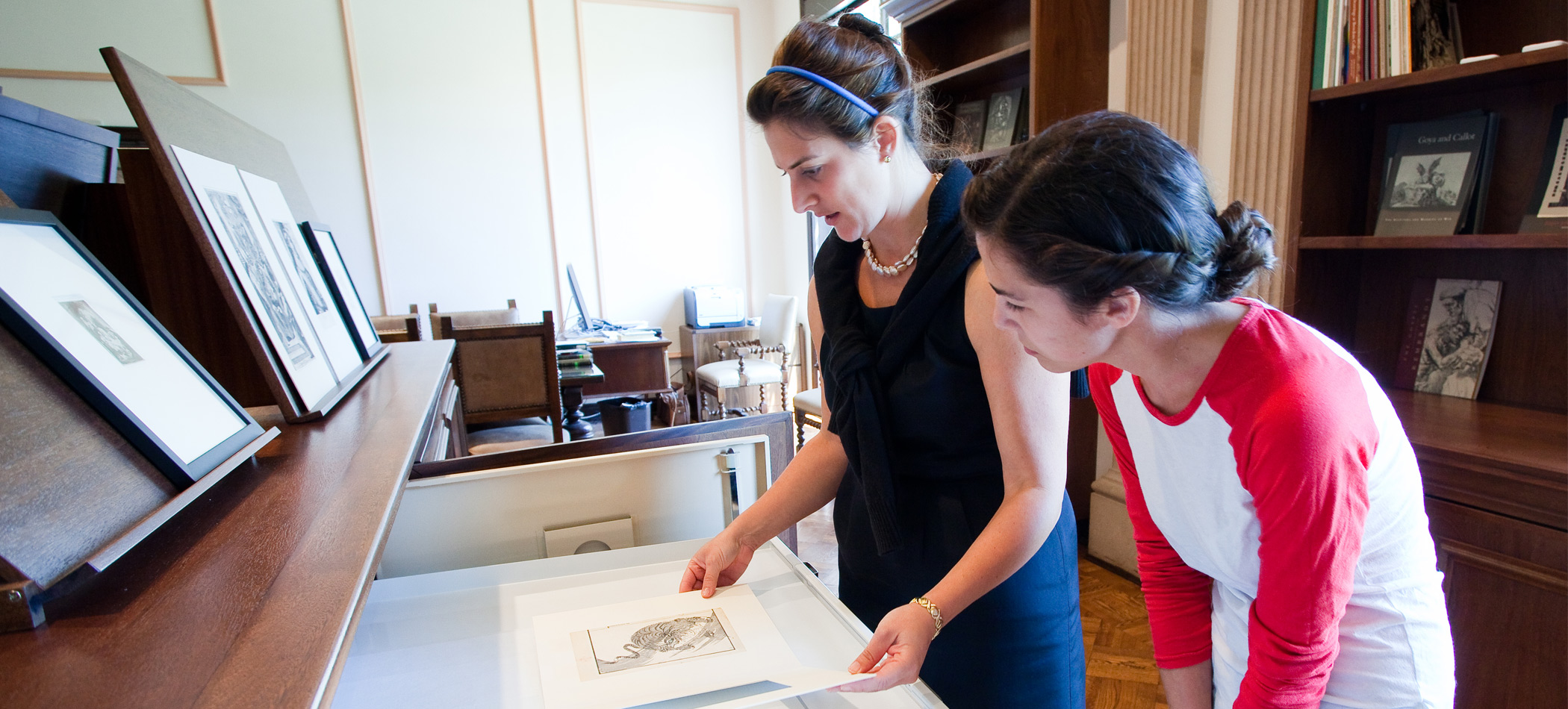
This path offers students a robust background in the history of art and architecture, with an emphasis on modern and contemporary work. Students have the opportunity to study objects and buildings firsthand; many take up internships in USD's University Galleries and Print Study Collection, as well as in the museums and artists' spaces of San Diego.
Equipped to look critically and contextually at works of art, students are prepared to take on the onslaught of images that have come to frame our understanding of the world. Students go on to graduate programs in art history; careers in museums, artists' spaces and galleries; law school; work in art-related organizations, foundations and non-profits. Students concentrating on the History of Art and Architecture draw on the expansive and focused resources of the Department of Art, Architecture + Art History, with its compelling faculty in all three fields.
Students must complete 28 upper-division units in Art History (ARTH), including the Methods and Capstone Sequence:
ARTH 395 | Methods in Art History | 3 |
ARTH 490 | Image World/Written Word | 3 |
ARTH 495 | Senior Thesis | 1 |
Select seven additional upper-division Art History (ARTH) courses | 21 | |
Total Units | 28 | |
Please note that some courses are cross-listed and may be taken under either subject code: ARTH 144/FILM 101, ARTH 321/ARCH 321, ARTH 322/ARCH 322, ARTH 323/ARCH 323, ARTH 340/ARCH 340.
Museum and Curatorial Practice
This path prepares students to think critically and proactively about the ways that art is positioned—in the museum and in the larger arena of public space—shaping viewers' perceptions of the past and sense of the future. Mindful of the politics of representation and display, students will examine the shifting ground that reaches from the early museums of the mid-eighteenth century to the urban interventions and cyber-exhibitions of the twenty-first century.
This concentration prepares students to pursue graduate work and careers in museums, galleries, artists' spaces, art in public places programs, and emerging online venues. Enlisting the robust resources of San Diego, students gather first-hand experience through internships in USD's Hoehn Print Study Collection and University Galleries, together with the city's major museums and public art programs. Recent student internships have included: Hoehn Print Study Collection, Museum of Contemporary Art San Diego, San Diego Museum of Art, Timken Museum, New Children's Museum, and Quint Contemporary Art. Internships further afield have included: Corcoran Gallery, Washington, DC; Freer Gallery, Washington, DC; and the Whitney Museum of American Art, NY.
Prerequisites are as in the major. Students must complete 28 upper-division units in Art History (ARTH), including:
Select at least four of the following courses, planned in consultation with the advisor: | 12 | |
ARTH/ARCH 323 | Memory, Monument, Museum | |
ARTH 331 | Art in Public Spaces | |
ARTH 334 | Art of the Twentieth and Twenty First Centuries in Europe and the Americas | |
ARTH 345 | The Avant-Garde and Mass Culture: Art and Politics | |
ARTH 360 | Asia Modern | |
ARTH 370 | Museum Studies | |
ARTH 371 | Curatorial Practice | |
ARTH 372 | Exhibition Design | |
ARTH 373 | Collections, Collecting, Collectors: History, Theory, Madness | |
ARTH 498 | Museum Internship (ARTH 498 Museum Internship is required and is typically taken during the junior or senior year. May be repeated once) | |
Select three additional upper-division Art History (ARTH) courses | 9 | |
Capstone Sequence | ||
ARTH 395 | Methods in Art History | 3 |
ARTH 490 | Image World/Written Word | 3 |
ARTH 495 | Senior Thesis | 1 |
Total Units | 28 | |
Students are encouraged to meet with their advisor to select pertinent electives from such fields as Communication, Ethnic Studies, Sociology, Business, and Leadership.
History and Theory of Architecture and the City
This path encourages students to address contemporary social/cultural circumstances in the light of a historically grounded sense of visual expression and material culture. Courses in the history and theory of architecture and the city will be augmented by studies in other fields appropriate to each student’s interests. History and Theory of Architecture and the City is conceived for students who intend to move into fields such as architecture, architectural history and historic preservation, city planning, or public arts programs, and who will work toward creative strategies of urban intervention.
Prerequisites are as in the major. Students must complete 28 upper-division units in Art History (ARTH), including:
Select at least six courses from the following: 18 | |
ARTH/ARCH 320 | Money by Design: Architecture and Political Economy |
ARTH/ARCH 321 | City and Utopia: Introduction to History of Urbanism |
ARTH/ARCH 322 | Contemporary Architecture |
ARTH/ARCH 323 | Memory, Monument, Museum |
ARTH/ARCH 327 | Architecture and Decolonization |
ARTH/ARCH 330 | Topics in the History of Architecture and Design |
ARTH 331 | Art in Public Spaces |
ARTH 334 | Art of the Twentieth and Twenty First Centuries in Europe and the Americas |
ARTH/ARCH 340 | Biographies of World Cities |
ARTH/ARCH 345 | The Avant-Garde and Mass Culture: Art and Politics |
ARTH/ARCH 350 | Art and Organicism |
ARTH 354 | Art in the 1960s and 70s |
ARTH 356 | Race, Ethnicity, Art and Film |
ARTH/ARTV 382 | Public Art Seminar | |
Select one additional upper-division Art History (ARTH) course | 3 | |
Capstone Sequence | ||
ARTH 395 | Methods in Art History | 3 |
ARTH 490 | Image World/Written Word | 3 |
ARTH 495 | Senior Thesis | 1 |
Total Units | 28 | |
Please note that a number of courses are cross-listed and may be taken under either subject code.
History and Theory of the Moving Image and Media Art
This path focuses on time-based artistic practices, with emphasis on work made since 1960. Courses delve into experimental performance and video work; confront moving images that range from the painstaking hand-crafted animation of William Kentridge to the LED declamations of Jenny Holzer; and consider the ways that artists have operated within carefully calibrated parameters of time and space (as in the works of Ja'Tovia Gary and Ragnar Kjartannson). Students will be equipped to think critically and contextually about the moving images that have come to envelop us in the 21st century.
This emphasis prepares students to pursue graduate studies and careers in museums, galleries, artists' spaces and emerging online venues. Art history students focusing on History and Theory of the Moving Image and Media Art draw on the expansive resources of the Department of Art, Architecture + Art History and its interdisciplinary Visual Arts concentration in Film, Performance + Media Art.
Prerequisites are as in the major, but students in this emphasis must take ARTH 101 Introduction to the History of Art and ARTH 144/FILM 101 Introduction to Cinema; and their Visual Arts courses must include two of: ARTV 104: Introduction to Animation, ARTV 108: Introduction to Film/Video, MUSC/ARTH 109: Introduction to Sonic Arts, ARTV 308: Virtual Reality and 3-D Studio, ARTV 320: Topics in Film/Video, ARTV 323: Film and the Female Gender, ARTV 324: Intermediate/Advanced Film/Video, ARTV 355: Architecture, Film & Media: The Space of the Screen. Students must complete 28 upper-division units in Art History (ARTH) and Film (FILM), including:
FILM 301 | Introduction to Film Theory | 3 |
Select at least 5 elective courses from the following: | 15 | |
ARTH 334 | Art of the Twentieth and Twenty First Centuries in Europe and the Americas | |
ARTH 336 | History and Theory of Photography | |
ARTH 345 | The Avant-Garde and Mass Culture: Art and Politics | |
ARTH 354 | Art in the 1960s and 70s | |
ARTH 356 | Race, Ethnicity, Art and Film | |
ARTH 357 | Global Film and 'Asia' | |
ARTH 358 | Mexican Cinema | |
ARTH 494 | Special Topics in Art History | |
Select one additional upper-division Art History (ARTH) course | 3 | |
Capstone Sequence | ||
ARTH 395 | Methods in Art History | 3 |
ARTH 490 | Image World/Written Word | 3 |
ARTH 495 | Senior Thesis | 1 |
Total Units | 28 | |
Art History Study Abroad
No more than a total of two study abroad courses can be counted toward Art History major credit.
Honors Courses
Honors Seminars focused on the history of art and architecture are open to all Art History majors as space allows, and count toward the major. Topics have included several team-taught courses: Trash: Modernity and Evacuation, Images of Enlightenment, Modern Palestinian Art and Literature, and Modern Latin American Art and Literature.
Double Majoring in Art History and Architecture or Art History and Visual Arts
Students are allowed to double count units toward two majors within the Department of Art, Architecture + Art History in a limited manner: they must complete a total of at least 48 upper-division units in the two majors while fulfilling all of the requirements for both majors.