
Department of Languages, Cultures and Literatures Marks 10 Years of Empowering Language Learners and Honoring Cultural Diversity at USD
By Leslie Ridgeway
For Debby Romero ’18 (BA), taking Spanish courses for heritage speakers at the University of San Diego not only broadened her knowledge of Latino cultures but also instilled a sense of belonging and empowerment.
Romero, the daughter of immigrants from Mexico, grew up with Spanish spoken in her home. As a bilingual learner at USD, she quickly realized that even as a heritage speaker, she lacked the confidence to communicate effectively in Spanish. So, she chose Spanish for her language requirement and enrolled in Spanish 311, an advanced writing course that gave her the academic skills she desired and centered her culturally.
“It felt like home,” says Romero, who majored in Spanish and now works in the Department of Urban Education at Rutgers University-Newark, N.J. campus as Assistant Director of Teacher Preparation and Certification. “[In the program] I learned about European Spanish and Latin American culture, and it was very challenging, which was what I was craving — to expand my knowledge and push beyond my beliefs and borders. My cohort was intimate; no more than eight people. It felt like a place of refuge.”
The Department of Languages, Cultures and Literatures in the College of Arts and Sciences is celebrating 10 years of bringing this experience to dozens of students whose first language was Spanish or who grew up speaking it at home but lack the skills to communicate academically and professionally.
The coursework in Spanish for heritage speakers, was developed by Professor Julia Medina, PhD, then director of the Spanish program in the college. Medina immigrated with her family from Nicaragua as a child and remembers her own challenges with the Spanish language. As a professor, she recognized that a one-size-fits-all approach could not meet the needs of heritage speakers and second-language speakers alike.
“By the time I was in college, I had forgotten the technical aspects of Spanish,” says Medina. “I [became] a student of a heritage speaker program at the University of California, Davis, a turning point in my life and career. Because of that personal experience, I understood the impact and significance of having that program.”
In organizing her proposal at USD, Medina surveyed the Spanish-speaking community within the Spanish program, finding that more than 30 percent were heritage speakers. “Their knowledge was not really recognized in courses that are focused on second language learning,” she says. “I thought it was urgent to bring [the program] for my students.”
The program focuses on improving students’ writing skills in the context of their own cultural knowledge and personal experiences. The first course in the series, Spanish 212, provides a formal Spanish education for heritage speakers, building on their inherited knowledge as it exposes them to the Spanish-speaking cultural world and instills an understanding of grammar, orthography and punctuation.
Spanish 311: Advanced Writing for Heritage Speakers is “a cornerstone,” Medina says. The course serves heritage speakers who lack formal training in academic or professional communication, teaching the tools to refine and expand writing and reading skills and vocabulary, while exploring what it means to be bilingual in the U.S.
Medina, who has been teaching at USD since 2010, developed Spanish 311, while Spanish 212 was championed by Professor Clara “Bicho” Azevedo, who also taught classes for heritage speakers at USD for many years. Professor Iñigo Yánguas, PhD (now director of the Spanish program), also taught Spanish 311 until the program recently welcomed Assistant Professor Karen López Alonzo, PhD, a specialist in sociolinguistics. López Alonzo also developed heritage Spanish programs and curriculum at Baylor University and Northern Arizona University.
López Alonzo’s research and teaching focus on heritage Spanish speakers, and her work links with the linguistic landscape of San Diego. She designs her courses to connect students with each other and to their own professional and academic interests.
“Allowing students to work on collaborative projects cultivates community by engaging them in enticing activities like podcasting or video recording,” she says.
For Romero, the community within the Department of Languages, Cultures and Literatures has provided valuable support, as a student and after graduation, as a multilingual educator teaching elementary school students, first in San Diego and later in Brooklyn, N.Y., for six years. Her current position at Rutgers is an opportunity to encourage aspiring teachers from marginalized communities.
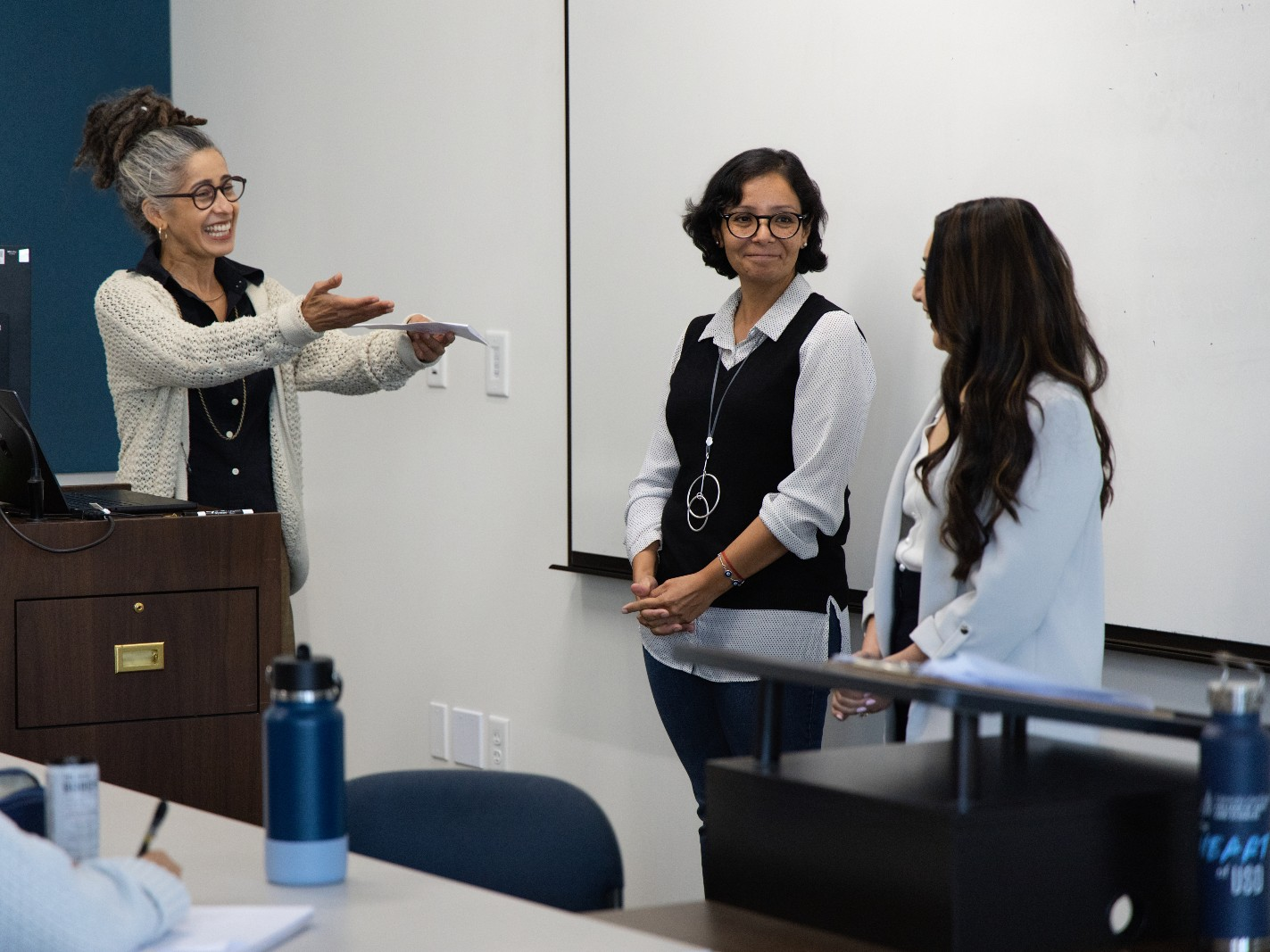
On Oct. 15, Romero returned to campus to speak to López Alonzo’s students about the lifelong lessons she learned at USD.
“I took away that there’s power in being a Latina, there’s power in being a first-generation college graduate and power in using your privilege to further your community through your passion. “The course showed me that being Latina is not just an aesthetic, it’s political. It’s reclaiming your heritage.”