
Developing a Winning Concept
First-year USD students relive winning submission for Fowler Business Concept Challenge
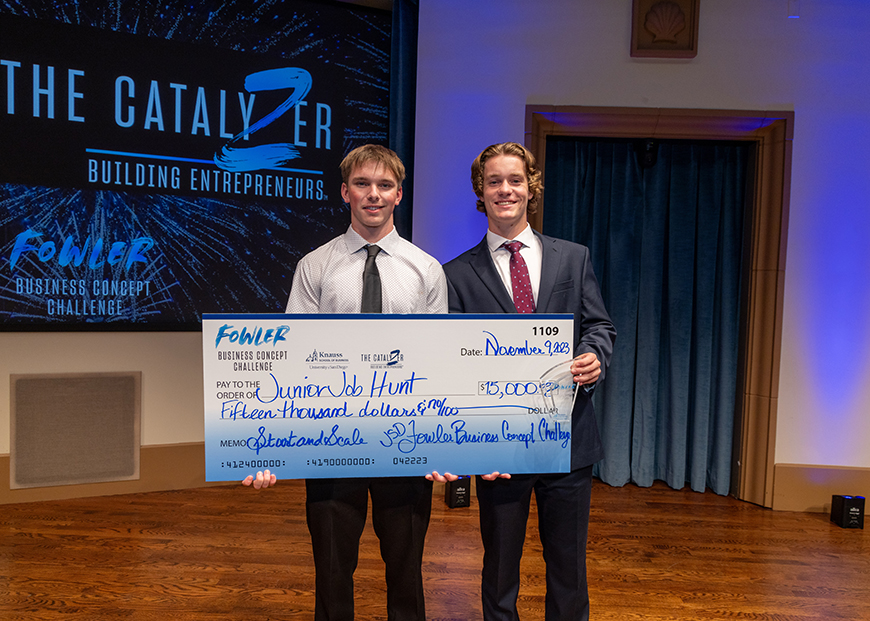
First-year students Ethan Addams and Brennan Martin met during an introductory business course — neither had any previous experience navigating the rigors of a pitch competition. A few weeks later, the duo stood on stage with a check for $15K in seed funding and the title of champions of the 2023 Fowler Business Concept Challenge (FBCC).
Addams and Martin created Junior Job Hunt during the beginning of the fall semester and quickly developed the concept into an official submission for the annual competition organized by the Knauss School of Business’ Entrepreneurship and Innovation Catalyzer.
The overall goal is to empower young entrepreneurs through work within their local communities.
“Junior Job Hunt is a platform that connects young entrepreneurs with neighboring adults in their communities,” explained Addams. “They can connect through three different means of work: labor, education and service.”
The labor category includes household maintenance tasks such as lawn care and window washing. Education includes tutoring, babysitting and personal training, while the service category includes tasks focused on aid for senior citizens.
The primary target user of Junior Job Hunt is high school students, ages 15-18, with the secondary target user being young adults, ages 19-22.
“We know there are a lot of kids out there like ourselves that need a platform to post what they can do,” Addams said.
This year’s competition set a new record with a total of 78 business concept submissions during the preliminary round. Addams and Martin presented a rough draft of their entry to their class just a few days prior to submission. When they received word that they were selected for the semifinals, things really kicked into high gear.
“That’s when we started to take it very seriously,” Addams said.
The initial idea for a gig economy platform targeting teens and young adults sprung from a pressure washing business Martin ran during high school in Oregon. Each summer, both the business and Martin’s confidence grew.
“That experience of getting out there and building genuine relationships with the clients was so valuable,” said Martin. “
Sitting next to each other during the first few weeks of their initial semester at USD, Addams and Martin began developing the concept.
It was a natural partnership.
“Ethan and I were both immediately passionate about it and saw the idea as something that could be a lot bigger than a class project,” said Martin. “There are so many kids who offer unique skills. We want to give them the resources to grow.”
They envision Junior Job Hunt as a platform to connect young adults with those who need work done in their local community. While similar in concept to other applications like TaskRabbit, an online marketplace that matches freelance labor with local demand, Junior Job Hunt would also be an educational tool that offers their young users tutorial videos and other support resources.
“They get to learn more about their community, develop skills they are passionate about and apply those skills to real world jobs,” explained Addams. “Our goal is to build up their confidence on how to talk to clients, price their work, talk professionally and then take those skills out into the real world,” said Martin.
The experience of pitching their concept at the FBCC was exciting and inspirational, said Addams.
“The competitors and judges were all brilliant and everyone was super supportive.”
Yet along with the camaraderie, it was also a high pressure event, one that tested the young competitors.
“In-between each session, we would spend the hour frantically running our pitch over and over again,” Martin said. “It was Ethan and I trying to keep each other hyped up, yet calm and centered at the same time. It was high energy and high anxiety, but also so much fun.”
Winning the competition proved rewarding that Junior Job Hunt is not only a good idea, but one that has traction, Martin said.
“It’s validation and such a motivator that it’s something we can now move forward with,” he said. “Being in the beginning stages leaves so much room for the judges and all of these awesome people we’ve met to help us build from the ground up rather than help us fix bad habits if we were further along.”
Addams and Martin are now working with The Brink SBDC and the Entrepreneurship and Innovation Catalyzer and are focusing on obtaining additional guidance before they open their idea to mentors.
“At the end of the day, what we are trying to do is close that generation disconnect that is present in our neighborhoods,” Martin said. “There is such a big need both ways — adults want to hire young adults and the kids want to work for people in their communities. If we can create this in a way Ethan and I see it, there isn’t a homeowner or a kid between age 15-22 that wouldn’t benefit.”
— Story by Matthew Piechalak