
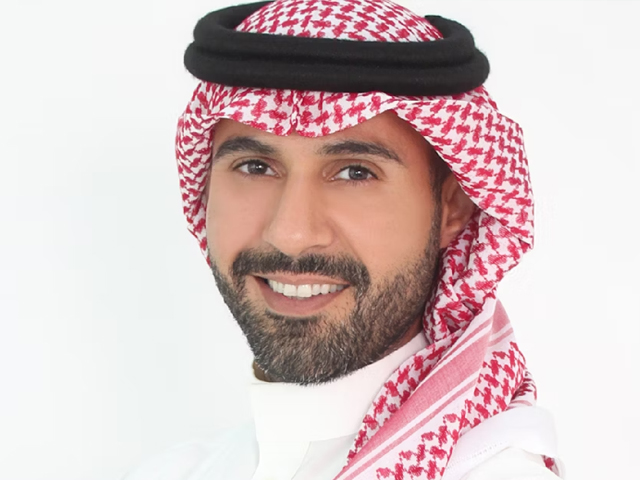
Yazaid Al-Salloom ’05, ’07: Opening Financial Paths in Saudi Arabia
In 2022, Saudi Arabia was the fastest-growing G20 economy, according to the International Monetary Fund. Strong growth continued into 2023, reflecting robust oil production and surges in wholesale markets, retail trade, construction and transportation.
With a front seat to it all is Yazaid Al-Salloom ’05, ’07 (MBA), who in 2022 was named Bank of America’s CEO in Saudi Arabia, Kuwait and Bahrain, where he oversees the U.S. lender’s local operations in equities and investment banking, and offshore dealings involving transaction banking, fixed income and corporate banking. The Riyadh, Saudi Arabia office may be small in comparison to New York or London, says Al-Salloom, but it's growing. "These are emerging markets and no other country has a growth plan more ambitious than Saudi Arabia over the next decade.”
Al-Salloom’s role — guided by his experiences at USD's Knauss School of Business — positions him to do good in a part of the world that is experiencing rapid positive change.
“We went from a country that was much more closed off with strict religious laws banning most forms of entertainment,” says Al-Salloom, who spent his adolescent years in Saudi Arabia, after a childhood in Washington D.C. “But it lacked proper planning for future generations until the new leadership rose to power in 2015 and the Vision 2030 initiative was put in place a year later as a blueprint to transform the economy and allow the Kingdom of Saudi Arabia to function more efficiently than most other G20 economies.” The Vision was established around three main pillars which are a vibrant society with equal rights to its citizens and residents, a thriving economy with the highest standards of transparency, governance, and procurement and lastly an extremely ambitious young nation. Also, new policies mean women are playing a heightened role in the transformation.
“We’ve now got concerts, cinemas, new cities and ‘giga’ projects happening across the country,” says Al-Salloom. “None of these things happen organically. They require financial support through lending, and they need expertise and connections and industry experts which international consultants helped bridge, but the most important aspect was bold execution which the leadership and its citizens deserve most of the credit for. Companies want to invest in Saudi, because Saudi is now open for business with record ease in the process of setting up.”
Al-Salloom grew up in Virginia, the son of the cultural attaché for the Saudi embassy in Washington, D.C. Wanting to attend college in sunny Southern California, he enrolled at USD, where he considered majoring in marketing or advertising. He ended up pursuing a BBA in finance. On the advice of a friend, Al-Salloom took a yearlong internship at Merrill Lynch’s wealth management division. It was the start of what’s now nearly a two-decade banking career.
Early in his career, he worked for HSBC Dubai for almost 8 years, where he split time between debt capital markets, investment banking and fixed-income institutional sales. Prior to that, he worked for three years at Deutsche Bank as part of the investment banking division.
From 2020-22, he was managing director and CEO at the Standard Chartered bank’s Saudi Arabia operations. There, he opened a new branch that created more than 45 jobs and brought additional capital into the country. Previously, Al-Salloom led the bank’s Financial Institutions Sales team in the Middle East, North Africa and Turkey (MENAT).
It was at the Knauss School of Business where it all started. There, Al-Salloom was able to bloom.
“I had friends who were in public schools, where the classrooms were massive and professors didn’t know who they were,” he says. “USD was small enough for the professor to recognize you, discover capabilities in you that you didn’t know you have and help you nourish them. They worked on you. Everyone was incredibly supportive.”
He is using those skills to remake a corner of the world that is becoming more economically diversified and integral to global commerce beyond oil.
“The growth and ambition happening now – both economically and socially – is crazy,” Al-Salloom says. “These are things that I never thought would happen in my lifetime, or even my kids’ lifetime. It feels like a dream that it’s materializing today.”