
Finding Opportunity in Crisis: Developing Strategies for Managing Climate Risk
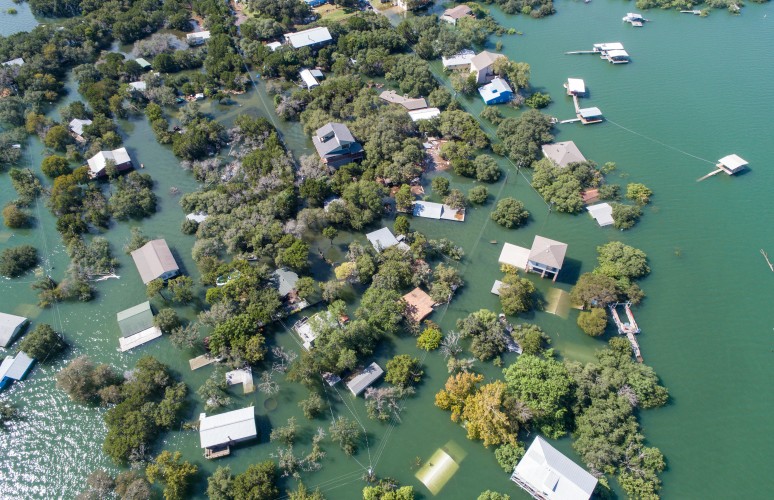
In May 2020, hail storms that stretched across several Texas cities caused an estimated $1.2 billion in damage to homes, businesses and vehicles. It was the sixth weather-related disaster with damages exceeding $1 billion to affect the state in 2020, and Texas had not yet entered its hurricane season.
The South Texas hail storms also marked the 10th weather- or climate-related disaster with damages exceeding $1 billion in the United States in 2020. The country is now on its sixth consecutive year with 10 or more billion-dollar disasters involving storms, wildfires, flooding, drought, and freezes.
Increasing global surface temperatures and rising sea levels make it likely that the number and intensity of droughts and storms will continue to increase, according to the U.S. Geological Survey. The effects of climate change — and humans’ impact on climate and ecosystems — have given rise to an unofficial name for our current epoch: the Anthropocene.
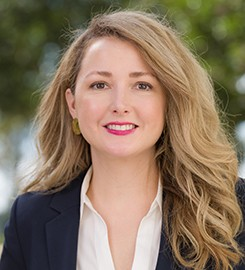
The threat to lives and livelihoods posed by climate-related disasters is growing, and with it the challenge of assessing disaster risks and preparedness. The critical question of how humans adapt to climate-related risks in the Anthropocene is a research focus of Dr. Nichole Wissman-Weber, assistant professor of management at the University of San Diego Knauss School of Business.
Risk Regimes
Climate-related risks might not seem like an obvious field of study for a professor of management, but the subject’s prominence in the discipline is growing. Management scholars are increasingly looking at how organizations are responding to current and future climate change impacts, according to Wissman-Weber.
Wissman-Weber’s graduate research developed the concept of “risk regimes,” a framework to understand “how climate risks are comprehended and defined; how they are measured, monetized and managed; and how their associated costs and benefits are distributed.”
The necessity of such a framework becomes apparent when one considers the scale and complexity of the crisis Wissman-Weber and others are addressing. The climate risks that define the Anthropocene threaten the ecological foundations of the economy and society. Because climate-related disasters have interconnected economic, ecological, cultural and political impacts, those risks require a collective understanding and response. However, various stakeholders share widely varying levels of risk, financial burden, vulnerability and power.
Wissman-Weber’s work on risk regimes provides a way of comprehending, structuring and managing risk; allocating responsibilities; distributing costs and benefits; and handling conflict. More generally, it shifts climate-related risk assessment from an individual approach to a collective exercise.
Putting Theory Into Action
Wissman-Weber’s research is grounded in practical work she did during her doctoral studies at the University of Massachusetts Boston. Under the leadership of Dr. David Levy, DBA, she contributed to a project that helped the city of Boston identify proactive strategies for financing investments in flood protection and other efforts to mitigate climate-related risks. The research culminated in a report called “Financing Climate Resilience: Mobilizing Resources and Incentives to Protect Boston From Climate Risks.”
In many ways, Boston is a perfect location for the study of climate risk and human adaptation to climate change. The city's geography makes it particularly vulnerable to stormwater, coastal and riverine flooding. Boston also has one of the highest levels of income inequality in the United States, which makes it a case study for the ways that climate risk intersects with other vulnerabilities, such as low-income housing and limited access to health care and insurance. Wissman-Weber’s research involved gathering data from a broad range of stakeholders, including government officials, real estate developers, insurance companies and community organizations.
The diversity of constituencies was critical for research focused on managing the complexity of collective solutions. Addressing the need of a single entity could be relatively simple — protecting a building from flooding with a storm barrier, for example — but such narrow measures for addressing climate-related risks only shift the problem to someone else. A storm barrier might protect a building, but the water it displaces overruns storm drains and floods a nearby neighborhood. Arriving at a collective understanding of risk at an urban level allows cities to look at funding options for projects designed to protect everyone.
Building on a Core Interest
An interdisciplinary scholar, Wissman-Weber built a strong foundation in business and environmental science. She studied English and American cultural studies at Heritage University before earning her master's degree in sociology at New Mexico State University. Nichole attended the University of Massachusetts Boston’s PhD in Business Administration program as a National Science Foundation Integrated Graduate and Research Traineeship Fellow.
Business management, environmental sustainability and social equity might seem an unlikely combination to some, but Wissman-Weber traces her interests to her upbringing in central Washington. Growing up in an agricultural area in the foothills of the Cascades allowed her to develop an early connection to nature, as well as an awareness of industrialized agriculture as both an economic engine and a source of byproducts that harm migrant workers.
She offers sage advice for students figuring out a career path: “What’s really driven me in this process is the core thing that was really important to me and that I found really interesting. I wanted to learn more about it. If you know what your core is, what’s really important to you, then you can start pursuing it and taking small steps that will lead you down a path that will ultimately make you satisfied and keep you interested.”
The Next Chapter
Wissman-Weber recently received funding to start an environmental integration lab from the University of San Diego’s Institutional Effectiveness and Strategic Initiatives office. She and Dr. Julia Cantzler, associate professor of sociology at USD, are developing the lab as an interdisciplinary initiative to increase faculty engagement on issues of climate change and sustainability. As an extension of the virtual lab, Wissman-Weber and Cantzler are planning a speaker series — designed to get students and faculty involved in environmental issues across campus — for Fall 2021.
Discover Your Passion in Business
The University of San Diego Knauss School of Business understands that there is more to business than profit. Dr. Wissman-Weber and her fellow faculty members prepare students to become ethical leaders and innovators. Offering a range of degree programs, internships and real-world experiences, the Knauss School of Business challenges students to imagine ventures that are fiscally and socially responsible. Visit the University of San Diego Knauss School of Business to learn more about how it can encourage you to explore your passions and change the world.
Sources
National Geographic Resource Library, Anthropocene
University of San Diego, Nichole Wissman-Weber
U.S. Geological Survey, How Can Climate Change Affect Natural Disasters?
 Nichole Wissman-Weber is an assistant professor of management at the University of San Diego's Knauss School of Business. Her research focuses on how organizations manage interconnected social and environmental problems such as climate change. In her current work, she examines cross-sector collaborative efforts to adapt to climate risk in the northeast coast of the United States.