
Research Spotlight: The Pollution You Cannot See: Microplastics in Coastal Bays and Beaches
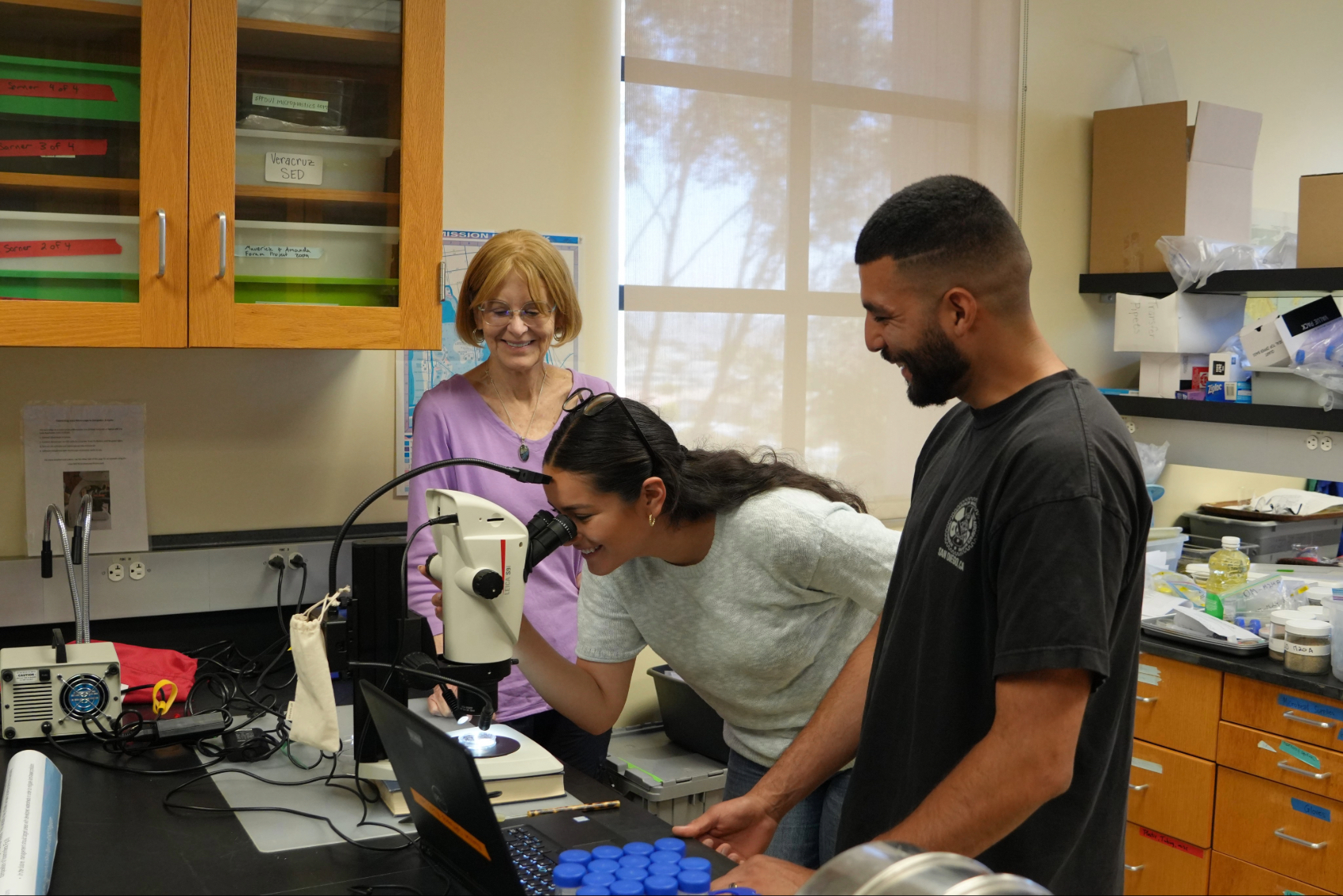
David Salinas, a McNair Scholar, and Valeria Negrete, who is part of the Summer Training in Advanced Research (STAR), are both studying environmental and ocean sciences and working alongside mentor Sarah Gray, PhD, professor of environmental and ocean sciences.
Gray and the students are working on a research project titled, The Pollution You Cannot See: Microplastics in Coastal Bays and Beaches. This project investigates microplastics in sediments at different San Diego beach and bay locations.
Every day working on this project looks different. Some days, the team is out in the field collecting samples, processing the samples, counting filters or reading related articles. Once the samples are collected, the sediment is sieved through to collect nurdles (a tine pre-production plastic pellet about 2-5 mm) before a more precise retrieval of the smaller microplastics. For this process, the sediment is placed in a tube with zinc chloride, placed in a centrifuge where the sample is spun at 3000 rpm. The microplastics rise to the top of the zinc chloride and separate from the sand. From there, the microplastics are collected and filtered and sent to a lab at the Scripps Institution of Oceanography where they are collaborating with Dehayn Lab to image their samples using a fluorescent light.
Seeing the images of the microplastics became one of the most unexpected parts of the project for Salinas and Negrete. They quickly became aware of just how prevalent microplastics are in our daily lives. Something as simple as a plastic water bottle can leave a big impact on the environment due to the particles that can break off and be ingested by small animals. This then works its way up the food chain before being consumed by humans.
The end goal in mind for Salinas, Negrete and Gray is for the public to recognize that plastic pollution is a problem and that microplastics must be dealt with. This can start with the public properly disposing of plastic trash and eventually limiting plastic usage.
Salinas encourages fellow students to get involved in research. “Don’t be afraid to make mistakes and be wrong,” he says. “Ask as many questions as you can, and most importantly, have fun.”
Negrete’s advice is to always ask around on campus because you never know which lab is looking for more student involvement. She also encourages other students to be open minded about different research projects and don’t be afraid to just go for it.