
Research Spotlight: Callie Schreiber
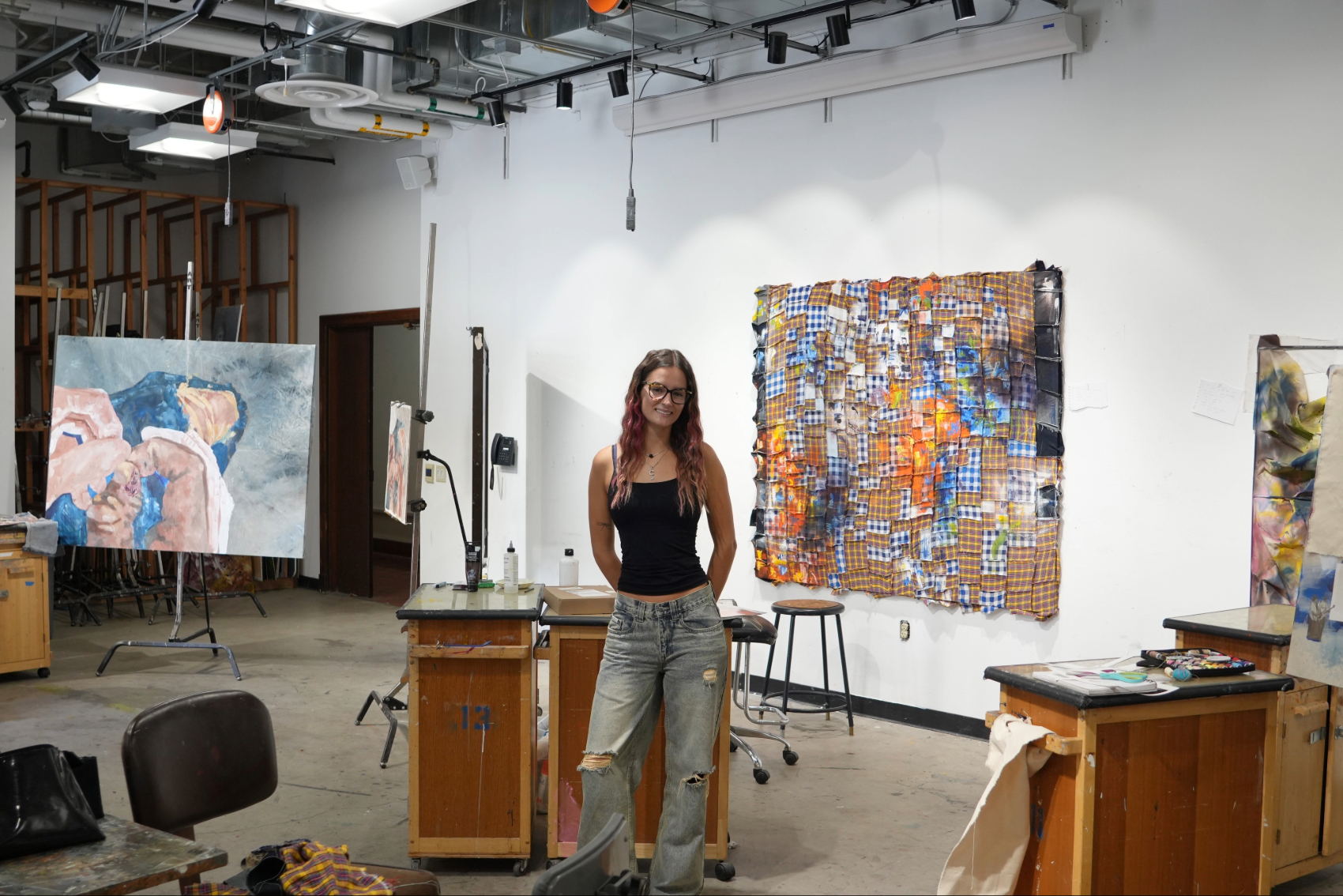
Callie Schreiber, a rising senior at the University of San Diego double majoring in visual arts and psychology, is pursuing creative works through the Summer Training in Advanced Research (STAR) program under the mentorship of Professor Matt Rich, MFA, visual arts program director. Her research focuses on representing art and psychology through painting.
Schreiber decided to pursue research this summer upon learning about the STAR award through friends. Busy with classes and other responsibilities, Schreiber did not having as much time as she would like to paint during the school year. Having the opportunity to dedicate nearly every day of the summer to her art sounded appealing. A typical day in the studio for Schreiber starts with painting for a few hours, reading different art articles from her mentor, or psychology articles from previous professors and going back to her art, but in a different form.
Although it may look like Schreiber is simply painting, she is also sewing, welding in the metal shop, building in the wood shop and more. She handmade each component of her work to make it precisely how she wanted and is even putting attention to detail into elements such as the wall on which her paintings will hang.
One of Schreiber’s current pieces explores the relationship between psychology and art by examining the limitations of diagnostic labels. Inspired by the Diagnostic and Statistical Manual of Mental Disorders (DSM), the work uses a structured framework of sewn fabric and quilt-like grids to represent the organization and rigidness that is the DSM. Layers of paint are then applied over the material, partially obscuring the structure beneath and symbolizing clinical treatment, the reality that no diagnosis or label can fully capture a person’s lived experience. Schreiber emphasizes that sometimes you need to abandon the labels and the DSM and go on your own route.
The art extends beyond the expected boundaries of traditional painting, much like her mentor Matt Rich's work. Schreiber uses holes, different textures, and gravity-driven paint marks, while still maintaining the familiar rectangular shape of a canvas. Through this process, Schreiber portrays the tension between relying on the DSM and recognizing that sometimes real-world experiences require moving beyond labels and categories.
Schreiber’s advice for others wanting to get involved in any research field is to not put too much pressure on your idea or end goal. At the beginning, your research may feel heavy and daunting, but it’s your idea and there is room to grow and change that.