
Lessons We Don’t Expect to Teach
Greg Prieto on Mortality and Meaning in the Classroom
One of our mutual friends jokingly refers to Greg Prieto, PhD, as the Mayor of Hillcrest, San Diego. You can hardly walk a few feet down University Avenue with Greg without running into someone he knows (I witnessed this on his birthday a few years ago). And like moths to a flame, they were all eager to bask in the glow of his warm smile and share a hug.
I first caught a glimmer of this charisma when I met Greg, a professor of sociology at the University of San Diego, about nine years ago at a Rainbow Educator training. I was captivated by his lecture style, which I would describe as precise and passionate. It was clear Greg cared deeply about the subject matter and our learning. I had only been at USD for about a year, and it made me think I was going to need to step up my game!
I’ve not managed to match his style, but our pedagogy overlapped more explicitly this year when Greg started teaching a course called The Sociology of Living and Dying. Since I’ve been studying and teaching about dying and death for 20 years, I was happy to share ideas for his course.
“You have the confrontation with mortality, and all of a sudden your priorities become much clearer.”
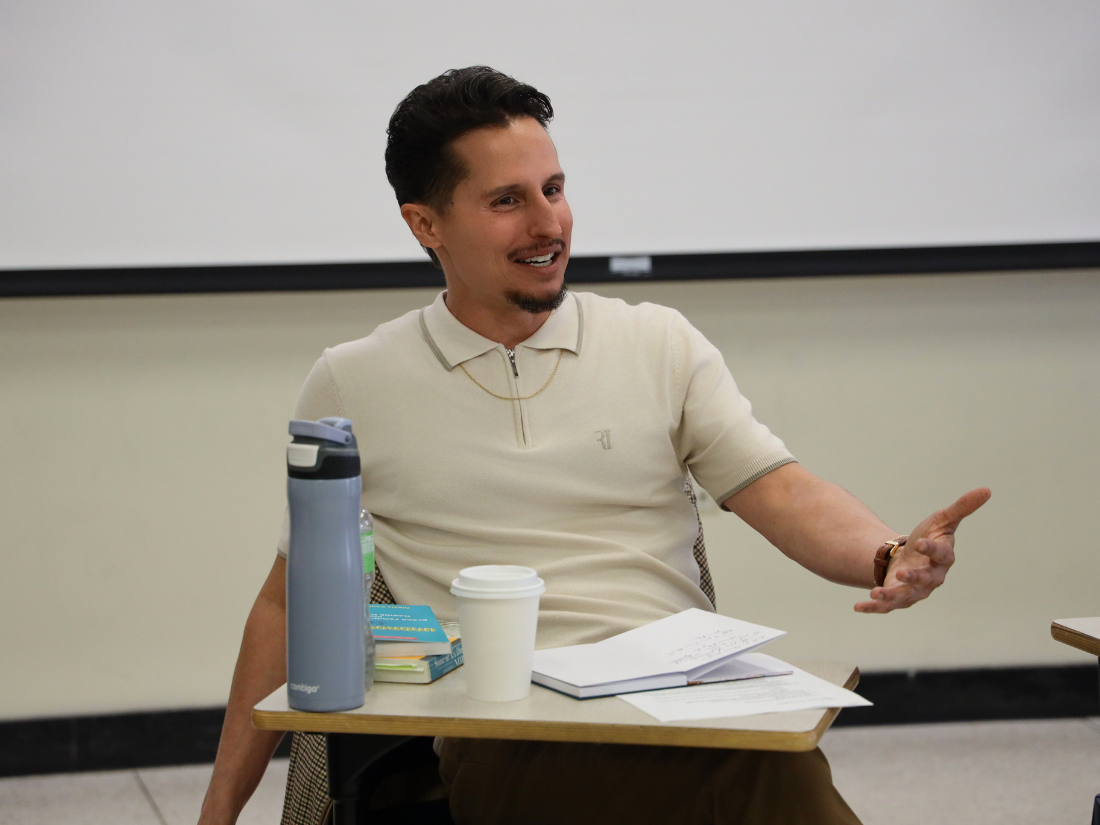
As the semester wrapped up, I was eager to talk with Greg about his experience teaching about a topic so many folks want to avoid. So, on a sunny San Diego afternoon, we found time to sit down and chat about teaching and mortality over a cup of coffee.
Prieto has taught courses about controversial or taboo topics before on subjects such as sexualities, juvenile justice and immigration. He arrived at USD with “advocate’s zeal,” which he developed while studying sociology. Yet the turn toward teaching about the sociology of living and dying was guided by two factors: pedagogy and biology.
Like many new faculty at the beginning of their careers, “I wanted to make sure everybody knew I was an expert. I think I spent a lot of time building up that wall,” Prieto says. Teaching a faculty-led study abroad course was instructive for Prieto and fundamentally shaped his teaching. “The best moments we had together were the in-between times when we weren’t doing a structured activity, so I think the other big piece [shaping my teaching] was this turn to a more strategically vulnerable, more personal, more holistic, more human approach.” This method fashioned Prieto into an award-winning educator.
“And then I was diagnosed with stage IV colon cancer in March 2024. March 18.” A diagnosis of this sort is devastating but also illuminating. Prieto observed between sips of espresso, “You have the confrontation with mortality, and all of a sudden your priorities become much clearer.”
Some folks quip that if faced with a serious illness, they would quit their jobs, run up their credit card debt and start traveling the world to tackle their bucket list. Greg started chemotherapy, which he continues today, but also turned to contemplation and silent preparation, “You sort of sandblast off the surface. What’s underneath this?”
Once the intensity of Greg’s treatment diminished and he was cleared to return to work part-time, he says, “The Dean’s Office sort of pitched me different things that I could do. I thought to myself, ‘Okay, in the time I have remaining, what do I want to do?’ Well, something good for the world. But like, what? What I’m actually good at is teaching. The decision was so obvious. And when I thought about what I would teach, I couldn’t imagine teaching anything other than the process that I was so bound up with — how your own dying inspires a reflection on how you want to live.”
My last question: Has there been any magic in Greg’s life since his diagnosis? As he spoke, tears welled up in his eyes and mine. I felt that same passion for teaching that I saw in that training a decade ago.
“Every day, every day, every day, every day. There is this way in which the beauty and the horror of the situation is all braided up together,” he says. “You feel the delicacy of [life], and then you feel the preciousness next. I’m the guy at the music festival who’s crying and everybody’s like, ‘Oh, he must really love that song,’ and I’m like, no, I’m trying to memorize this moment. I never want to forget what this felt like.”