
Dean Noelle Norton sees research as one of the key elements that binds the College of Arts and Sciences together. “We provide a very robust undergraduate research model,” she says. “Students can work in a laboratory, or work on doing archival research or data collection and develop a variety of research skills while being mentored by faculty.”
Norton sees research as essential to a liberal arts education. “We have a lot of first-year students who sign up to do undergraduate research, which we encourage beyond the sciences and the social sciences, where you’d more naturally see it. We want students to be engaged in humanities research.”
“Every time a faculty member applies for a grant, they always include asking for support for undergraduate research,” Norton explains. “We know that the faculty-student connection is one of the key indicators for student retention, and our emphasis on undergraduate research helps students to know they’re welcome and that they belong at USD.”
Digging Deeper
While research can light the match that sparks epiphanies, for some, it grows organically.
Claudia Christina Escobar Avila grew up gardening in California’s Inland Empire. “My family are farmers from Zacatecas. When my mom came to the U.S., she wanted to grow the crops that she grew before and would carry me in a sling while she worked. She grew chiles, citrus, beans, corn, nopales. Pretty much everything that goes into salsa.”
Avila vividly remembers foraging in that garden. “Anything that was growing, I was eating. I always saw the outdoors as a resource.”
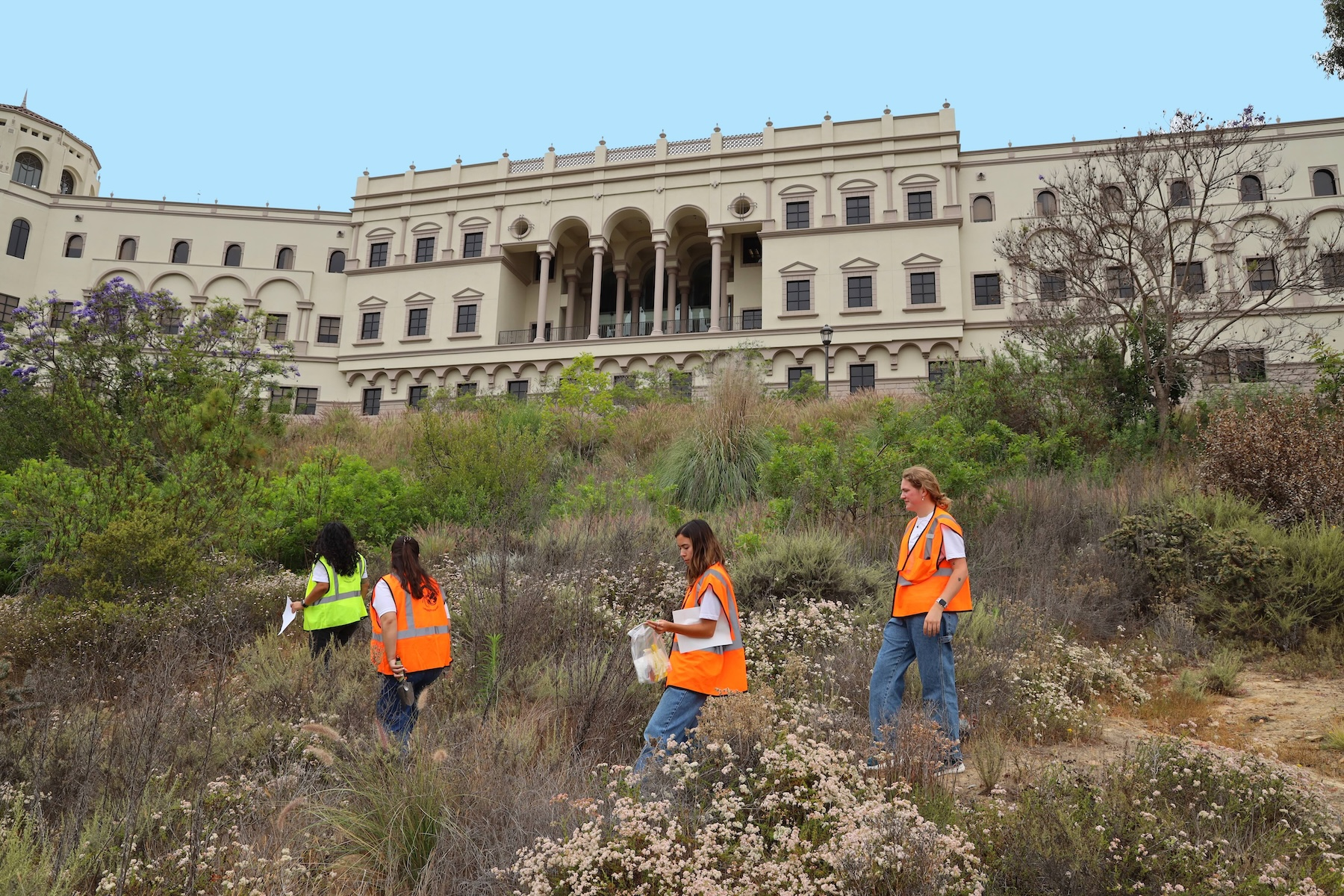
Even so, she didn’t consider integrating gardening into her academic life until she started community college. “I was part of the sustainability club, which made sense because my family is agrarian and very resourceful.” After earning her undergraduate degree, she went on to earn a PhD from the University of California, Riverside, and was subsequently named a postdoctoral fellow at Stanford University. Throughout those studies, soil continued to fascinate her.
“We don’t often think about soil health until something goes wrong, like when there’s an algae bloom in the Gulf due to the over-application of fertilizer in the surrounding farmland. Soil mismanagement impacts aquatic ecosystems. All things require healthy soils, but most people don’t think about it. They just think, ‘Oh, that’s just the stuff I walk on.’”
When Avila joined USD’s faculty as an assistant professor of environmental and ocean sciences, she filled a gap as a soil scientist. She notes that it’s a given that environmental sciences majors are passionate about protecting the earth, but believes there is real value to this learning for students from every discipline. “Business students relate to the fact that we need resources from the environment; business models don’t work if you don’t have those resources. Every field is essentially reliant on the natural environment.”
Borrowing the Mexican colloquial term for “badass woman,” Avila’s Xingona Dirt Science Lab at USD has a mission to use soil biogeochemistry as a tool for research focused on environmental justice and community building.
“My family called me ‘Xingona’ because I was in academia,” she explains with a laugh. “Also, at UC Riverside — which is historically a very well-known soils science center — in every one of my soil science classes, we were not allowed to say ‘dirt.’ But when people would ask me what I did and I’d tell them, they’d say, ‘Oh. You study dirt.’ My response was, ‘Yeah, I do. Let me tell you how cool it is.’”
The lab is about transformation and community; recent research is focused on the ways that wildfires impact soil chemistry. “What happens while soil is burning in an area with vegetation or forests? In what situations is a burn a good thing?” Avila asks. “Since the largest and most destructive wildfires on record have happened within the last five years, we know they’re going to get more intense. If we don’t address climate change and the ways we can mitigate wildfire risk, they’re going to get more and more frequent.”
She notes that farmworkers, outside laborers and the incarcerated (who frequently work as wildfire fighters) are vulnerable communities that inhale the most contaminants when there’s a wildfire. “My family are farmers. Essentially, I’m doing work to protect the people in my family.”
“Business students relate to the fact that we need resources from the environment; business models don’t work if you don’t have those resources. Every field is essentially reliant on the natural environment.”
The Psychology of Connection
After teaching high school math and accounting in Baltimore, Steven Berkley, PhD, segued into educational nonprofits in New York City. “In this work, I was responsible for supporting students with transitioning to college,” he recalls. “Many highlighted their excitement, and some shared challenges of feeling connected.”
“That’s what pulled me into research,” says Berkley. “I wanted to understand how identity, campus culture and family dynamics shape students’ transitions into college, and how this knowledge informs developmental science.”
Berkley joined USD as a Postdoctoral Teaching Pathway Fellow in 2021. Now an assistant professor in the Department of Psychological Sciences, his teaching and research aim to better understand human development and family dynamics, focusing on the sociocultural experience. “At the intersection of identities, my main focus is: What is the role of family? How do families support college transitions? How do students use this knowledge to navigate campus life?”
Berkley’s research laboratory in the Department of Psychological Sciences delves into these questions. “We investigate lived experiences, resilience and sources of strength,” he explains. “The goal is to generate insights that contribute to developmental psychology.”
In addition to courses in Developmental Psychology, one popular course Berkley teaches is PSYC 362: Black Families. “We move beyond deficit narratives,” he says. “Students become familiar with strengths and humanistic contributions that remain underrepresented in scholarship.” This course regularly enrolls students from varied ethnic-racial backgrounds and academic majors.
Student researchers in Berkley’s lab pursue questions that matter to them. Areas of focus include campus accessibility and belonging, family/stepfamily dynamics and the role of family culture on health and well-being.
Berkley encourages students to develop independent projects that embrace learning from multiple courses. “I meet students where they are,” he says. “We start with a focused question, build a realistic timeline, and hopefully turn curiosity into a doable study.”
Looking ahead, Berkley is excited about what the lab will become. “I want this to be a place where students grow as researchers and carry those skills into graduate study, community work or any career that they choose.”
“I meet students where they are. We start with a focused question, build a realistic timeline, and hopefully turn curiosity into a doable study.”
Designing for the Future
From the time he was a child, Daniel López-Pérez was always drawing. The son of an engineer father and artist mother, he credits his mom for instilling the sense of purpose and discipline he brings to his vocation as an architect. “I try to instill in my students that the rigor of drawing is important, in that it negotiates the built environment,” he says.
One of the founding faculty members of USD’s Architecture program, he draws upon that foundation in his work as a professor at USD. “My mother used to paint a lot of landscapes,” he recalls. “That sense of understanding our built environment and its relationship with nature came through in my own art and drawing. The relationship between nature and the built environment through art and through drawing was always present.”
He and his fellow department faculty members have a commitment to teaching students by coming up with solutions to real-world problems. “For the last 15 years, we’ve all been working on housing, which is one of the most complex and multifaceted problems in the discipline of architecture,” says López-Pérez.
Often working in conjunction with the City of San Diego, his students look at opportunities like replacing golf courses with housing or studying ways to find solutions to the thorny problem of making housing not just affordable but resilient in the face of challenges.
“The importance of not taking our built environment for granted has come to the fore of our collective consciousness,” he says. “All the faculty in the Architecture program unfold our design studios into the world. We do not invent abstract problems for the students. We, as a faculty, all agree that the problems that we have in the built environment are so much more interesting and complex than anything we could conceive of in the abstract.”
López-Pérez believes that technological advances can transform the field from a 20th-century mindset into a positive — even hopeful — force.
“We are being thrust into finding new solutions by climate change and growing inequities. We can no longer take the built environment for granted and do business as usual. One question is, ‘Does planning come from the bottom up, such as ADUs that create urban chaos?’ Because that’s what’s happening. Or does planning come from the top down, so that everyone ends up living in big, partially subsidized buildings?”
In his own professional practice, he’s come up with a solution that bypasses the status quo of building houses one 2x4 at a time. Polyhaus is a design and technology company that promises “rapid-housing made of mass-timber grown in North America.”
The idea came from seeking ways to densify housing without creating new problems, such as building in canyons, which are connected to the region’s water tables. López-Pérez notes that while larger buildings can be built relatively quickly and efficiently, due to their employment of industrial technologies, smaller projects are built significantly slower, given that they are built quite literally by hand and effectively without industrialized technology.
“Polyhaus is focused on housing units from 500 to 2,500 square feet. During the pandemic, I discovered mass timber, which has an extraordinary capacity to panelize. Suddenly, a 500 square-foot structure can be produced with 60 panels. It’s the solution to a 100-year-old promise in architecture: an entire house delivered on a single truck and assembled in days.”
While Polyhaus is entirely separate from his work with students in the Department of Art, Architecture + Art History at USD, it’s also deeply connected to the Architecture program’s overarching ethos. López-Pérez’s students can see the idea’s fruition by touring a fully functional housing unit with their own eyes — radical innovation right in their faculty’s backyard.
“My students can come and see it for themselves. Some of them saw the first prototype go up. They learn, firsthand, that it’s possible to be the first. Imagine, in a discipline as old as ours, the idea that you can innovate anything is really remarkable.”
He marvels at how well the process worked. “It was built as a proof of concept, and it was flawless. Its structure, built in two-and-a-half days, is simply miraculous.”
“[My students] learn, firsthand, that it’s possible to be the first.”
Beyond the Notes
Although she was eager to start piano lessons at the age of four, Charissa Noble had to wait until kindergarten, since that was the minimum age that the local piano teacher would accept. She’s been immersed in music ever since. But it wasn’t until studying voice during her third year at the Biola Conservatory of Music that she realized what really fascinated her was how and why others made music.
“I was interested in context, and there wasn’t room for that as a performer. I didn’t even know that music research existed, since I was at a conservatory and not a liberal arts school,” Noble explains.
She switched her focus to music composition, thinking that writing music might help her understand it better. “I was studying other composers’ scores and learning how they wrote them. That was my best attempt at musical research, so I switched to a composition major, the degree I completed.”
After graduation, a bookstore clerk introduced her to the musicology section. The rest, as they say, is history. “I was hooked,” Noble says with enthusiasm. “I thought research into the intersection of music and art was the most interesting thing I’d ever considered. I knew that was what I wanted to do with the rest of my life.”
Now an assistant professor of music at USD, Noble is delighted to offer students something that she didn’t have access to as an undergraduate: “An opportunity to do music research and understand the intricate connections between music, aesthetics and style, culture, history and precedent.”
Those are intersections that can reverberate through a lifetime. “I help students think about how different academic disciplines can contribute to nuanced understandings of music. Conversely, they learn how music can meaningfully participate in scholarly conversations happening in other fields, and in how we understand ourselves and our world.”
Noble believes music plays a critical role in shaping worldviews. “If you know enough about music and style and their historical precedents, suddenly, this huge part of your life that perhaps went unnoticed or under-recognized becomes unlocked in a meaningful way. You’ll miss that if you only think of music as something that’s merely pleasing or entertaining.”
To get there, research is crucial. “I integrate research into every part of my teaching,” Noble stresses. “Whether it’s teaching the basics of humanities or music research in the lower division, or examining music in more detail and doing research that produces new questions and answers, or toward more applied forms of research.”
At the most rigorous level, Noble’s students conduct individual or independent study, with her alongside as a guide. “I’ve had two students who were accepted to the Keck Undergraduate Humanities Research Fellowship Program,” she notes with pride.
Keck Fellows Yahaira Rodriguez ’23 (BA in music and political science) and Carly O’Rear ’25 (BA in music and theatre) were invited to present their papers at the local chapter of the preeminent musicological scholarly society, the American Musicological Society. It’s exciting for recipients and the department itself, but beyond accolades, Noble stresses that music majors can excel in any field.
“Everybody enjoys and is curious about music,” she says. “If you majored in music and that’s on your job application, it’s an instant win. It makes you intriguing to people. You stand out among other applicants.”
“I help students think about how different academic disciplines can contribute to nuanced understandings of music.”
A Collaborative Ecosystem
Undergraduate research goes beyond working in laboratories, delving into archival research and assessing the results of data collection: it’s about discovery in the truest sense of the word. Students learn what it feels like to follow a concrete problem to a viable solution, to hit and overcome roadblocks and to mold ideas into shape within a collaborative ecosystem.
“Our students are introduced to cutting-edge research by the faculty members in their classrooms; our faculty’s research ideas are shared with their students in a variety of ways,” explains Dean Norton. “One of the expectations for most of our departments is that faculty will work alongside students.”
At USD, students know from day one that they’re welcome, that they belong and that their contributions are valued. That intrinsic connection ensures that research is woven into the very fabric of their learning, building a foundation that can reverberate for a lifetime.