
From Practice to Purpose: Restorative Justice for Campus Sexual Harm
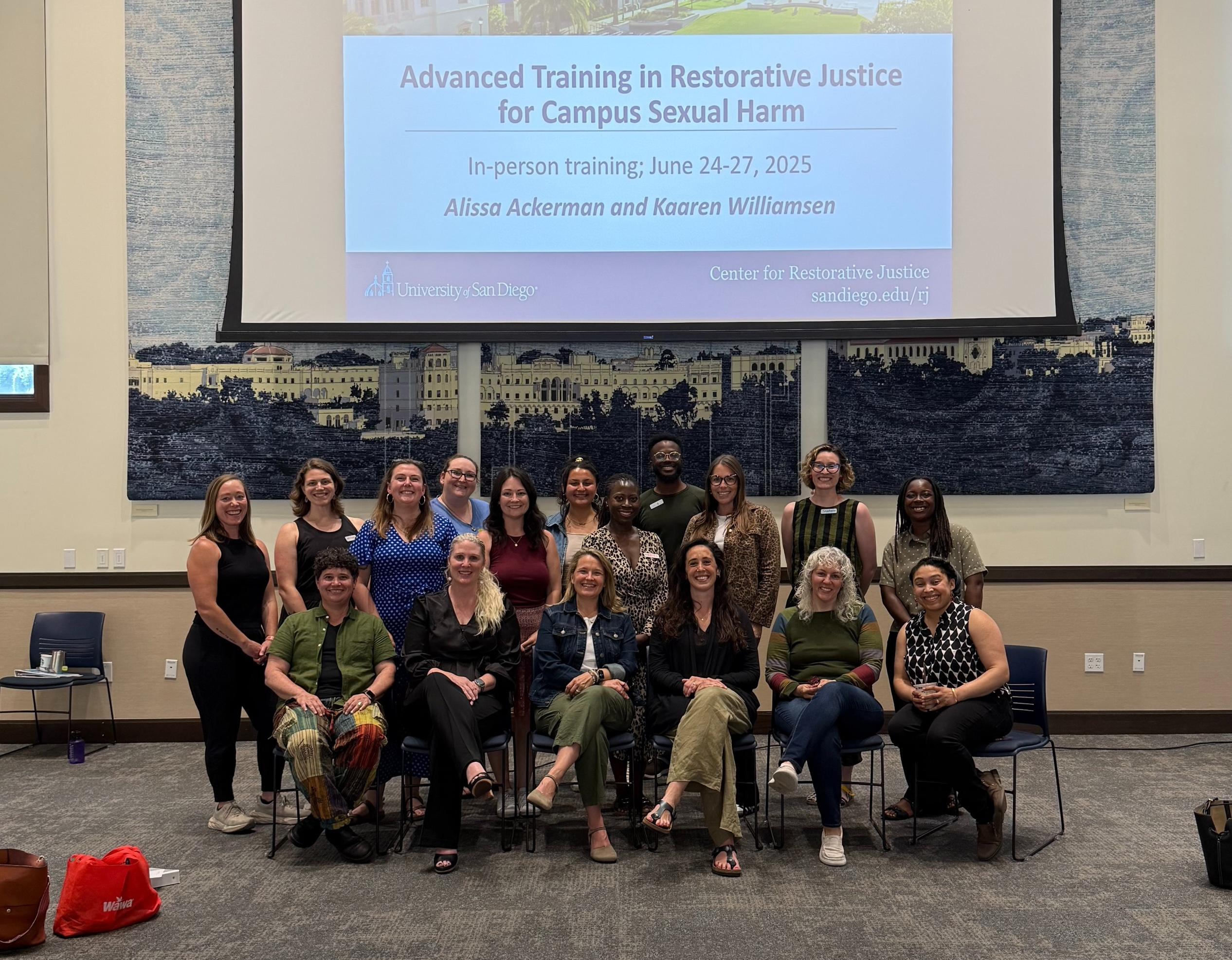
The University of San Diego’s Center for Restorative Justice prepares higher education professionals to go beyond theory, equipping them with the practical skills needed to navigate one of the most complex and harmful challenges in higher education and our society at large: sexual misconduct. The Advanced Training in Restorative Justice for Campus Sexual Harm is designed to support professionals in responding to these challenges with compassion, care, and skill.
“This training went above and beyond; we were trained on both the soft skills and the craft of establishing something tangible in the face of the real-world challenges,” said former participant, Craig Kofi Farmer, M.Ed. As the Assistant Director of Student Conduct at Johns Hopkins University, Farmer focuses on creating spaces that support student self-actualization, empowerment, and belonging.
The program began in January 2025, with the first section of a three-part training composed of eight online courses over four months. This initial phase focused on building a strong foundation in restorative justice philosophy and practices, including common approaches for addressing sexual misconduct.
“We created a learning space where higher-education professionals could grapple with the content together through readings, case studies…and rich discussions," explained trainer Kaaren M. Williamsen, PhD, an instructor and trainer with the USD Center for Restorative Justice. With more than 20 years of experience, she consults with colleges, universities, and organizations nationwide to build sustainable structures for prevention, community well-being, and restorative approaches to addressing sexual harm.
The second section was a four-day, in-person intensive designed to deepen participants’ skills through hands-on practice. Participants engaged in restorative justice dialogues, circles, conferences, and shuttle processes. The structure of the training itself intentionally models the restorative circle process, the exact framework we advocate for when addressing complex conflicts and cases of sexual harm. By actively engaging in restorative circles, participants experience firsthand how shared reflection and dialogue can effectively build and sustain community and address harm.
“Two moments stand out to me…both took place while we were in the circle,” said trainer Alissa R. Ackerman, PhD. “We each shared an object of meaning and placed it in the center. Then, in the second round, we picked up someone else’s object and returned it while sharing something meaningful about that object or person. It was such a powerful exercise.”
Alissa R. Ackerman, PhD is an Assistant Professor of Criminal Justice at California State University and co-founder of Ampersand Restorative Justice. She brings together her academic, practitioner, and lived experience to deepen understanding of sexual harm and its restorative pathways for survivors.
These circles created a space where participants could show up authentically, reflect deeply, and begin to break down barriers shaped by societal expectations. The experience often inspired participants to bring these practices back to their own institutions.
Another profound moment emerged during a circle exercise in which participants were asked to write an apology where they longed to give on one side of a colorful sheet of paper, and an apology they hoped to receive on the other.
“I still remember the sun’s warmth accompanying me as I wrestled with the simple, yet powerful exercise,” said participant Erica Adarkwa, Assistant Director of Restorative Practices at Yale University and Black feminist care worker dedicated to fostering communal dignity. “It was not easy to write either apology, despite years of distance between the harm I experienced and caused. Completing this activity reminded me that expressing genuine remorse, a key step in any accountability process, requires skillfulness, empathy, humility, and care. There is no short-cut.”
The final section of the training meets bi-weekly from September through November, offering participants the opportunity to continue developing their facilitation skills through guided, in-class practice.
“RJ is a way of approaching the world, not just a set of practices,” said Ackerman.“Many participants were already in or stepping into that leadership space, and the cohort became a practical community of practice: sharing concrete strategies, troubleshooting challenges, and offering feedback, not only from Alissa and me, but from one another,” said Williamsen.
As these professionals return to their respective institutions, they carry with them a shared belief: that even in the face of profound harm, there is a path forward rooted in accountability and human dignity.
The Advanced Training in Restorative Justice for Campus Sexual Harm will be offered again in 2027, with applications opening in August 2026. For more information, visit our website.
To stay updated when applications open, subscribe to our monthly newsletter and select Sexual Harm/Title IX as your area of interest.