
An Interview with USD Theatre Graduate Santiago Iacinti
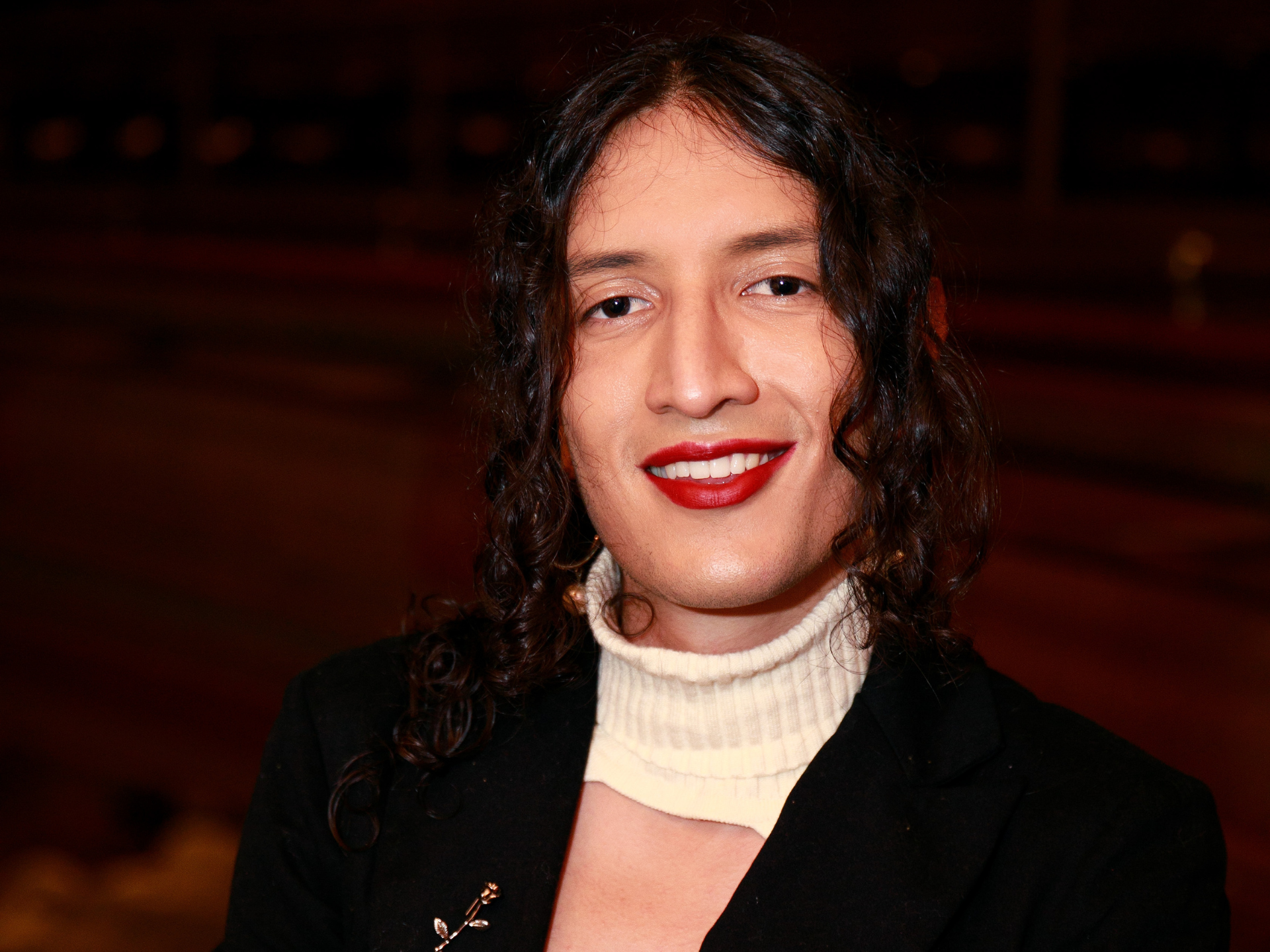
When in question, remember why you wanted to be an artist to begin with.
Santiago Iacinti ’15 (BA), who majored in theatre at USD, is a director, producer, writer and educator. They were born in Mexico, raised in San Diego and live full-time in New York. Over the past four seasons, they have served as Associate Artistic Director and Director of Education at PlayPenn* — where they have helped develop more than 29 new plays. Iacinti was the inaugural Artistic/Literary Intern at The Old Globe, an inaugural member of the Roundabout Directors Group, an Emerging Directing Resident at Milwaukee Rep and an alum of Directors Lab West. As a director, they have also worked nationally at Yale Rep, Primary Stages, Playwrights Center, Philadelphia Theatre Company, Wilma Theatre, La Jolla Playhouse, The Sol Project and Moxie Theatre — to name a few. Their expertise is in New Play Development, and 85% of their work has been with a living playwright in the room. They think visually and integrate video art, photography, puppetry, movement and technology into their work. Prior to becoming a full-fledged member of The Kilroys, they were a two-time Kilroy honoree. As a human being, their personhood is intersectional. Iacinti immigrated to the U.S. at age two and was undocumented until age 19, before becoming a DACA recipient. They identify as gay, trans/nonbinary and are bilingual.
This year, Iacinti was named one of 14 new members of The Kilroys, “a collective of artists, producers, educators and organizers who are done talking about gender parity and are taking action” (Owens PR, 2025). In 2014, The Kilroys launched The List, which highlights the most recommended under- and unproduced plays by women, trans and nonbinary playwrights annually. In 2023, The List was reimagined as The Web to not only highlight playwrights but the entire ecosystem of artists that make new plays possible.
The USD Department of Theatre loves to celebrate our alumni, and Iacinti is our latest celebration! We interviewed them all about their time at USD and their career beyond.
Iacinti Interview
What year did you graduate and with what major(s)/minor(s)?
I graduated in May 2015. I was a theatre major. I declared as a freshman on my first day on campus. So, it has been over 10 years since then, chipping away in the real world.
How was your time at USD? Any favorite classes? Faculty?
I was 17 when I started, 20 when I graduated. I had still not come into my own. I was not yet comfortable in my own skin. And I was one of the few BIPOC students in the department. There was not always a place for me. And I was by no means considered a heavy hitter. But I was stubborn and kept at it.
I think anyone and everyone should take at least one acting class. Acting requires a level of self-awareness and teaches interpersonal skills that STEM classes do not. I am partial to the Meisner Technique (which, when I was a student, was Acting II). Lisa Berger (Senior Teaching Professor) taught the class and it has stayed with me since. Meisner teaches you how to be publicly private and how to take ownership of your point of view. But the Producing and Directing class was my real turning point. I realized that I was more interested in fleshing out the relationships between the characters and building the world they inhabit than I was in acting myself. If I am not mistaken, I was the first student at USD to direct a play as my senior thesis. Since 2022, I have served as the Associate Artistic Director and Director of Education at PlayPenn and I am still directing and producing to this day.
Did you perform or participate in any shows? If so, what was your favorite?
Before I found directing, I trained as an actor. I performed in the ensemble of Anatomy of Grey and A Streetcar Named Desire. But my most fond memories were as Lisa's assistant director on Eurydice by Sarah Ruhl. I love magical realism. That production incorporated shadow puppetry, red-nose clowns, a stilt walker and a marionette. It was meant to be experienced live, in every sense. That production challenged my preconceptions about theatre as a form and expanded what I thought was possible.
What's your favorite piece of theatre of all time or at the moment?
Spring Awakening was the show that made me fall in love with theatre. As a queer, immigrant and person of color, I was often expected to assimilate — to a new culture, to a new language, to gender norms, to heteronormative love. But I was always one to ask questions and speak my mind. In that way, I related to Melchior. But I also understood Moritz's profound sense of loneliness. To me, the songs were anthems. I was empowered by the idea of young people using their voices for change. And I am grateful that, unlike the characters in Spring Awakening, I had mentors who encouraged me to be a critical thinker. I hear USD is currently working on a production of the musical. If dates coincide, I would love to see it when I visit San Diego.
How do you feel the department prepared you for your career in theatre?
Perhaps the biggest blessing in disguise was attending a liberal arts program instead of a conservatory. I had no prior training before USD. At 17, I felt like I had a late start. I felt the need to take every possible acting class so I could catch up to my peers. However, the theatre department at USD emphasized breadth over depth. If I am honest, at the time, it felt like an impediment to my training. But had I not been required to take a variety of classes, I might not have found Directing. And even though I no longer act, studying acting gave me a language with which to talk to actors. And I left the program a more well-rounded practitioner.
I also loved that the professors were working artists in the community. Through Moxie Theatre and Cygnet, I was able to work with Lisa Berger, Nate Parde (Department Chair and Professor) and Nicole Ries (Program Coordinator, Graduate Theatre) in a professional setting. Moxie Theatre was where I first learned about The Kilroys. But perhaps what really set me on my current path was my internship at The Old Globe during my senior year. I was the first-ever Artistic Literary Intern at The Old Globe. I worked directly with Danielle Mages Amoto (now, the Director of New Plays and Dramaturgy at The Old Globe) and Eric Keen Louie (now, the Artistic Producing Director at La Jolla Playhouse). It gave me insight into the inner workings of a regional theatre and solidified my interest in New Play Development.
What's the best advice you could give to current students or students hoping to pursue theatre after graduation?
There is no linear path. I would encourage each student to define what success looks like for themselves. Success is not the same as fame, nor is it necessarily the same as financial stability. It is possible to make a living as an artist, but many artists do so by doing a little of everything. More and more artists working today are multi-hyphenates.
A career in the arts is a long game. A strong work ethic and being dependable go a long way. And more than anything, people want to work with other nice and decent human beings. You can be incredibly talented, but if you cannot work with others, you won't be hired.
There is a difference between what you want and what you need. Feeling like you "need" any one gig for validation is a trap. Your self-worth is not measured by your work alone. And it is okay to take breaks, reassess your priorities and set boundaries (say no).
What are your goals going into The Kilroys 3.0?
The Kilroys is a collective of artists, educators, producers, activists, and organizers with no leaders. Part of the ethos of The Kilroys is that no one person can speak on behalf of the entire collective. So, I cannot speak about future projects. However, what excited me about becoming a member was their history of advocating for gender parity in the theatre and championing new voices. I was raised in the theatre by women and queer artists of color who helped me carve my own nook in the industry and now I want to pay it forward.
Anything else you'd like to add?
When in question, remember why you wanted to be an artist to begin with. And never stop learning.
PlayPenn, now celebrating its 20th anniversary, is an artist-driven organization dedicated to the development of new plays and playwrights. PlayPenn aims to fully support the needs of the writer and the demands of the plays in an ever-evolving process within which playwrights can engage in risk-taking and boundary-pushing work. PlayPenn has developed over 160 plays and is one of the last few remaining new play incubators in the United States.
Learn more about Santiago Iacinti: www.santiagoiacinti.com | @santiago.iacinti