
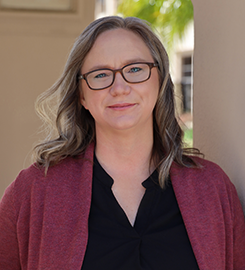
Clare Boothe Luce Associate Professor of Physics
Physics and Biophysics Honors Faculty Liaison
- BS, Physics, Phi Betta Kappa, Washington State University (2012); Partially supported by the Boeing Scholar’s Program
- MS, Physics, Washington State University (2016)
- PhD, Physics, Washington State University (2019)
- Postdoctoral Research Associate, Washington State University
Dr. Maren Mossman joined the faculty in the Department of Physics and Biophysics at University of San Diego (USD) in the Fall of 2020 as the Clare Boothe Luce Assistant Professor of Physics. She comes to USD after a long term at Washington State University, where she received her BS in Physics with an Astrophysics focus, and her MS and PhD in Physics under the guidance of Prof. Peter Engels. Her research involves the creation, manipulation, and study of Bose-Einstein condensates, which is the fifth state of matter (after solids, liquids, gasses, and plasmas). Bose-Einstein condensates, as the coldest form of matter in the universe, gives us unprecedented access to the quantum world and Mossman uses them to study the fundamental nature of matter, fluid flow, and quantum turbulence. Dr. Mossman is very excited about ultracold atoms, atomic physics, and quantum technologies.
Awards
- 2024 Cottrell Scholar Award Recipient
Scholarly Work
In her lab at USD, currently under construction, Mossman focuses on the flow and generation of turbulence and microscopic vortices, i.e. little “quantum tornadoes.” The creation of Bose-Einstein condensates, or BECs, is an amazing achievement of modern science and opens a window to view the quantum world and to understand ideas like superfluidity. BECs are macroscopic quantum objects that can be manipulated with light and magnets to simulate other types of physical systems in an extremely controllable manner. To analyze data, researchers in Mossman’s lab and other labs like this take a picture of the cold clouds of atoms, so students in these labs learn how to code in languages like python to perform analyses. In addition to her work on the ground, Mossman is part of a collaboration with researchers from Washington State University and University of Colorado, Boulder, to study the formation and fundamental nature of extremely fragile three-body states. These states can only be formed in low or micro-gravity environments, and so this research is performed on JPL’s Cold Atom Laboratory onboard the International Space Station.
Areas of Interest
In addition to her research, Mossman is pioneering a new program at the University of San Diego, the “Physics Identity Program,” that works to empower females and underrepresented students in physics to ‘see themselves as scientists’ and continue to pursue careers in STEM. This program provides small stipends to participants and pairs students with mentors in industry and within USD. Mossman is also passionate about teaching the next generation of physicists and engineers both in the classroom and in her lab. She believes that good science communication and enthusiastic mentorship are some of the most important and lasting contributions we can make as scientists and members of the community. As such, she tries to have both when interacting with her students and her peers. She also aims to create a healthy environment in her lab and classroom that is built upon integrity, inclusion, mutual respect, and promoting good mental, physical, and emotional health.