

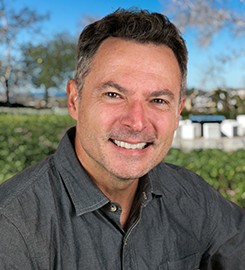
Chair and Professor, Languages, Cultures and Literatures
Honors Faculty Liaison
- PhD University of Pittsburgh, Latin American Literature and Culture
- MA, University of Nebraska, Lincoln; Hispanic Studies
- BA, California State University, Northridge; Spanish
Alejandro Meter, PhD, teaches courses in Latin American literary and cultural studies. His research focuses on the Jewish experience in Latin America, immigration, and the politics of memory, with particular attention to questions of identity, diaspora, and cultural representation. His work also engages the cultural dynamics of the U.S.–Mexico borderlands and the literary and visual cultures shaped by migration, borders, and cultural exchange. His scholarly and creative interests intersect in his ongoing work with literature, photography, and visual culture.
Professional Experience
Professor Meter has served as chair of the Department of Languages, Cultures, and Literatures since 2022. He has also served as Director of the Spanish Area and Director of the Latin American Studies Program, among other leadership roles. His university service has included the Committee on Academic Rank, Reappointment, and Tenure, the University Senate, and the Study Abroad Committee, as well as numerous other departmental, college-wide, and university committees.
Scholarly Work
Professor Meter’s research centers on Jewish Latin America, with particular emphasis on cultural production in the Southern Cone. He edited Literatura judía en América Latina (Revista Iberoamericana) and co-edited Memoria y Representación: configuraciones culturales y literarias en el imaginario judío latinoamericano (Beatriz Viterbo). His articles, essays, and book chapters have appeared in journals including Chasqui: Revista de literatura latinoamericana, Revista de Estudios Hispánicos, Hispania, and Latin American Research Review, among others.
Creative Work
Alongside his scholarly work, Professor Meter maintains an active photographic practice that has developed through a sustained engagement with writers, intellectual communities, and questions of cultural representation. His work can be viewed at Meterphoto, and since the early 2010s he has photographed writers throughout the Spanish-speaking world, exploring the relationship between literary production and visual representation. His long-term projects include portraits of writers in the U.S.–Mexico borderlands, Latin American Jewish communities, and the international crime fiction and noir literary community.
In 2017, the National Library of Argentina (Biblioteca Nacional Mariano Moreno) in Buenos Aires invited him to photograph Argentine crime fiction writers. The resulting portraits became Rostros del crimen (Faces of Crime), a 2022 exhibition accompanied by a catalog featuring seventy portraits and texts by the participating authors. The project brought together his interests in literature and photography, using portraiture, dramatic lighting, and the architecture of the library to explore the visual language and atmosphere associated with noir and detective fiction.
During the COVID-19 pandemic, Meter developed Postales del confinamiento, a series of remote portraits made with writers and cultural figures around the world. The project subsequently became a published book. His photographs have been exhibited in the United States, Mexico, Argentina, and Spain, and have appeared in print and digital publications across the United States, Latin America, and Europe.
Areas of Interest
Professor Meter teaches courses at all levels of Spanish language and literature at USD, including Jewish Latin America, Writing and Composition, Cultural History of Latin America, Cultural Analysis, Crime Fiction in Latin America, and Latin American Visual Cultures. His teaching and research frequently explore migration, cultural memory, diaspora, border identities, and the intersections of literature, photography, and visual media. He regularly teaches courses abroad, including in Buenos Aires.
He has also taught a range of special-topics courses, including “Sports and National Culture” and “Argentina: Memory and Justice,” as well as team-taught courses within the Honors Program, first-year preceptorials, and cross-listed courses with Latin American Studies, Political Science, Anthropology, Art, Communication, and Ethnic Studies. These courses have addressed topics including the literature and politics of the Southern Cone, U.S. Latino studies, Border Studies, and Jewish cultural studies.