

AI Tools Available Through Google Workspace
USD faculty, staff, and students have access to a suite of generative AI tools through the university’s Google Workspace for Education environment. These tools can support learning, teaching, research, communication, creativity, and everyday work.
When using these tools, always sign in with your USDOne account to ensure you are working within USD’s approved Google environment and receiving the privacy and security protections associated with the university’s agreement with Google.
Always Access Gemini Using your USDOne Account
When using Google’s AI tools for university-related learning or work:
- Sign in with your USDOne credentials.
- Confirm that you are using your USD account before uploading files or connecting Google Workspace content.
- Follow the data-use requirements established for each tool.
- Do not connect unapproved AI tools, plug-ins, or services to USD systems or accounts.
The Gemini app provided through Google Workspace for Education includes enterprise-grade data protections and that chats are not used to train its generative AI models. Review Google’s education privacy information.
Google Workspace Tools
Gemini - Gemini is Google’s general-purpose AI assistant. It can help you brainstorm, summarize information, develop and refine ideas, analyze files, conduct research, create content, and work through complex questions.
Gemini also includes several specialized features:
- Gemini Live: Have a natural voice conversation with Gemini to explore ideas, practice a presentation, or talk through a problem.Canvas: Create and refine documents, presentations, quizzes, applications, and code in an interactive workspace.
- Deep Research: Develop a research plan, locate relevant sources, and generate a detailed report for your review.
- Image and video generation: Create original visual materials using written prompts.
Get started using Google Gemini.
Gemini Pro accounts can be requested at ITOrders. Please note you must have budget approval from the department and provide an associated worktag.
Gems - Gems are customized versions of Gemini designed for a particular task, topic, or workflow. You can use a premade Gem or create one with instructions that tell Gemini how to respond.
For example, you might create a Gem to:
- Provide feedback using specific criteria.
- Help you prepare for a meeting or presentation.
- Guide you through a recurring planning process.
- Serve as a study partner for a particular subject.
- Apply a consistent format or approach to repeated tasks.
Gems can improve consistency and save time, but their responses must still be reviewed for accuracy and appropriateness. Get started using premade Gems or learn how to customize and build your own Gems.
NotebookLM - NotebookLM is an AI-powered research and learning assistant grounded in the sources you provide. Unlike a general-purpose chatbot, NotebookLM uses your uploaded materials to answer questions, summarize information, identify themes, and make connections across sources and includes direct citations from your selected sources.
You can use NotebookLM to:
- Organize and analyze articles, reports, notes, and course materials.
- Ask questions grounded in your uploaded sources.
- Create summaries, study guides, timelines, briefing documents, and frequently asked questions.
- Compare ideas or findings across multiple sources.
- Generate audio or video overviews of your materials.
Learn more about using NotebookLM [https://support.google.com/gemininotebook/#topic=16164070] for research, teaching and learning.
Library Databases with AI Features
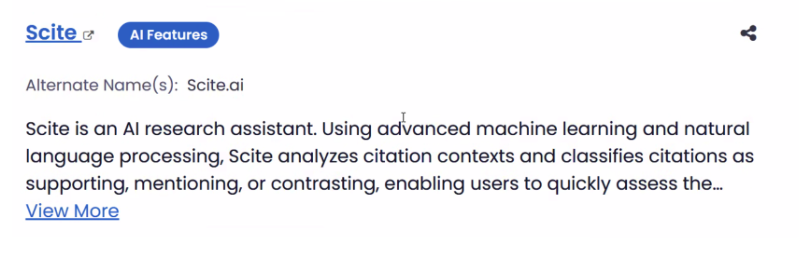
Many Copley library databases now include built-in AI features designed to support the research process. These AI features allow users to ask questions in natural language, suggest search terms, summarize articles or search results, identify key concepts, and allow users to inquire about a source. Because AI-generated responses can be incomplete, inaccurate, or misleading, these features should always supplement careful reading, traditional search strategies, and critical evaluation of original sources. Databases that include AI-powered tools are identified by a blue AI Features label, as shown below. Users should also follow course expectations for acknowledging or citing AI assistance.
Zoom AI Companion
Zoom AI Companion is an integrated AI assistant available within Zoom meetings and the Zoom platform. This tool can generate meeting summaries, create action items, draft follow-up emails, and provide real-time assistance during video conferences. AI Companion can help transcribe meetings, highlight key discussion points, and suggest next steps based on meeting content. At USD, this feature enhances meeting productivity and ensures important information is captured and organized effectively. The AI Companion integrates seamlessly with your existing Zoom workflow without requiring additional software or credentials. Learn how to use Zoom AI features.
Public Generative AI Tools
Public AI tools are consumer-facing generative AI services that have not been formally approved, licensed, or managed by USD. These may include free or individually purchased versions of popular AI chatbots like ChatGPT or Claude, image generators like Dall-E, writing assistants, browser extensions, plug-ins, and other AI-powered applications.
Although you may be able to register for these tools using your USD email address, doing so does not mean the tool is approved, supported, or protected by a university agreement.
Your Responsibilities When Using Generative AI for Work or Learning
Access to an approved tool does not mean that every use is appropriate. Watch this video to learn the
5 essential things to know about generative AI from Google.
When using these tools always be sure to consider the following:
- Protect personal, confidential, student, research, and other non-public information.
- Review and verify AI-generated content.
- Follow the expectations of your instructor, discipline, department, or professional role.
- Be transparent about how AI contributed to your work.
- Respect copyright, intellectual property, and licensed-resource requirements.
- Use AI to support — not replace — human judgment, learning, creativity, and ethical decision-making.
You remain responsible for the accuracy, quality, integrity, and appropriate use of anything you create with AI.