
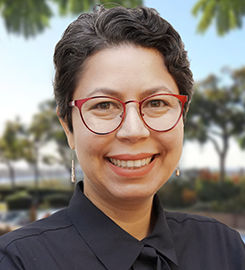
Associate Director, Carnegie Elective Classification for Community Engagement
- PhD, Leadership Studies, Gonzaga University (GU).
- MA, International Studies, Autonomous University of Barcelona (UAB)
- MBA, International Master of Business Administration, Eserp Business School, Barcelona.
- MA, Women, Gender and Citizenship Studies, University of Barcelona (UB) and Inter-University Women and Gender Studies Institute (IIEDG).
Dr. Carla Penha-Vasconcelos currently serves as Associate Director for the Carnegie Elective Classification for Community Engagement. In this role, she advances a national framework that guides higher education institutions in recognizing, strengthening, and elevating meaningful community engagement — deepening institutional practice and fostering more reciprocal relationships between colleges and universities and the communities they serve.
Previously, she served as a Research Associate and Project Manager at the Jacobs Institute for Innovation in Education, where she led equity-driven innovation and applied research spanning K–12, higher education, and community settings. Her work included managing the NSF/USD AnchorSTEM S-STEM Project, a multi-year initiative supporting STEM recruitment and retention, culturally responsive mentorship, and holistic support for students from low-income backgrounds.
Dr. Penha-Vasconcelos brings deep international experience in community engagement, education, and social justice across Spain, Brazil, and the United States. Through her work with social movements, nonprofits, universities, and community partners, she has consistently bridged research and practice to advance equity and meaningful social change.
She has taught graduate courses on Leadership and Collaboration, Global Leadership, and Diversity, Leadership, and Intercultural Communication at Gonzaga University. Currently, she serves as an adjunct faculty member in the Leadership Studies Department at USD's SOLES, where she teaches the EdD course Critical Thinking and Research Methods. Her pedagogical approach is rooted in intercultural, global, community-engaged, and justice-centered frameworks.