

Cam Colucci: A Formidable Force
The University of San Diego (USD) often attracts students from diverse backgrounds, but few arrive with the unique blend of seasoned military experience and academic ambition as senior Cameron (Cam) Colucci ‘25 (ME and Physics), whose journey through the Shiley-Marcos School of Engineering has been marked by a clear vision for the future.
Having served more than 14 years as an active-duty Marine, Colucci earned a place in a highly competitive enlisted-to-officer commissioning program — one that fewer than 1% of enlisted service members successfully participate in. “When you get selected as an enlisted Marine, you attend a university with an ROTC program, then commission as a 2nd Lieutenant when you graduate,” explains Colucci.
After graduating from officer candidate school, Colucci applied to a few universities — UC San Diego, University of Colorado Boulder, University of Hawaii, University of San Diego, San Diego State University, Texas A&M, Cornell and MIT. An impressive list, indeed.
Admission to the two Ivy League schools looked promising for Colucci, but to attend, he had to enter as a freshman, not as a transfer student. “The admissions offices said that if I reapply as a first-year student, then I would be accepted. I had one year to be accepted to a school after graduating from Officer Candidate School, and I did not have the time to start the application process over again.” It was disappointing how it worked out, but it was an honor for them to even talk to me and say they wanted me.”
Undeterred by hard work, Colucci quickly pivoted. "I have tried a lot of things,” he admits. “Before the military, I worked as a welder since I was 9 years old. I liked building and making things. When I joined the Marines, I moved into aviation and learned about various aircraft and became a subject matter expert in my field.”
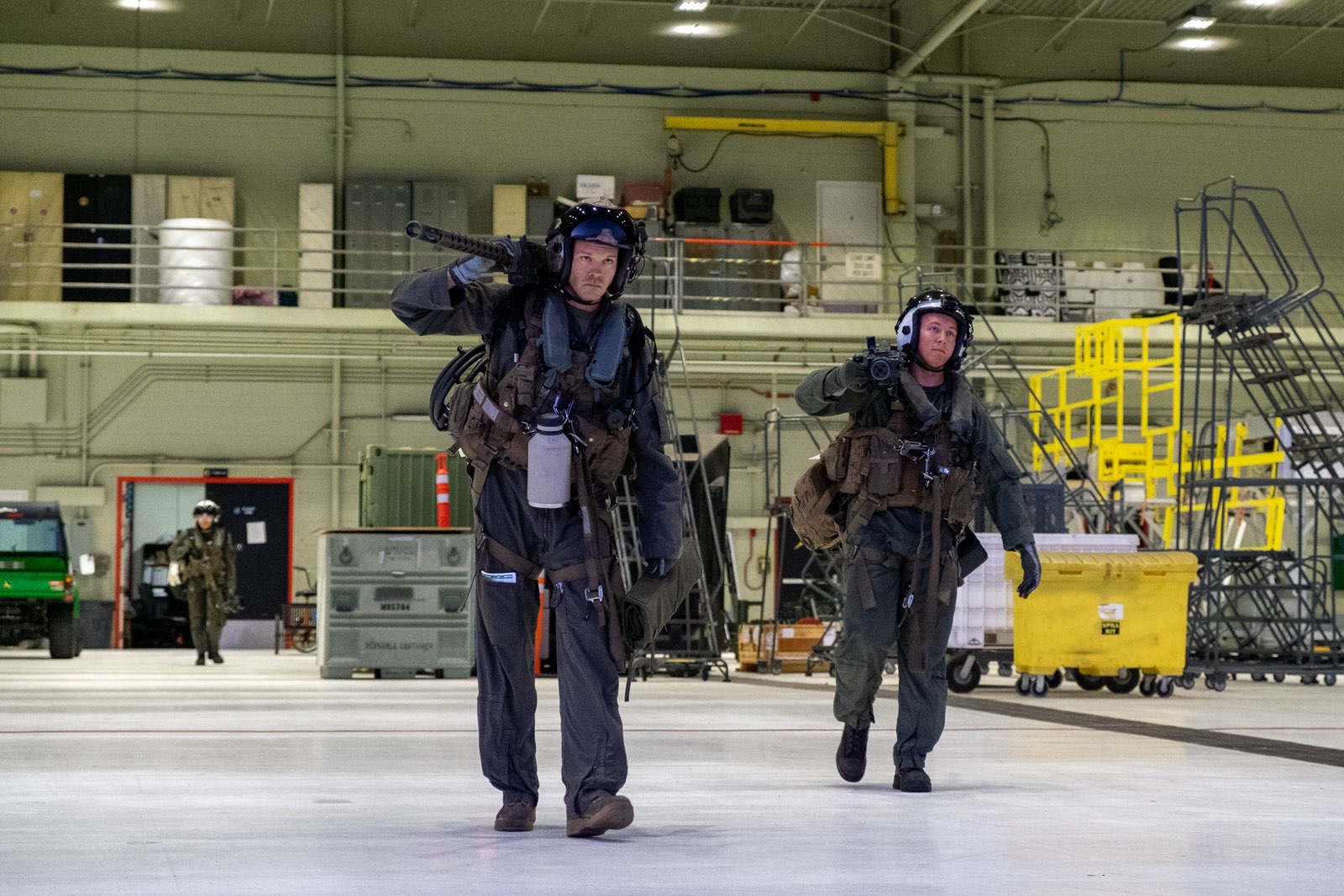 Cam Colucci (center) serving in the Marines.
His path to USD was a strategic choice; after exploring various institutions, USD's well-ranked engineering program and its proximity to his prior work at MCAS Miramar proved ideal. "It really worked out," he reflects. "It wouldn’t have been the same anywhere else."
Colucci’s transition was not without its academic hurdles. Despite transferring a significant number of units, he found himself starting fresh in core engineering subjects, including revisiting Calculus I after a decade's pause. This rigorous academic re-entry, combined with a complete lifestyle change, taught him profound lessons. "Academic work is different from physical work. It is hard to understand how draining it is until you do it." This period allowed Colucci to cultivate a "stronger mind” to be able to handle his coursework and learn how to budget time very well.
Among his most significant academic endeavors was the Ascender Systems project, a senior design experience that aimed at designing a delivery vehicle capable of climbing vertical structures — such as poles and trees. The initial objective was to provide temporary infrastructure for first responders in disaster areas, enabling them to survey the area and send in rescue teams post-disaster.
The project involved a two-part system: his team focused on the delivery vehicle, while the company’s engineers tackled the "leave-behind" aspect — a clamping mechanism for extended deployment.
The scope evolved, shifting focus to the versatility of the climbing mechanism itself, with the climber remaining the company's primary design focus. He became the sole student from his original team to continue working on the project part-time, collaborating with Ascender Systems' core engineers. The continuation of the climber has now been handed down to a new senior design team. After a summer of testing, data collection and modifications, Colucci is now the engineer advising the new capstone group, as a representative and liaison of the Ascender System’s core engineering team.
The team's exceptional dedication and Colucci’s steadfast leadership led them to win the Professional Gold Medal Award at the 2025 Engineering and Computing Showcase for their work. “We had a lot more buy-in to the project than most other teams. I personally did a lot of work outside of the classroom and went above and beyond the scope of the class for the sake of the project — including proactive work through winter break, completing three design iterations in collaboration with the core team and having fabrication drawings ready for the spring semester, allowing more time for testing and modification for a second version by the end of the first semester.”
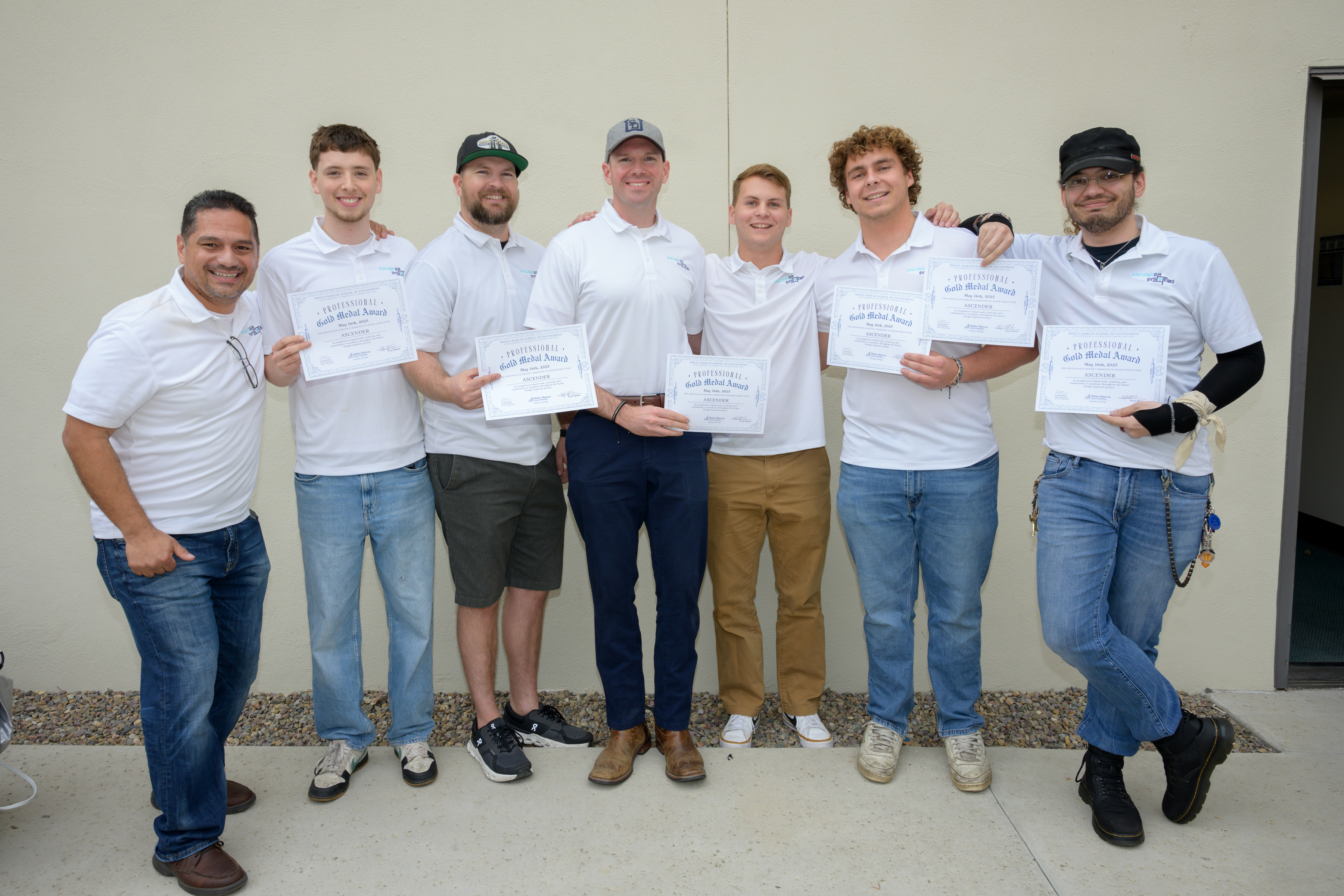 Cam Colucci (center) and the Ascender team win the Professional Gold Medal Award.
Colucci’s greatest takeaway from the Ascender project was the importance of communication and collaboration with both the student team and the sponsor. “The foundation of any successful project is a driven team who are willing to come in every day and give their all."
Beyond his academic projects, Colucci has gained invaluable industry experience through his internship at Clarity Design, Inc. Starting in January 2025, he worked part-time during the semester, transitioned to full-time over the summer and will continue part-time through his final semester until his commissioning in December 2025.
At Clarity Design — an FDA-certified firm specializing in medical devices — he's been involved with a diverse range of engineering and manufacturing solutions, ranging from specialized medical products to general engineering solutions and machining.
“I am also working as a design engineer for Ascender Systems. They offered me a part-time position midway through the spring semester to work on other aspects of their business model. I have been providing design solutions and analysis for the company’s core team, and will continue to do so for the foreseeable future as the company continues to gain traction.”
Colucci has attended innovation conferences and expos as a representative of Ascender Systems, where he serves as one of their technical experts on the climber, which has been vital for grant submissions.
His hands-on experience has provided a crucial bridge between theoretical knowledge and practical application. After having been an Engineer-in-Training (EIT) for almost two years — the first critical step toward becoming a licensed Professional Engineer (PE) — he successfully passed his PE exam in September 2025. “I’m so relieved to have taken and passed the PE Mechanical exam on my first try. Putting in the enormous amount of time and effort to learn and retain the material on my own was one of the most challenging things I have ever done. I’m thrilled to have achieved this significant career milestone and a major step toward licensure before completing my degree.
Upon graduating this fall, his journey will lead him back to the Fleet Marine Corps, with a clear aspiration: to become a pilot. This goal is heavily influenced by his 1,800 hours of flight experience as an MV-22 Osprey Crew Chief, where he flew Ospreys and instructed Marines in weapons deployment and integrated Air-Ground tactics during his enlisted service. He sees piloting as one of the more “technical roles available to an officer,” aligning with his desire for challenging and skill-based work.
The path to becoming a Marine Corps pilot is rigorous, involving extensive medical screenings and a competitive application process, which he navigated for over a year before being awarded a flight contract. After completing the six-month Basic School, he’ll continue to military flight school and take the first steps toward becoming a Marine Pilot.
Beyond his military career, he plans to continue his consulting work with Ascender Systems and eventually establish his own engineering consulting LLC to “further contribute to the industry and gain relevant experience.”
Whether soaring over the fleet as a pilot, advising Ascender Systems as a technical expert or building his own consulting firm, Cam Colucci has established a powerful truth: that a clear vision — backed by intense focus and practical mastery — is the ultimate blueprint for success in any field.
— By Michelle Sztupkay