
Natural and Social Sciences Collaborate to Continue Bahamas Research
Last spring and over intersession, two University of San Diego Environmental and Ocean Sciences (EOS) classes embarked on transformational study abroad research trips to San Salvador Island in The Bahamas. Guided by Adjunct Assistant Professor Eric Cathcart and Professors Sarah Gray, PhD, and Steve Searcy, PhD, the students spent several weeks in the field studying the many human and environmental stressors affecting the island. While most of the students in the class have since graduated, the research they laid the groundwork for in The Bahamas is far from finished. This summer, a new group of students have picked up their lab coats to continue researching San Salvador from right here on the USD campus.
In a unique mix of the natural and social sciences, the student-led team is joining forces with a team of anthropologists from Miami University, Ohio and UC Santa Barbara to extend the scope of the research. In building on previous studies, this summer’s research focuses on the native Bahamian (Lucayan) populations and their early (600 AD) and later (1200 AD) pottery and firing techniques. The team is made up of four College of Arts and Sciences students, a totally unique blend of majors, degrees and interests. Each member is handling a different aspect of the project.
Senior and double EOS and English major Jess McKechnie is focusing her summer research on the temporal and spatial variability of metals within the pottery. No complete Lucayan Pottery has ever been discovered– it has only ever been recovered in small fragments– and thus little is known about its origins. McKechnie is assessing the metals content of those fragments, and then comparing her findings to the paleosol (fossilized soil) outcrops and lake sediments near each of the settlements to help determine the clay sources of the pottery.
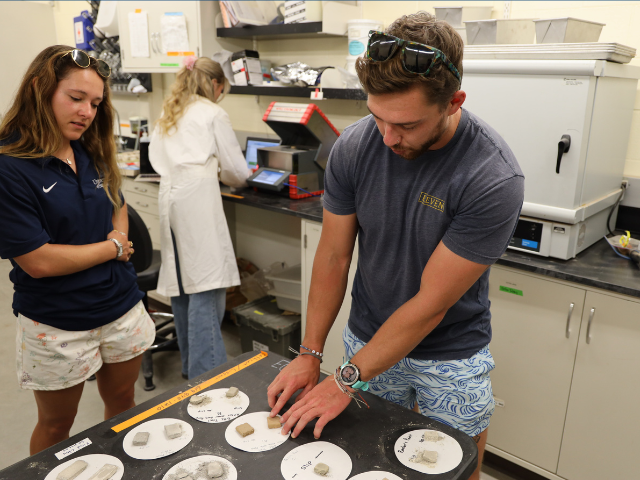
EOS major and senior Rachel Schmidt is studying the quality of Lucayan "Palmetto Ware" and the leachability of the metals it contains. Schmidt is researching the leachability of metals in Lucayan Pottery to determine if the pottery was safe for water storage, food storage and cooking. Because the Lucayan Pottery sherds are only available for non-destructive testing, Schmidt is carrying out the testing on mock-pieces made by team member Joel Wittel.
Wittel, a junior and anthropology major, is assessing the Lucayan “Palmetto Ware” firing techniques. By researching shell temper, clay content, firing temperatures and the creation of slip (glaze), Wittel will be able to create scientifically accurate mock-pieces capable of withstanding the destructive testing necessary for Schmidt’s studies.
Finally, graduate EOS student Hannah Lissner is doing a high-resolution spatial and temporal metals analysis of the metals variability within the paleosols on San Salvador. Using over 400 paleomagnetism cores previously collected by researchers in the early to mid-1990s, she is assessing the variability of insoluble residues (metals) within specific paleosol outcrops as well as lateral and temporal variability across the island. This information will be compared to Saharan Dust and other continental and volcanic signatures to show the importance of understanding intra-island paleosol insoluble residue variability as it relates to Quaternary climate.
The team will be traveling back to the Gerace Research Centre on San Salvador Island in May 2026 to present their findings at the 5th Joint Natural History and Geology Symposium.