
Surf Culture Students Roll Through Local History
“There is something distinctly impactful about experiencing knowledge as opposed to listening about it in a classroom setting.”
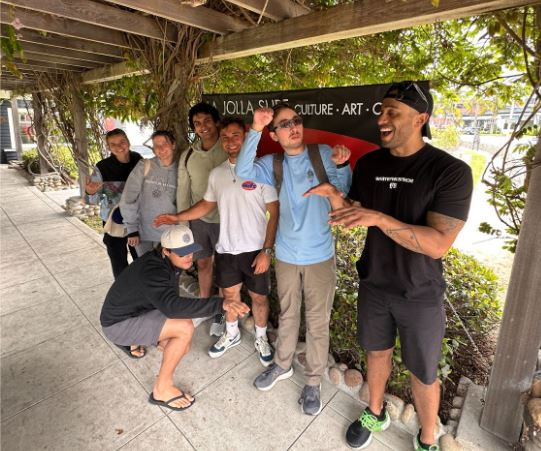
Seven University of San Diego students joined Associate Professor of Anthropology Jerome Hall, PhD, for a bicycle tour through several beach communities to visit spots important to the culture and history of surfing in San Diego. The tour was offered as an optional activity for Anth 364 Surf Culture and History and about half the class participated.
The bike tour started at the Mission Bay outflow jetty and rolled through Mission Beach, Pacific Beach and La Jolla with multiple stops to learn from Dr. Hall about the characters and places that define San Diego’s unique surf culture. ”This outing provided an opportunity to connect not only with nature but to connect with the lessons we talk about everyday,” said Oz Fox who is an Anthropology major with a Theatre minor, “There is something distinctly impactful about experiencing knowledge as opposed to listening about it in a classroom setting.”
Dr. Hall has offered the Surf Culture and History class multiple times since he introduced it in 2006. Every time he teaches it he hopes both to engage the students in this dynamic and rich cultural history, and encourage reflection on the spirit of Aloha, an Indigenous Hawaiian concept that emphasizes cultivating harmony of mind and heart. According to Hawaii’s Revised Statutes, “‘Aloha’ means mutual regard and affection and extends warmth in caring with no obligation in return. ‘Aloha’ is the essence of relationships in which each person is important to every other person for collective existence.” Its original translation from the Hawaiian language means “forward facing” (Alo) “breath of life” (ha) which is an encouragement to meet life “head on” with all the grace one can muster.
“The annual bike ride each spring semester is a way for students to appreciate the cultural norms within California surfing, dating back to the late 19th and early 20th centuries,” said Dr. Hall. “Our ‘pedigree’ really is from the Hawaiian Islands, the roots of which are deep in the arrival of three Hawaiian Princes who surfed the waves at the mouth of the San Lorenzo River in the summer of 1885.” According to Dr. Hall, this Hawaiian influence coupled with returning US soldiers from World War II popularized surfriding, luaus and aloha shorts.
The tour also included stops at the site of the first wave generator (patented by San Diego surf icon Tom Lochtefeld) and the famous Windansea Beach “Surf Shack” first built in 1947 by people returning from WWII service in the South Pacific, where they learned to surf. Additionally, students got to see multiple spots with excellent surfing conditions such as Bird Rock and Tourmaline Beach, where the first ever U.S. surf park was created in 1963. The tour wrapped up with a visit to the La Jolla Surf: Culture, Art, Craft exhibit at the La Jolla Historical Society’s Wisteria Cottage Gallery. The exhibit has been on view since Feb. 8 and concludes on May 25. Students saw examples of surfboards created by culturally important local creators, as well as viewed a timeline of surf culture in San Diego.
“We were able to get a very immersive and local perspective of San Diego,” said James Duckworth who is a Psychology major with an Ethics minor. “Not only the history that you would read from a book, but the history from his [Dr. Hall’s] lens of what it was like growing up here. And just how much has changed. Learning from his own experience growing up here–it’s probably one of the best experiences I’ve had at this university so far.”