
Recap: Burnham-Moores Center for Real Estate’s 29th Annual Real Estate Conference
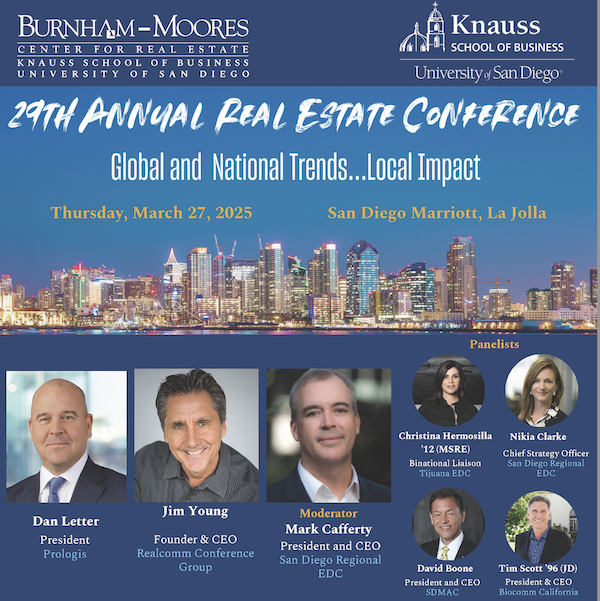
The global and national environments continue to create headlines, and so do the ways the local San Diego economy looks to adapt. On Thursday, March 27, 2025, the Burnham-Moores Center for Real Estate held its 29th Annual Real Estate Conference, titled Global and National Trends…Local Impact. More than 400 real estate industry leaders registered for the event which took place at the San Diego Marriott La Jolla.
The conference, which included three sessions, offered valuable and prominent insights into the national, regional and local impacts in today’s market.
The first session featured Jim Young, founder and CEO of Realcomm; Gary Bailey, senior vice president and CIO at Phillips Edison & Company and Joe Martino, vice president of Information Technology at Primaris Management Inc. The speakers discussed the current and future use cases of AI in the real estate industry and how it will change the way the industry functions.
The second session featured a panel discussion on the economic trends impacting San Diego ‘s economy and the real estate landscape. The panel was led by Mark Cafferty, president and CEO of the San Diego Regional EDC. The four panelists included: David Boone, president and CEO of the San Diego Military Advisory Council; Nikia Clarke, PhD, chief strategy officer at the San Diego Regional EDC; Cristina Hermosillo ’12 (MSRE), binational liaison at the Tijuana EDC; and Tim Scott ’96 (JD), president and CEO of BioCom California.
The third session addressed the major shifting factors that may impact real estate, including tariffs, capital, energy and global logistics. Dan Letter, president of Prologis and Tom Olinger, former president of Prologis and board member at American Assets (AAT) and Equinix (EQUX), led this session.
Session 1 Recap: Artificial Intelligence (AI) and its intersection with Real Estate
Jim Young and his panel energized attendees with a deep dive into artificial intelligence. If you’re concerned about AI, the best thing to do is “jump in!” Young compared the current phase of AI development to baseball—at game two of a seven-game series. He shared compelling case studies, demonstrating how generative AI is revolutionizing market research, operations and compliance. In one instance, a task that typically takes four hours was completed in 30 seconds using AI. Another example featured a virtual AI employee capable of analyzing insurance and lease compliance laws with 98 percent accuracy in under two minutes. AI is also reshaping the tenant experience. One demonstration featured a fully AI-powered system that could receive service requests, dispatch maintenance and manage communications, all without human intervention.
Session Two Recap: Military, Mexico, Global Trade and Life Sciences
As global and national dynamics continue to evolve, the 29th Annual Real Estate Conference capitalized San Diego’s unique position at the intersection of innovation, trade, defense and logistics. While uncertainty remains a recurring theme, the insights shared at the conference point to a region that is both resilient and ready to put community before self—a themed shared by Mark Cafferty, who moderated this session on military, tech, Mexico, global trade and biotech.
San Diego’s military presence continues to be a major economic engine, as emphasized by David Boone. With one in six sailors and Marines living in the region, military investment, totaling $40 billion in region annually, supports over 2,000 small businesses. However, housing affordability remains a challenge. Boone warned that rising housing costs are forcing military families and veterans to relocate to more affordable states like Texas and Tennessee. Cuts in contracts and civil service positions also pose risks. Yet, Boone sees opportunities ahead. Private industry may need to step in to fill the gaps created by these government decisions.
Cristina Hermosillo ’12 (MSRE) stressed the importance of the San Diego-Tijuana “Mega Border”—the most economically significant binational region in North America. Tijuana hosts companies from over 40 countries, with more than half of its registered workforce employed in manufacturing. Education and workforce development are critical to this region’s future. Hermosillo highlighted the collaboration between Arizona and Baja California institutions to support a future potential semiconductor sector through specialized training in design and labor to high education schools and college professors for students in the future. Hermosillo explained the top priority for the Baja region for the future is talent, infrastructure, patents, energy and sustainability. Hermosillo cautioned policy uncertainty, particularly around tariffs, has led some stakeholders to pause decision-making, waiting for clarity from both U.S. and Mexican governments, and stalling growth in some areas for the anticipated next year.
Nikia Clarke, PhD, echoed the importance of the binational relationship. Clarke cited noteworthy trade policy shifts in the San Diego region, including: a 20 percent increase in China tariffs; the three days of U.S. border tariffs from Canada and Mexico, which were quickly rolled back and the expansion of 25 percent steel tariffs. This period is marked by uncertainty, Clarke noted. The next six-to-twelve months will be a time of rapid change, and the region will need to adapt accordingly.
Clarke also underscored the broader geopolitical implications, especially in technology-related fields, such as semiconductors, genomics, data privacy, export controls and strategic technology—areas where San Diego companies and industries could have large impacts.
Tim Scott addressed the growing concern in the biotech sector over federal funding and regulatory shifts. Biocom members are trying to stay up-to-date with the latest information on tariffs, the Federal Transit Administration (FTA) and National Institutes of Health (NIH) funding cuts, combined with executive orders being heard by Federal judges. NIH funding fuels advances in the biotech industry. Scott described the “valley of death” between early-stage NIH funding and initial venture capital investment—a gap that appears to be widening amid economic headwinds and rising interest rates. This uncertainty has real estate implications as well. While life sciences remain a cornerstone of San Diego’s economy, many developers are holding off on new builds, opting to “wait and see” how the economic environment unfolds. Clarke added that more than half of all medical devices entering the U.S. cross through Otay Mesa, further tying trade policy to the region’s life science sector.
Session Three Recap: Global Logistics and Supply Chains
Dan Letter and Tom Olinger shared their perspectives on how global logistics and supply chains are evolving and what it means for regions like San Diego. With nearly three percent of global GDP passing through its logistics network, Prologis remains a bellwether for macroeconomic shifts. According to Letter, uncertainty creates the need for more inventory. Companies cannot run at “just-in-time” scenarios with supply chain, opting instead for more resilient strategies that include increased inventory and built-in redundancies. Letter explained that the size of the industrial leased footprint is about consumption—it doesn’t matter where the goods are coming from, it’s about being close to the end user. Letter described Prologis’ focus on “last touch” logistics—warehouses that are strategically placed near rooftops for final delivery.
Olinger and Letter emphasized the importance of data-driven decision making and pointed to Prologis’ extensive research on logistics and supply chain trends. Notably, the company is expanding its role in renewable energy and technology, recently converting a Prologis warehouse near the Chicago O’Hare International Airport into a data center with marketed capacity generating 32 megawatts of energy, highlighting the company’s forward-thinking approach toward AI and hyperscale infrastructure [1].
Globally, Prologis controls 1.3 billion square feet of industrial real estate, equivalent to 47 square miles, or twice the size of the City of Manhattan, with a customer base of 6,500 companies and 18,000 leases across 20 countries. In Mexico alone, 99.7 percent of Prologis’ 100 million square feet of real estate is leased, signaling high demand even amid macroeconomic uncertainty.
The conference offered an opportunity for guests to network and provided an opportunity for USD Knauss School of Business undergraduate and graduate real estate students to build relationships with key San Diego real estate leaders.
View photos of the event.
____________________
[1] Nelson, Jennifer, Global Industrial Real Estate Leader Converts Illinois Warehouse into Turnkey Data Center, https://www.prologis.com/about/news-press-releases/global-industrial-real-estate-leader-converts-illinois-warehouse-turnkey.
— By Jason Santos '26 (MSRE) and Kimberly Malasky, director of communications and marketing