
USD Interdisciplinary Humanities and Art History Alumnus Edits Book about Comic Artist Icon
"No one needs permission to do what they want to do. It took me a really long time to realize this– both scholarly and creatively." Jake Zawlacki '13
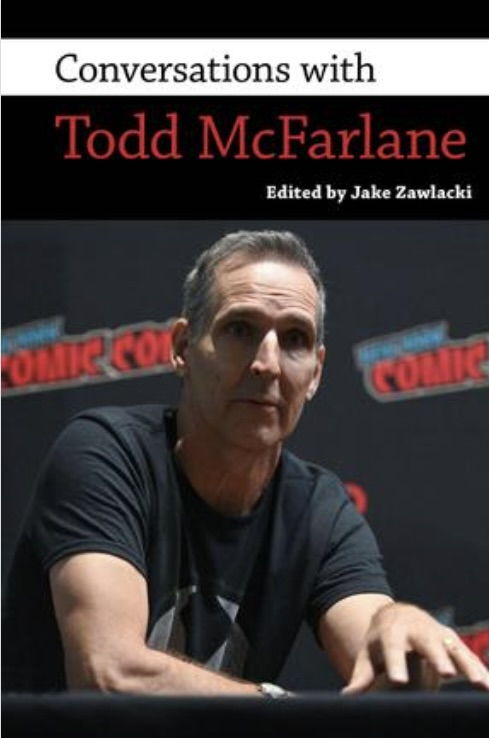
University of San Diego alumnus Jake Zawlacki ‘13 (BA in interdisciplinary humanities and art history) recently edited a book published by the University Press of Mississippi about acclaimed comic artist Todd McFarlane. Conversations with Todd McFarlane includes a series of interviews with McFarlane that Zawlacki selected, introduced and edited.
The book explores the comic book world in the 1990s through the eyes of one of the world’s most famous comic book artists.
Find out more about the book and Zawlacki’s journey from USD College of Arts and Sciences student to published author.
Q&A with Jake Zawlacki
What was your major at the University of San Diego, and when did you graduate? How did the classes, or even one class in particular, help you gain the skills to do this kind of work?
I had two majors: Interdisciplinary Humanities and Art History. I actually wrote my Art History thesis on contemporary graphic novels and their connections to Lynd Ward’s wordless novels. While I didn’t take specific classes on comics or graphic novels, the general milieu of creative writing, literature and art history classes provided me with a background I would build on almost 10 years later.
What is this book about, and why were you interested in editing it?
The book is the first scholarly work to look at Todd McFarlane’s career. I wanted to edit this collection of republished interviews to shed some light on one of the most important comic creators in comics history for his influence on how comics have been created, marketed and sold in the U.S. since the 1990s.
What are the steps to editing a book like this? What did you have to do and how long did it take?
The biggest step was submitting a proposal. I needed to gather together most of the research that would be included in the book: a formal cover letter, annotations for each interview to be included, selected major works, table of contents and my CV. Once that was submitted and the proposal accepted, I had to get permissions to reprint each interview from their original authors, with some interviews being over 30 years old. Many hours were spent scouring LinkedIn, Facebook, Google and White Pages to find recent contact information. After I had the permissions, I organized the book and wrote an Introduction and Chronology. Then it went to the editors and came back to me for proofreading and then again for indexing. From initial pitch to the printing of the book, it took about two years, although I spent about a year working on it.
Is this your first publication that you edited and how did you get connected to this project?
This is my first publication. I was introduced to the Conversations with Comic Artists Series by Dr. Brannon Costello at Louisiana State University. I was in his graduate seminar on comics and graphic novels, and during our breaks I picked his brain about the edited volumes he had done for University Press of Mississippi. After a couple months of working on it, and a lot of Dr. Costello’s advice and edits, I sent off the proposal.
What is your advice for fellow writers and/or Interdisciplinary Humanities and Art History majors?
For anyone who wants to publish a scholarly book, I’ve found success in starting off small. First, I published an article on McFarlane’s work, then I pitched an edited book, and then I pitched a monograph. More broadly, if a student can find a professor who has done the thing they want to do, the professor will be more than happy to help. That’s been true for every university I’ve attended: USD, Stanford and LSU.
What is next for you?
I just sent in another completed edited volume in the series, on comic artist Denys Cowan, an immensely important creator of color whose work hasn’t been given nearly enough attention. I also recently signed a contract with Rutgers University Press to write a scholarly manuscript on Spawn, Todd McFarlane’s most successful series at Image Comics.
Anything else you would like to add?
No one needs permission to do what they want to do. It took me a really long time to realize this– both scholarly and creatively. I always wanted to make sure someone gave me the O.K. with whatever project I was doing, or that I was following in a lineage of writers or thinkers. It wasn’t until I had a creative writing professor say, “You have permission to write anything,” that I realized just how much I was trying to stay within the guidelines. So, I needed permission to not need permission, but it’s opened up my work in unforeseeable ways, like editing this book and working on more in the future.